| Weight | 1 lbs |
|---|---|
| Dimensions | 9 × 5 × 2 in |
| host | mouse |
| isotype | IgG |
| clonality | monoclonal |
| concentration | concentrate, predilute |
| applications | IHC |
| reactivity | human |
| available size | 0.1 mL, 0.5 mL, 1 mL concentrated, 7 mL prediluted |

rabbit anti-Somatostatin Receptor Type 2 (SSTR2) monoclonal antibody (ZR233) 6364
Price range: $160.00 through $528.00
Antibody summary
- Rabbit monoclonal to Somatostatin Receptor Type 2 (SSTR2)
- Suitable for: Immunohistochemistry (formalin-fixed, paraffin-embedded tissues)
- Reacts with: Human
- Isotype:IgG
- Control: Neuroendocrine tumor
- Visualization: cell surface
- 0.1, 0.5, 1.0 mL concentrated, 7 mL prediluted
rabbit anti-Somatostatin Receptor Type 2 (SSTR2) monoclonal antibody ZR233 6364
| target relevance |
|---|
| Homo sapiens SSTR2 Somatostatin receptor type 2 |
| Protein names Somatostatin receptor type 2 |
| Alternative names SRIF-1 |
| Gene names SSTR2 |
| Protein family Belongs to the G-protein coupled receptor 1 family |
| Function Receptor for somatostatin-14 and -28. This receptor is coupled via pertussis toxin sensitive G proteins to inhibition of adenylyl cyclase. In addition it stimulates phosphotyrosine phosphatase and PLC via pertussis toxin insensitive as well as sensitive G proteins. Inhibits calcium entry by suppressing voltage-dependent calcium channels. Acts as the functionally dominant somatostatin receptor in pancreatic alpha- and beta-cells where it mediates the inhibitory effect of somatostatin-14 on hormone secretion. Inhibits cell growth through enhancement of MAPK1 and MAPK2 phosphorylation and subsequent up-regulation of CDKN1B. Stimulates neuronal migration and axon outgrowth and may participate in neuron development and maturation during brain development. Mediates negative regulation of insulin receptor signaling through PTPN6. Inactivates SSTR3 receptor function following heterodimerization |
| Subcellular location Cell membrane, Cytoplasm |
| Structure Homodimer and heterodimer with SSTR3 and SSTR5. Heterodimerization with SSTR3 inactivates SSTR3 receptor function. Heterodimerization with SSTR5 is enhanced by agonist stimulation of SSTR2 and increases SSTR2 cell growth inhibition activity. Following agonist stimulation, homodimers dissociate into monomers which is required for receptor internalization. Interacts with beta-arrestin; this interaction is necessary for receptor internalization and is destabilized by heterodimerization with SSTR5 which results in increased recycling of SSTR2 to the cell surface. Interacts (via C-terminus) with SHANK1 (via PDZ domain) |
| Post-translational modification Phosphorylated on serine and threonine residues in response to agonist stimulation, leading to receptor desensitization and rapid internalization. Phosphorylated to a greater extent on serine than threonine residues. Threonine phosphorylation is required for arrestin binding and receptor endocytosis but is not necessary for desensitization (By similarity) |
| Keywords 3D-structure, Alternative splicing, Cell membrane, Cytoplasm, Disulfide bond, G-protein coupled receptor, Glycoprotein, Lipoprotein, Membrane, Palmitate, Phosphoprotein, Proteomics identification, Receptor, Reference proteome, Transducer, Transmembrane, Transmembrane helix |
| Sequence MDMADEPLNGSHTWLSIPFDLNGSVVSTNTSNQTEPYYDLTSNAVLTFIYFVVCIIGLCG NTLVIYVILRYAKMKTITNIYILNLAIADELFMLGLPFLAMQVALVHWPFGKAICRVVMT VDGINQFTSIFCLTVMSIDRYLAVVHPIKSAKWRRPRTAKMITMAVWGVSLLVILPIMIY AGLRSNQWGRSSCTINWPGESGAWYTGFIIYTFILGFLVPLTIICLCYLFIIIKVKSSGI RVGSSKRKKSEKKVTRMVSIVVAVFIFCWLPFYIFNVSSVSMAISPTPALKGMFDFVVVL TYANSCANPILYAFLSDNFKKSFQNVLCLVKVSGTDDGERSDSKQDKSRLNETTETQRTL LNGDLQTSI |
| UniProt accession: P30874 |
Data
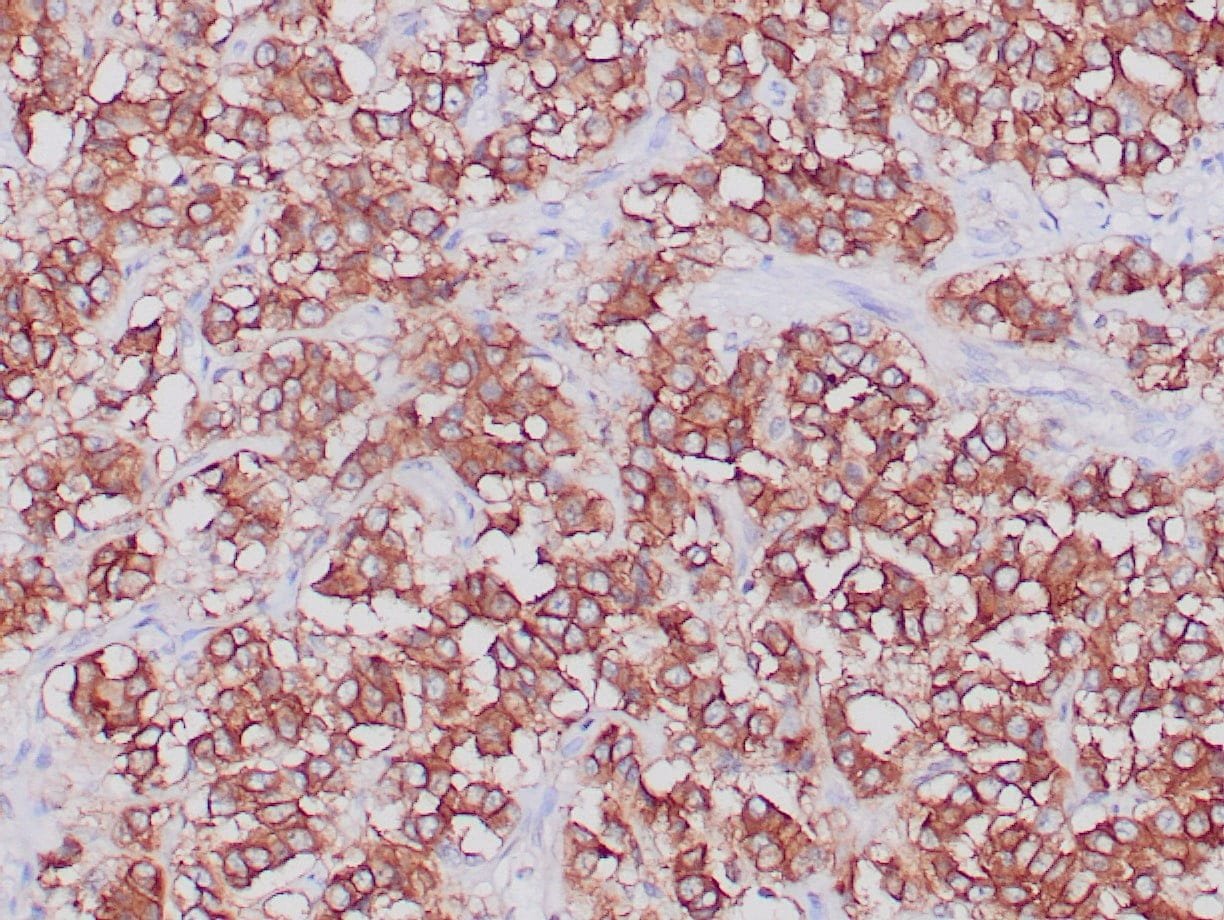 |
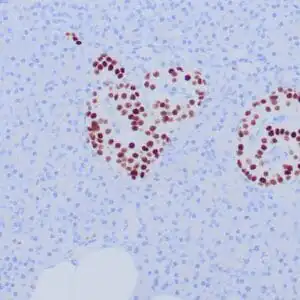
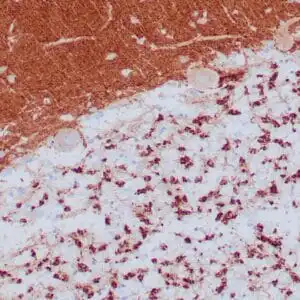
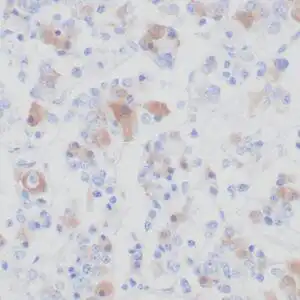
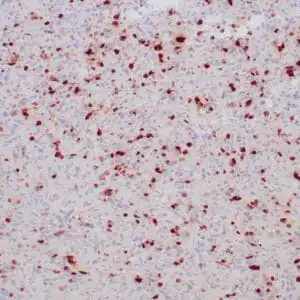
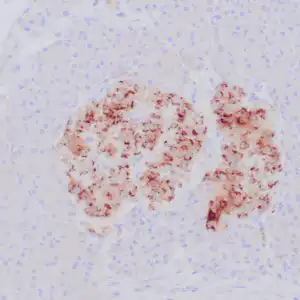
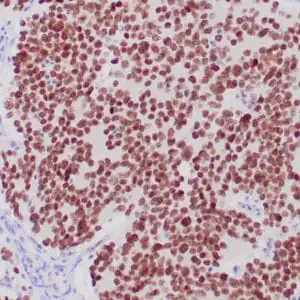
| Formalin-fixed, paraffin-embedded human neuroendocrine tumor stained with anti-SSTR2 antibody using peroxidase-conjugate and DAB chromogen. Note cytoplasmic staining of tumor cells |
FAQ & Publications
Frequently Asked Questions
What is the recommended application for the rabbit anti-Somatostatin Receptor Type 2 (SSTR2) monoclonal antibody (ZR233)?
This antibody is suitable for immunohistochemistry (IHC) on formalin-fixed, paraffin-embedded human tissues.
Which species does this SSTR2 antibody specifically react with?
The antibody reacts specifically with human Somatostatin Receptor Type 2.
How should the rabbit anti-SSTR2 monoclonal antibody be stored to maintain stability?
For short-term storage, keep the antibody at 2-8°C. For long-term preservation, store it at -20°C and avoid repeated freeze/thaw cycles.
What is the host species and clonality of this anti-SSTR2 antibody?
The antibody is a rabbit monoclonal antibody of the IgG isotype.
What is the immunogen used to generate this monoclonal antibody against SSTR2?
The immunogen is a recombinant fragment of human Somatostatin Receptor Type 2, covering approximately amino acids 169 to 369.
Publications
| pmid | title | authors | citation |
|---|---|---|---|
| We haven't added any publications to our database yet. | |||
Published literature highly relevant to the biological target of this product and referencing this antibody or clone are retrieved from the PubMed database provided by the United States National Library of Medicine at the National Institutes of Health.
Protocols
| relevant to this product |
|---|
| IHC |
Documents
| Batch Number | QC File | SDS |
|---|---|---|
| To view batch-specific Safety Datasheets and Quality Certificates associated with your account, please Log In. | ||
Only logged in customers who have purchased this product may leave a review.



Reviews
There are no reviews yet.