| Weight | 1 lbs |
|---|---|
| Dimensions | 9 × 5 × 2 in |
| host | mouse |
| isotype | IgG |
| clonality | monoclonal |
| concentration | concentrate, predilute |
| applications | IHC |
| reactivity | human |
| available size | 0.1 mL, 0.5 mL, 1 mL concentrated, 7 mL prediluted |

rabbit anti-Steroidogenic Factor-1 (SF-1) monoclonal antibody (ZR397) 6437
Price range: $160.00 through $528.00
Antibody summary
- Rabbit monoclonal to Steroidogenic Factor-1 (SF-1)
- Suitable for: Immunohistochemistry (formalin-fixed, paraffin-embedded tissues)
- Reacts with: Human
- Isotype:IgG
- Control: Adrenal cortical carcinoma
- Visualization: Nuclear
- 0.1, 0.5, 1.0 mL concentrated, 7 mL prediluted
rabbit anti-Steroidogenic Factor-1 (SF-1) monoclonal antibody ZR397 6437
| target relevance |
|---|
| Homo sapiens NR5A1 Steroidogenic factor 1 |
| Protein names Steroidogenic factor 1 |
| Alternative names Adrenal 4-binding protein, Fushi tarazu factor homolog 1, Nuclear receptor subfamily 5 group A member 1, Steroid hormone receptor Ad4BP |
| Gene names NR5A1 |
| Protein family Belongs to the nuclear hormone receptor family. NR5 subfamily |
| Function Transcriptional activator. Essential for sexual differentiation and formation of the primary steroidogenic tissues (PubMed:27378692). Binds to the Ad4 site found in the promoter region of steroidogenic P450 genes such as CYP11A, CYP11B and CYP21B. Also regulates the AMH/Muellerian inhibiting substance gene as well as the AHCH and STAR genes. 5'-YCAAGGYC-3' and 5'-RRAGGTCA-3' are the consensus sequences for the recognition by NR5A1 (PubMed:27378692). The SFPQ-NONO-NR5A1 complex binds to the CYP17 promoter and regulates basal and cAMP-dependent transcriptional activity. Binds phosphatidylcholine (By similarity). Binds phospholipids with a phosphatidylinositol (PI) headgroup, in particular PI(3,4)P2 and PI(3,4,5)P3. Activated by the phosphorylation of NR5A1 by HIPK3 leading to increased steroidogenic gene expression upon cAMP signaling pathway stimulation |
| Subcellular location Nucleus |
| Structure Binds DNA as a monomer. Interacts with NR0B2 and PPARGC1A (By similarity). Part of a complex consisting of SFPQ, NONO and NR5A1. Interacts with NCOA2. Interacts with DGKQ and CDK7. Binds to and activated by HIPK3 |
| Post-translational modification Acetylation stimulates the transcriptional activity Sumoylation reduces CDK7-mediated phosphorylation on Ser-203 Phosphorylated on Ser-203 by CDK7. This phosphorylation promotes transcriptional activity |
| Involvement in disease 46,XY sex reversal 3 A condition characterized by male-to-female sex reversal in the presence of a normal 46,XY karyotype. 46,XX sex reversal 4 A condition in which male gonads develop in a genetic female (female to male sex reversal). Adrenal insufficiency, NR5A1-related A disorder characterized by adrenal insufficiency, muscular hypotonia, decreased sodium and increased potassium levels, elevated ACTH, salt-wasting crisis, prolonged jaundice, hypoglycemia, and vomiting. Premature ovarian failure 7 An ovarian disorder defined as the cessation of ovarian function under the age of 40 years. It is characterized by oligomenorrhea or amenorrhea, in the presence of elevated levels of serum gonadotropins and low estradiol. Spermatogenic failure 8 An infertility disorder characterized by spermatogenesis failure and severe oligozoospermia. |
| Keywords 3D-structure, Acetylation, Activator, Disease variant, DNA-binding, Isopeptide bond, Lipid-binding, Metal-binding, Nucleus, Phosphoprotein, Premature ovarian failure, Proteomics identification, Receptor, Reference proteome, Transcription, Transcription regulation, Ubl conjugation, Zinc, Zinc-finger |
| Sequence MDYSYDEDLDELCPVCGDKVSGYHYGLLTCESCKGFFKRTVQNNKHYTCTESQSCKIDKT QRKRCPFCRFQKCLTVGMRLEAVRADRMRGGRNKFGPMYKRDRALKQQKKAQIRANGFKL ETGPPMGVPPPPPPAPDYVLPPSLHGPEPKGLAAGPPAGPLGDFGAPALPMAVPGAHGPL AGYLYPAFPGRAIKSEYPEPYASPPQPGLPYGYPEPFSGGPNVPELILQLLQLEPDEDQV RARILGCLQEPTKSRPDQPAAFGLLCRMADQTFISIVDWARRCMVFKELEVADQMTLLQN CWSELLVFDHIYRQVQHGKEGSILLVTGQEVELTTVATQAGSLLHSLVLRAQELVLQLLA LQLDRQEFVCLKFIILFSLDLKFLNNHILVKDAQEKANAALLDYTLCHYPHCGDKFQQLL LCLVEVRALSMQAKEYLYHKHLGNEMPRNNLLIEMLQAKQT |
| UniProt accession: Q13285 |
Data
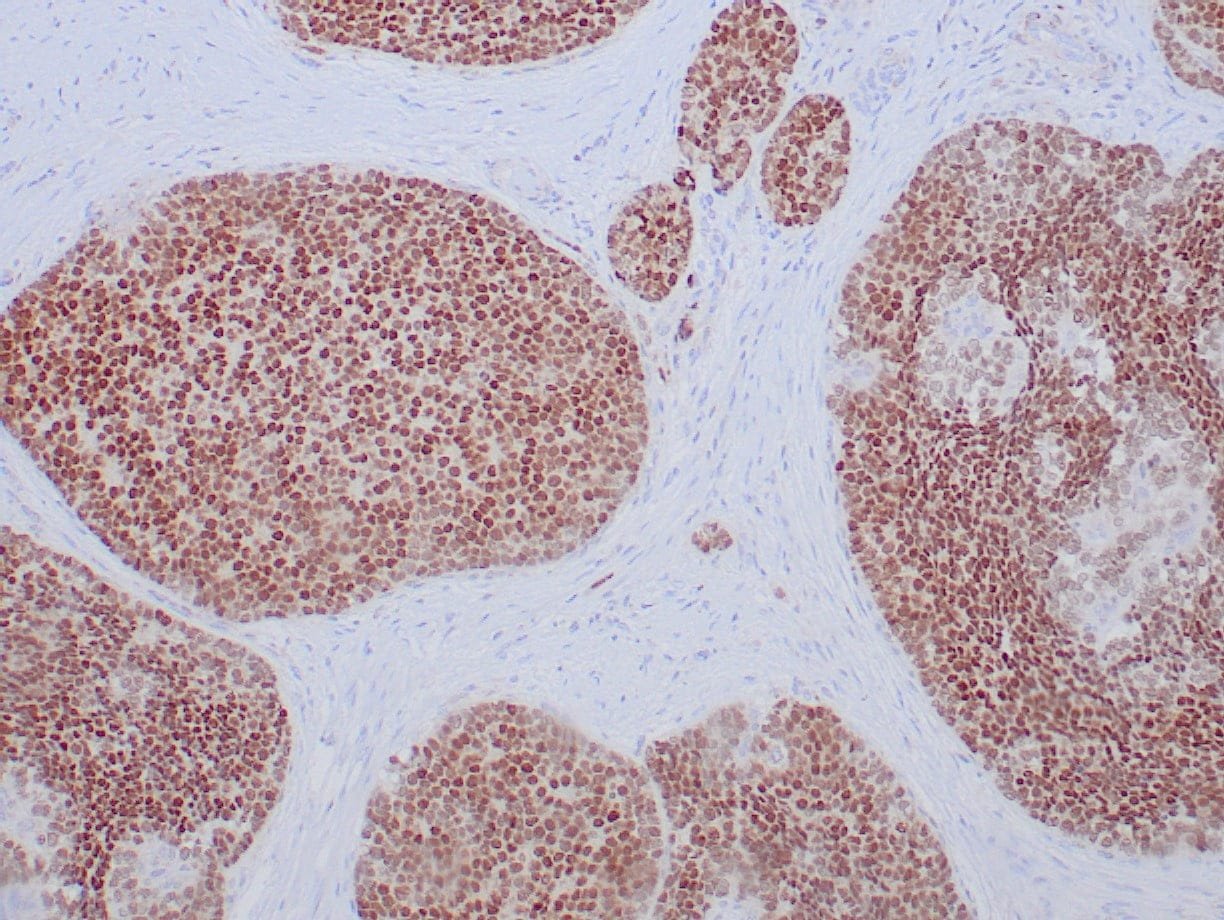 |
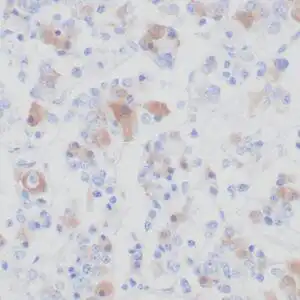
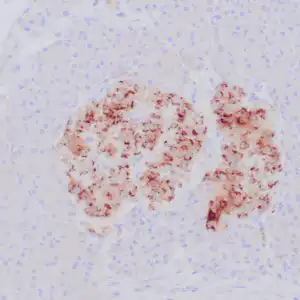
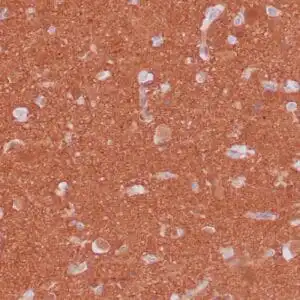
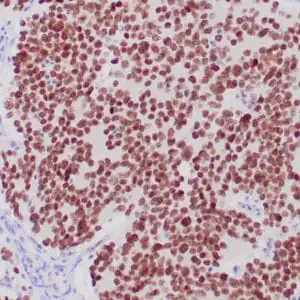
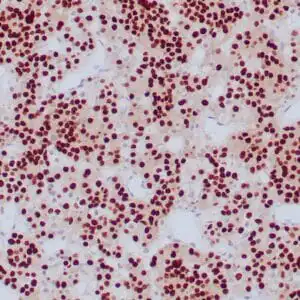
| Human adrenal gland stained with anti-SF-1 antibody using peroxidase-conjugate and DAB chromogen. Note nuclear staining of cortical cells. |
FAQ & Publications
Frequently Asked Questions
What species does the rabbit anti-Steroidogenic Factor-1 (SF-1) monoclonal antibody (ZR397) specifically react with?
This antibody specifically reacts with human tissues.
Which applications is this SF-1 monoclonal antibody validated for?
The antibody is validated for immunohistochemistry (IHC) on formalin-fixed, paraffin-embedded tissues.
How should the rabbit anti-SF-1 antibody be stored to maintain its stability?
For short-term storage, keep the antibody at 2-8°C. For long-term storage, it should be kept at -20°C, and freeze/thaw cycles should be avoided.
What are the available sizes and concentrations for this SF-1 antibody product?
The antibody is available in concentrated form at 0.1 mL, 0.5 mL, and 1.0 mL, as well as a 7 mL prediluted format.
Publications
| pmid | title | authors | citation |
|---|---|---|---|
| We haven't added any publications to our database yet. | |||
Published literature highly relevant to the biological target of this product and referencing this antibody or clone are retrieved from the PubMed database provided by the United States National Library of Medicine at the National Institutes of Health.
Protocols
| relevant to this product |
|---|
| IHC |
Documents
| Batch Number | QC File | SDS |
|---|---|---|
| To view batch-specific Safety Datasheets and Quality Certificates associated with your account, please Log In. | ||
Only logged in customers who have purchased this product may leave a review.

Reviews
There are no reviews yet.