| Weight | 1 lbs |
|---|---|
| Dimensions | 9 × 5 × 2 in |
| host | rabbit |
| isotype | IgG |
| clonality | polyclonal |
| concentration | 1 mg/mL |
| applications | ICC/IF, WB |
| reactivity | Myc (phospho-Thr358) |
| available sizes | 100 µL |

rabbit anti-Myc (phospho-Thr358) polyclonal antibody 3661
$366.00
Antibody summary
- Rabbit polyclonal to Myc (phospho-Thr358)
- Suitable for: WB,IHC,IF
- Isotype: Whole IgG
- 100 µl
rabbit anti-Myc (phospho-Thr358) polyclonal antibody 3661
| antibody |
|---|
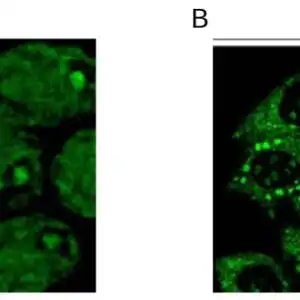
| Tested applications WB,IHC,IHC,ICC/IF |
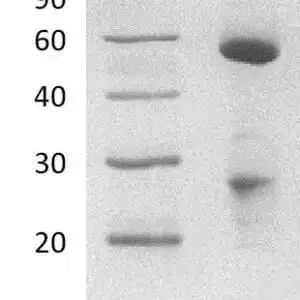
| Recommended dilutions Immunoblotting: use at dilution of 1:500-1:1,000. A band of ~60kDa is detected. Immunohistochemistry: use at dilution of 1:50-1:100. Immunofluorescence: use at 1:100-1:200. These are recommended working dilutions. End user should determine optimal dilutions for their |
| Immunogen Peptide sequence that includes phosphorylation site of threonine 358 (R-R-T(p)-H-N) derived from human Myc and conjugated to KLH. |
| Size and concentration 100µL and 1 mg/mL |
| Form liquid |
| Storage Instructions This antibody is stable for at least one (1) year at -20°C. |
| Storage buffer PBS (without Mg2 and Ca2 ), pH 7.4, 150mM NaCl, |
| Purity affinity purified |
| Clonality polyclonal |
| Isotype IgG |
| Compatible secondaries goat anti-rabbit IgG, H&L chain specific, peroxidase conjugated, conjugated polyclonal antibody 9512 goat anti-rabbit IgG, H&L chain specific, biotin conjugated polyclonal antibody 2079 goat anti-rabbit IgG, H&L chain specific, FITC conjugated polyclonal antibody 7863 goat anti-rabbit IgG, H&L chain specific, Cross Absorbed polyclonal antibody 2371 goat anti-rabbit IgG, H&L chain specific, biotin conjugated polyclonal antibody, crossabsorbed 1715 goat anti-rabbit IgG, H&L chain specific, FITC conjugated polyclonal antibody, crossabsorbed 1720 |
| Isotype control Rabbit polyclonal - Isotype Control |
| target relevance |
|---|
| Homo sapiens MYC Myc proto-oncogene protein |
| Protein names Myc proto-oncogene protein |
| Alternative names Class E basic helix-loop-helix protein 39, Proto-oncogene c-Myc, Transcription factor p64 |
| Gene names MYC |
| Function Transcription factor that binds DNA in a non-specific manner, yet also specifically recognizes the core sequence 5'-CAC[GA]TG-3' (PubMed:24940000, PubMed:25956029). Activates the transcription of growth-related genes (PubMed:24940000, PubMed:25956029). Binds to the VEGFA promoter, promoting VEGFA production and subsequent sprouting angiogenesis (PubMed:24940000, PubMed:25956029). Regulator of somatic reprogramming, controls self-renewal of embryonic stem cells (By similarity). Functions with TAF6L to activate target gene expression through RNA polymerase II pause release (By similarity). Positively regulates transcription of HNRNPA1, HNRNPA2 and PTBP1 which in turn regulate splicing of pyruvate kinase PKM by binding repressively to sequences flanking PKM exon 9, inhibiting exon 9 inclusion and resulting in exon 10 inclusion and production of the PKM M2 isoform (PubMed:20010808) |
| Subcellular location Nucleus, nucleoplasm, Nucleus, nucleolus, Nucleus, Cytoplasm, Chromosome |
| Structure Efficient DNA binding requires dimerization with another bHLH protein. Binds DNA as a heterodimer with MAX (PubMed:9680483). Interacts with TAF1C and SPAG9. Interacts with PARP10. Interacts with KDM5A and KDM5B. Interacts (when phosphorylated at Thr-73 and Ser-77) with FBXW7 (PubMed:17558397, PubMed:25775507). Interacts with PIM2. Interacts with RIOX1. The heterodimer MYC:MAX interacts with ABI1; the interaction may enhance MYC:MAX transcriptional activity. Interacts with TRIM6 (By similarity). Interacts with NPM1; the binary complex is recruited to the promoter of MYC target genes and enhances their transcription (PubMed:25956029). Interacts with CIP2A; leading to the stabilization of MYC (PubMed:17632056). Interacts with NUP205 (PubMed:22719065). Interacts with HEATR1; the interaction is required for localization of MYC to the nucleolus (PubMed:38225354) |
| Post-translational modification Phosphorylated by PRKDC (PubMed:1597196). Phosphorylation at Ser-344 by PIM2 leads to the stabilization of MYC (By similarity). Phosphorylation at Ser-77 by CDK2 prevents Ras-induced senescence (PubMed:19966300, PubMed:20713526). Phosphorylated at Ser-77 by DYRK2; this primes the protein for subsequent phosphorylation by GSK3B at Thr-73 (PubMed:22307329). Phosphorylation at Thr-73 and Ser-77 by GSK3 is required for ubiquitination and degradation by the proteasome (PubMed:15103331, PubMed:17558397, PubMed:8386367). Dephosphorylation at multiple sites by the PNUTS-PP1 complex promotes MYC stability by preventing ubiquitination by the SCF(FBXW7) complex (PubMed:30158517). Dephosphorylation at Ser-77 by protein phosphatase 2A (PPP2CA) promotes its degradation; interaction with PPP2CA is enhanced by AMBRA1 (PubMed:25438055, PubMed:25803737) Ubiquitinated by the SCF(FBXW7) complex when phosphorylated at Thr-73 and Ser-77, leading to its degradation by the proteasome (PubMed:15103331, PubMed:17558397, PubMed:25775507, PubMed:30158517). In the nucleoplasm, ubiquitination is counteracted by USP28, which interacts with isoform 1 of FBXW7 (FBW7alpha), leading to its deubiquitination and preventing degradation (PubMed:17558397, PubMed:17873522). In the nucleolus, however, ubiquitination is not counteracted by USP28 but by USP36, due to the lack of interaction between isoform 3 of FBXW7 (FBW7gamma) and USP28, explaining the selective MYC degradation in the nucleolus (PubMed:17558397, PubMed:25775507). Also polyubiquitinated by the DCX(TRPC4AP) complex (PubMed:20551172, PubMed:29779948). Ubiquitinated by UBR5 when not forming a heterodimer with another bHLH protein, leading to its degradation: UBR5 recognizes and binds a degron that is only available upon heterodimer dissociation (PubMed:33208877, PubMed:37478862). Ubiquitinated by TRIM6 in a phosphorylation-independent manner (By similarity) |
| Involvement in disease Burkitt lymphoma A form of undifferentiated malignant lymphoma commonly manifested as a large osteolytic lesion in the jaw or as an abdominal mass. |
| Keywords 3D-structure, Acetylation, Activator, Alternative initiation, Alternative splicing, Chromosomal rearrangement, Chromosome, Cytoplasm, DNA-binding, Glycoprotein, Isopeptide bond, Nucleus, Phosphoprotein, Proteomics identification, Proto-oncogene, Reference proteome, Transcription, Transcription regulation, Ubl conjugation |
| Sequence MDFFRVVENQQPPATMPLNVSFTNRNYDLDYDSVQPYFYCDEEENFYQQQQQSELQPPAP SEDIWKKFELLPTPPLSPSRRSGLCSPSYVAVTPFSLRGDNDGGGGSFSTADQLEMVTEL LGGDMVNQSFICDPDDETFIKNIIIQDCMWSGFSAAAKLVSEKLASYQAARKDSGSPNPA RGHSVCSTSSLYLQDLSAAASECIDPSVVFPYPLNDSSSPKSCASQDSSAFSPSSDSLLS STESSPQGSPEPLVLHEETPPTTSSDSEEEQEDEEEIDVVSVEKRQAPGKRSESGSPSAG GHSKPPHSPLVLKRCHVSTHQHNYAAPPSTRKDYPAAKRVKLDSVRVLRQISNNRKCTSP RSSDTEENVKRRTHNVLERQRRNELKRSFFALRDQIPELENNEKAPKVVILKKATAYILS VQAEEQKLISEEDLLRKRREQLKHKLEQLRNSCA |
| UniProt accession: P01106 |
Data
| No results found |
FAQ & Publications
Frequently Asked Questions
What applications has the rabbit anti-Myc (phospho-Thr358) polyclonal antibody 3661 been tested for?
This antibody has been validated for use in Western blotting (WB), immunohistochemistry (IHC), and immunofluorescence (IF/ICC) applications.
How should I store the rabbit anti-Myc (phospho-Thr358) polyclonal antibody to maintain stability?
The antibody should be stored at -20°C, where it remains stable for at least one year.
What is the recommended dilution for using this antibody in immunoblotting experiments?
For immunoblotting, use the antibody at a dilution between 1:500 and 1:1,000, where it detects a band of approximately 60 kDa.
What is the immunogen used to generate this rabbit anti-Myc (phospho-Thr358) antibody?
The immunogen is a peptide sequence containing the phosphorylated threonine 358 site (R-R-T(p)-H-N) derived from human Myc protein, conjugated to KLH.
Publications
| pmid | title | authors | citation |
|---|---|---|---|
| We haven't added any publications to our database yet. | |||
Published literature highly relevant to the biological target of this product and referencing this antibody or clone are retrieved from the PubMed database provided by the United States National Library of Medicine at the National Institutes of Health.
Protocols
| relevant to this product |
|---|
| Western blot IHC ICC |
Documents
| Batch Number | QC File | SDS |
|---|---|---|
| To view batch-specific Safety Datasheets and Quality Certificates associated with your account, please Log In. | ||
Only logged in customers who have purchased this product may leave a review.


Reviews
There are no reviews yet.