| Weight | 1 lbs |
|---|---|
| Dimensions | 9 × 5 × 2 in |
| host | rabbit |
| isotype | IgG |
| clonality | polyclonal |
| concentration | 1 mg/mL |
| applications | IP, WB |
| reactivity | human, mouse |
| available sizes | 10 µL, 100 µL |

rabbit anti-JNK polyclonal antibody 1037
Price range: $100.00 through $2,600.00
Antibody summary
- Rabbit polyclonal to JNK (c-Jun N-terminal kinases)
- Suitable for: IP,WB
- Reacts with: Hu, Ms
- Isotype: IgG
- 100 µL, 10 µL
rabbit anti- jnk polyclonal antibody 1037
| target relevance |
|---|
| Homo sapiens MAPK8 Mitogen-activated protein kinase 8 |
| Protein names Mitogen-activated protein kinase 8 |
| Alternative names JNK-46, Stress-activated protein kinase 1c, Stress-activated protein kinase JNK1, c-Jun N-terminal kinase 1 |
| Gene names MAPK8 |
| Protein family Belongs to the protein kinase superfamily. CMGC Ser/Thr protein kinase family. MAP kinase subfamily |
| Function Serine/threonine-protein kinase involved in various processes such as cell proliferation, differentiation, migration, transformation and programmed cell death. Extracellular stimuli such as pro-inflammatory cytokines or physical stress stimulate the stress-activated protein kinase/c-Jun N-terminal kinase (SAP/JNK) signaling pathway (PubMed:28943315). In this cascade, two dual specificity kinases MAP2K4/MKK4 and MAP2K7/MKK7 phosphorylate and activate MAPK8/JNK1. In turn, MAPK8/JNK1 phosphorylates a number of transcription factors, primarily components of AP-1 such as JUN, JDP2 and ATF2 and thus regulates AP-1 transcriptional activity (PubMed:18307971). Phosphorylates the replication licensing factor CDT1, inhibiting the interaction between CDT1 and the histone H4 acetylase HBO1 to replication origins (PubMed:21856198). Loss of this interaction abrogates the acetylation required for replication initiation (PubMed:21856198). Promotes stressed cell apoptosis by phosphorylating key regulatory factors including p53/TP53 and Yes-associates protein YAP1 (PubMed:21364637). In T-cells, MAPK8 and MAPK9 are required for polarized differentiation of T-helper cells into Th1 cells. Contributes to the survival of erythroid cells by phosphorylating the antagonist of cell death BAD upon EPO stimulation (PubMed:21095239). Mediates starvation-induced BCL2 phosphorylation, BCL2 dissociation from BECN1, and thus activation of autophagy (PubMed:18570871). Phosphorylates STMN2 and hence regulates microtubule dynamics, controlling neurite elongation in cortical neurons (By similarity). In the developing brain, through its cytoplasmic activity on STMN2, negatively regulates the rate of exit from multipolar stage and of radial migration from the ventricular zone (By similarity). Phosphorylates several other substrates including heat shock factor protein 4 (HSF4), the deacetylase SIRT1, ELK1, or the E3 ligase ITCH (PubMed:16581800, PubMed:17296730, PubMed:20027304). Phosphorylates the CLOCK-BMAL1 heterodimer and plays a role in the regulation of the circadian clock (PubMed:22441692). Phosphorylates the heat shock transcription factor HSF1, suppressing HSF1-induced transcriptional activity (PubMed:10747973). Phosphorylates POU5F1, which results in the inhibition of POU5F1's transcriptional activity and enhances its proteasomal degradation (By similarity). Phosphorylates JUND and this phosphorylation is inhibited in the presence of MEN1 (PubMed:22327296). In neurons, phosphorylates SYT4 which captures neuronal dense core vesicles at synapses (By similarity). Phosphorylates EIF4ENIF1/4-ET in response to oxidative stress, promoting P-body assembly (PubMed:22966201). Phosphorylates SIRT6 in response to oxidative stress, stimulating its mono-ADP-ribosyltransferase activity (PubMed:27568560). Phosphorylates NLRP3, promoting assembly of the NLRP3 inflammasome (PubMed:28943315). Phosphorylates ALKBH5 in response to reactive oxygen species (ROS), promoting ALKBH5 sumoylation and inactivation (PubMed:34048572) |
| Catalytic activity L-seryl-[protein] + ATP = O-phospho-L-seryl-[protein] + ADP + H(+) L-threonyl-[protein] + ATP = O-phospho-L-threonyl-[protein] + ADP + H(+) |
| Subcellular location Cytoplasm, Nucleus, Synapse |
| Structure Forms a complex with MAPK8IP1 and ARHGEF28 (By similarity). Found in a complex with SH3RF1, RAC1, MAP3K11/MLK3, MAP2K7/MKK7 and MAPK8IP1/JIP1. Found in a complex with SH3RF1, RAC2, MAP3K7/TAK1, MAP2K7/MKK7, MAPK8IP1/JIP1 and MAPK9/JNK2 (By similarity). Binds to at least four scaffolding proteins, MAPK8IP1/JIP-1, MAPK8IP2/JIP-2, MAPK8IP3/JIP-3/JSAP1 and SPAG9/MAPK8IP4/JIP-4 (PubMed:15693750). These proteins also bind other components of the JNK signaling pathway. Interacts with TP53 and WWOX (PubMed:12514174). Interacts with JAMP (By similarity). Interacts with HSF1 (via D domain and preferentially with hyperphosphorylated form); this interaction occurs under both normal growth conditions and immediately upon heat shock (PubMed:10747973). Interacts (phosphorylated form) with NFE2; the interaction phosphorylates NFE2 in undifferentiated cells (By similarity). Interacts with NFATC4 (PubMed:17875713). Interacts with MECOM; regulates JNK signaling (PubMed:10856240). Interacts with PIN1; this interaction mediates MAPK8 conformational changes leading to the binding of MAPK8 to its substrates (PubMed:21660049). Interacts with GRIPAP1 (PubMed:17761173). Interacts with POU5F1; phosphorylates POU5F1 at 'Ser-355'. Interacts with STMN2, STMN3 and STMN4 (By similarity). Interacts with HSF4 (PubMed:16581800) |
| Post-translational modification Dually phosphorylated on Thr-183 and Tyr-185 by MAP2K7 and MAP2K4, which activates the enzyme (PubMed:11062067). Phosphorylated by TAOK2 (PubMed:17158878). May be phosphorylated at Thr-183 and Tyr-185 by MAP3K1/MEKK1 (PubMed:17761173). Phosphorylated form is more concentrated at synapses than none-phosphorylated (By similarity) |
| Keywords 3D-structure, Alternative splicing, ATP-binding, Biological rhythms, Cytoplasm, Kinase, Nucleotide-binding, Nucleus, Phosphoprotein, Proteomics identification, Reference proteome, S-nitrosylation, Serine/threonine-protein kinase, Synapse, Transferase |
| Sequence MSRSKRDNNFYSVEIGDSTFTVLKRYQNLKPIGSGAQGIVCAAYDAILERNVAIKKLSRP FQNQTHAKRAYRELVLMKCVNHKNIIGLLNVFTPQKSLEEFQDVYIVMELMDANLCQVIQ MELDHERMSYLLYQMLCGIKHLHSAGIIHRDLKPSNIVVKSDCTLKILDFGLARTAGTSF MMTPYVVTRYYRAPEVILGMGYKENVDLWSVGCIMGEMVCHKILFPGRDYIDQWNKVIEQ LGTPCPEFMKKLQPTVRTYVENRPKYAGYSFEKLFPDVLFPADSEHNKLKASQARDLLSK MLVIDASKRISVDEALQHPYINVWYDPSEAEAPPPKIPDKQLDEREHTIEEWKELIYKEV MDLEERTKNGVIRGQPSPLGAAVINGSQHPSSSSSVNDVSSMSTDPTLASDTDSSLEAAA GPLGCCR |
| UniProt accession: P45983 |
Data
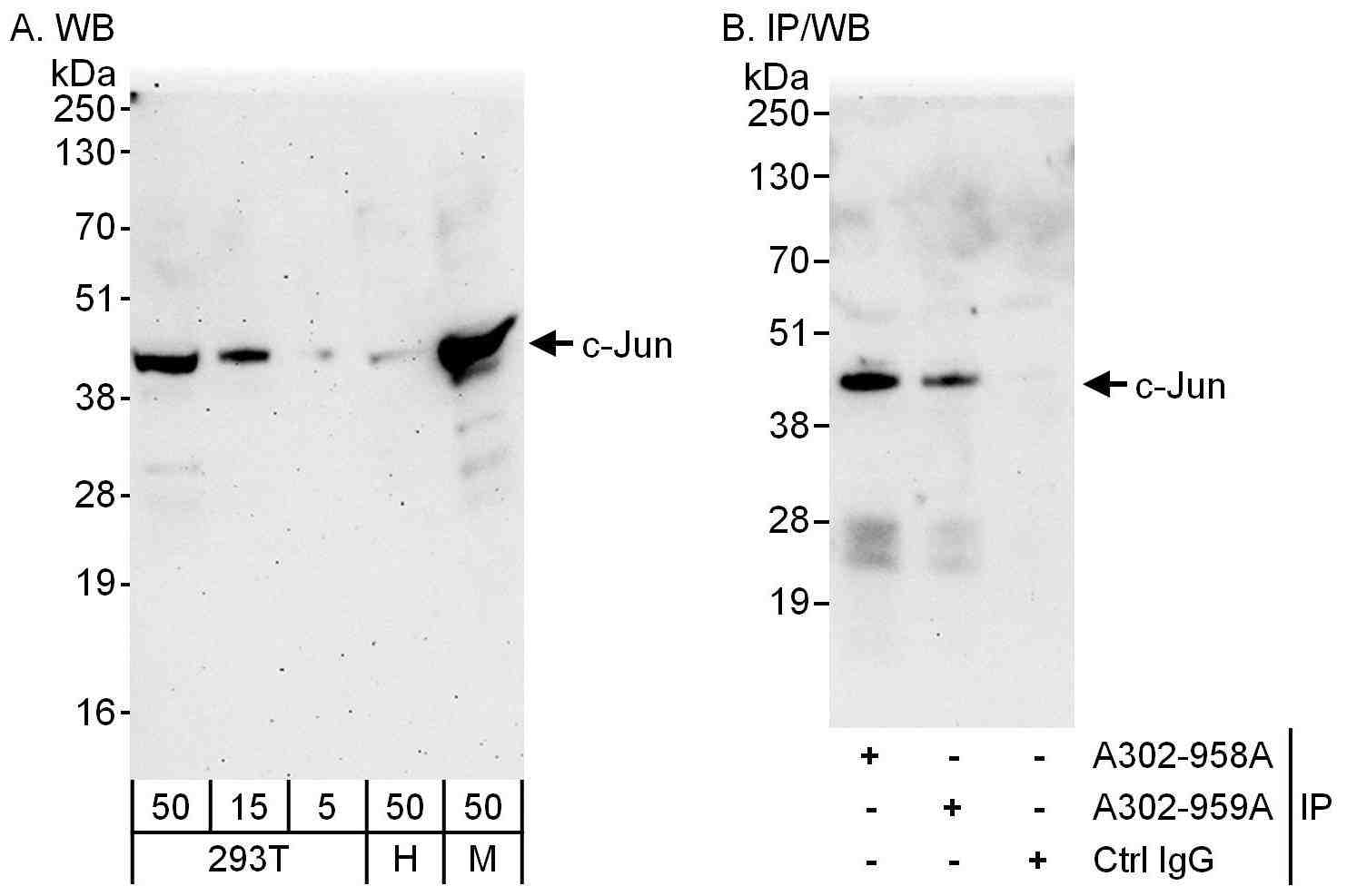 |
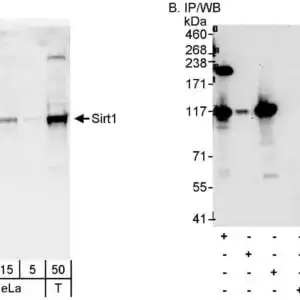
| Detection of human and mouse c-Jun by western blot (h&m) and immunoprecipitation (h). Samples: Whole cell lysate from HEK293T (5, 15 and 50 µg for WB; 1 mg for IP, 20% of IP loaded), HeLa (H; 50 µg) and mouse NIH 3T3 (M; 50 µg) cells. Antibodies: Affinity purified rabbit anti-c-Jun antibody #1037 used for WB at 0.1 µg/ml (A) and 1 µg/ml (B) and used for IP at 3 µg/mg lysate. c-Jun was also immunoprecipitated by rabbit anti-c-Jun antibody, which recognizes an upstream epitope. Detection: Chemiluminescence with exposure times of 3 minutes (A) and 30 seconds (B). |
FAQ & Publications
Frequently Asked Questions
What species does the rabbit anti-JNK polyclonal antibody 1037 react with?
This antibody reacts with human and mouse species.
For which applications has the rabbit anti-JNK polyclonal antibody been validated?
It has been tested and is suitable for immunoprecipitation (IP) and western blotting (WB).
How should the rabbit anti-JNK polyclonal antibody 1037 be stored to maintain stability?
Store the antibody at 2-8°C, and it expires one year from the date of receipt.
What is the recommended dilution range for western blot using this antibody?
For western blot applications, the recommended dilution range is between 1:2000 and 1:10,000.
Publications
| pmid | title | authors | citation |
|---|---|---|---|
| We haven't added any publications to our database yet. | |||
Published literature highly relevant to the biological target of this product and referencing this antibody or clone are retrieved from the PubMed database provided by the United States National Library of Medicine at the National Institutes of Health.
Protocols
| relevant to this product |
|---|
| Western blot |
Documents
| Batch Number | QC File | SDS |
|---|---|---|
| To view batch-specific Safety Datasheets and Quality Certificates associated with your account, please Log In. | ||
Only logged in customers who have purchased this product may leave a review.

Reviews
There are no reviews yet.