| Weight | 1 lbs |
|---|---|
| Dimensions | 9 × 5 × 2 in |
| host | mouse |
| isotype | IgG |
| clonality | monoclonal |
| concentration | concentrate, predilute |
| applications | IHC |
| reactivity | human |
| available size | 0.1 mL, 0.5 mL, 1 mL concentrated, 7 mL prediluted |

rabbit anti-FOXL2 monoclonal antibody (ZR399) 6184
Price range: $160.00 through $528.00
Antibody summary
- Rabbit monoclonal to FOXL2
- Suitable for: Immunohistochemistry (formalin-fixed, paraffin-embedded tissues)
- Reacts with: Human
- Isotype:IgG
- Control: Ovarian follicular and stromal cells
- Visualization: Nucleus
- 0.1, 0.5, 1.0 mL concentrated, 7 mL prediluted
rabbit anti-FOXL2 monoclonal antibody ZR399 6184
| target relevance |
|---|
| Homo sapiens ZEB2 Zinc finger E-box-binding homeobox 2 |
| Protein names Zinc finger E-box-binding homeobox 2 |
| Alternative names Smad-interacting protein 1, Zinc finger homeobox protein 1b |
| Gene names ZEB2 |
| Protein family Belongs to the delta-EF1/ZFH-1 C2H2-type zinc-finger family |
| Function Transcriptional inhibitor that binds to DNA sequence 5'-CACCT-3' in different promoters (PubMed:16061479, PubMed:20516212). Represses transcription of E-cadherin (PubMed:16061479). Represses expression of MEOX2 (PubMed:20516212) |
| Subcellular location Nucleus, Chromosome |
| Structure Binds activated SMAD1, activated SMAD2 and activated SMAD3; binding with SMAD4 is not detected (By similarity). Interacts with CBX4 and CTBP1 |
| Post-translational modification Sumoylation on Lys-391 and Lys-866 is promoted by the E3 SUMO-protein ligase CBX4, and impairs interaction with CTBP1 and transcription repression activity |
| Involvement in disease Mowat-Wilson syndrome A complex developmental disorder characterized by intellectual disability, delayed motor development, epilepsy, microcephaly and a wide spectrum of clinically heterogeneous features suggestive of neurocristopathies at the cephalic, cardiac, and vagal levels. Affected patients show an easily recognizable facial appearance with deep set eyes and hypertelorism, medially divergent, broad eyebrows, prominent columella, pointed chin and uplifted, notched ear lobes. Some patients manifest Hirschsprung disease. |
| Keywords 3D-structure, Acetylation, Alternative splicing, Chromosome, Disease variant, DNA-binding, Epilepsy, Hirschsprung disease, Homeobox, Intellectual disability, Isopeptide bond, Metal-binding, Nucleus, Phosphoprotein, Proteomics identification, Reference proteome, Repeat, Repressor, Transcription, Transcription regulation, Ubl conjugation, Zinc, Zinc-finger |
| Sequence MKQPIMADGPRCKRRKQANPRRKNVVNYDNVVDTGSETDEEDKLHIAEDDGIANPLDQET SPASVPNHESSPHVSQALLPREEEEDEIREGGVEHPWHNNEILQASVDGPEEMKEDYDTM GPEATIQTAINNGTVKNANCTSDFEEYFAKRKLEERDGHAVSIEEYLQRSDTAIIYPEAP EELSRLGTPEANGQEENDLPPGTPDAFAQLLTCPYCDRGYKRLTSLKEHIKYRHEKNEEN FSCPLCSYTFAYRTQLERHMVTHKPGTDQHQMLTQGAGNRKFKCTECGKAFKYKHHLKEH LRIHSGEKPYECPNCKKRFSHSGSYSSHISSKKCIGLISVNGRMRNNIKTGSSPNSVSSS PTNSAITQLRNKLENGKPLSMSEQTGLLKIKTEPLDFNDYKVLMATHGFSGTSPFMNGGL GATSPLGVHPSAQSPMQHLGVGMEAPLLGFPTMNSNLSEVQKVLQIVDNTVSRQKMDCKA EEISKLKGYHMKDPCSQPEEQGVTSPNIPPVGLPVVSHNGATKSIIDYTLEKVNEAKACL QSLTTDSRRQISNIKKEKLRTLIDLVTDDKMIENHNISTPFSCQFCKESFPGPIPLHQHE RYLCKMNEEIKAVLQPHENIVPNKAGVFVDNKALLLSSVLSEKGMTSPINPYKDHMSVLK AYYAMNMEPNSDELLKISIAVGLPQEFVKEWFEQRKVYQYSNSRSPSLERSSKPLAPNSN PPTKDSLLPRSPVKPMDSITSPSIAELHNSVTNCDPPLRLTKPSHFTNIKPVEKLDHSRS NTPSPLNLSSTSSKNSHSSSYTPNSFSSEELQAEPLDLSLPKQMKEPKSIIATKNKTKAS SISLDHNSVSSSSENSDEPLNLTFIKKEFSNSNNLDNKSTNPVFSMNPFSAKPLYTALPP QSAFPPATFMPPVQTSIPGLRPYPGLDQMSFLPHMAYTYPTGAATFADMQQRRKYQRKQG FQGELLDGAQDYMSGLDDMTDSDSCLSRKKIKKTESGMYACDLCDKTFQKSSSLLRHKYE HTGKRPHQCQICKKAFKHKHHLIEHSRLHSGEKPYQCDKCGKRFSHSGSYSQHMNHRYSY CKREAEEREAAEREAREKGHLEPTELLMNRAYLQSITPQGYSDSEERESMPRDGESEKEH EKEGEDGYGKLGRQDGDEEFEEEEEESENKSMDTDPETIRDEEETGDHSMDDSSEDGKME TKSDHEEDNMEDGM |
| UniProt accession: O60315 |
Data
 |
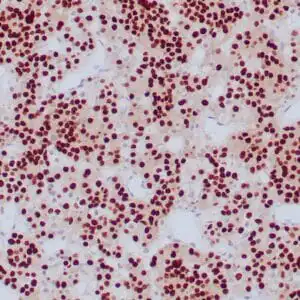
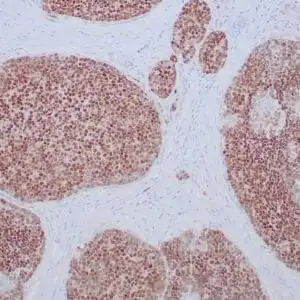
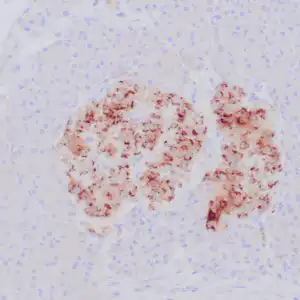
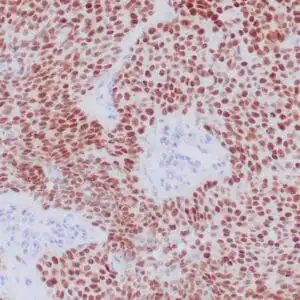
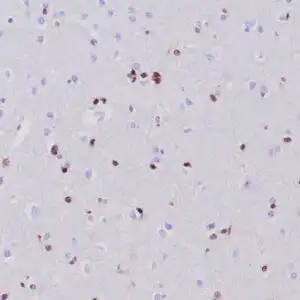
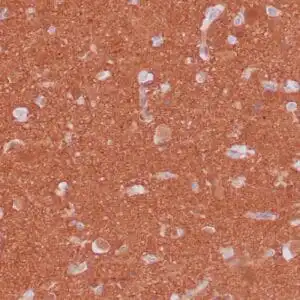
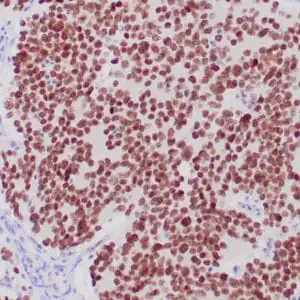
| Formalin-fixed, paraffin-embedded human adult granulosa cell tumor stained with anti-FOXL2 antibody using peroxidase-conjugate and DAB chromogen. Note nuclear staining of tumor cells |
FAQ & Publications
Frequently Asked Questions
What is the recommended dilution range for the concentrated rabbit anti-FOXL2 monoclonal antibody (ZR399) in immunohistochemistry applications?
For immunohistochemistry (IHC), the recommended dilution range of the concentrated rabbit anti-FOXL2 monoclonal antibody (ZR399) is 1:100 to 1:200.
How should the rabbit anti-FOXL2 monoclonal antibody be stored to maintain its stability?
The antibody should be stored at 2-8°C for short-term storage. For long-term preservation, it should be kept at -20°C while avoiding repeated freeze/thaw cycles.
Which species does the rabbit anti-FOXL2 monoclonal antibody specifically react with, and what is the cellular localization of the target protein?
This antibody specifically reacts with human FOXL2 protein, with visualization predominantly observed in the nucleus of cells.
Publications
| pmid | title | authors | citation |
|---|---|---|---|
| We haven't added any publications to our database yet. | |||
Published literature highly relevant to the biological target of this product and referencing this antibody or clone are retrieved from the PubMed database provided by the United States National Library of Medicine at the National Institutes of Health.
Protocols
| relevant to this product |
|---|
| IHC |
Documents
| Batch Number | QC File | SDS |
|---|---|---|
| To view batch-specific Safety Datasheets and Quality Certificates associated with your account, please Log In. | ||
Only logged in customers who have purchased this product may leave a review.
Reviews
There are no reviews yet.