| Weight | 1 lbs |
|---|---|
| Dimensions | 9 × 5 × 2 in |
| host | mouse |
| isotype | IgG |
| clonality | monoclonal |
| concentration | concentrate, predilute |
| applications | IHC |
| reactivity | human |
| available size | 0.1 mL, 0.5 mL, 1 mL concentrated, 7 mL prediluted |

rabbit anti-EZH2 monoclonal antibody (ZR150) 6179
Price range: $160.00 through $528.00
Antibody summary
- Rabbit monoclonal to EZH2
- Suitable for: Immunohistochemistry (formalin-fixed, paraffin-embedded tissues)
- Reacts with: Human
- Isotype:IgG
- Control: Breast carcinoma
- Visualization: Nuclear
- 0.1, 0.5, 1.0 mL concentrated, 7 mL prediluted
rabbit anti-EZH2 monoclonal antibody ZR150 6179
| target relevance |
|---|
| Homo sapiens EZH2 Histone-lysine N-methyltransferase EZH2 |
| Protein names Histone-lysine N-methyltransferase EZH2 |
| Alternative names ENX-1, Enhancer of zeste homolog 2, Lysine N-methyltransferase 6 |
| Gene names EZH2 |
| Protein family Belongs to the class V-like SAM-binding methyltransferase superfamily. Histone-lysine methyltransferase family. EZ subfamily |
| Function Catalytic subunit of the PRC2/EED-EZH2 complex, a Polycomb group (PcG) complex that methylates 'Lys-9' (H3K9me) and 'Lys-27' (H3K27me) of histone H3, leading to transcriptional repression of the affected target gene (PubMed:14532106, PubMed:15225548, PubMed:15385962, PubMed:16618801, PubMed:16936726, PubMed:17344414, PubMed:22323599, PubMed:24474760, PubMed:26581166, PubMed:30026490, PubMed:30923826). Able to mono-, di- and trimethylate 'Lys-27' of histone H3 to form H3K27me1, H3K27me2 and H3K27me3, respectively (PubMed:15231737, PubMed:17210787, PubMed:18285464, PubMed:22323599, PubMed:30923826). Displays a preference for substrates with less methylation, loses activity when progressively more methyl groups are incorporated into H3K27, H3K27me0 > H3K27me1 > H3K27me2 (PubMed:22323599, PubMed:30923826). Compared to EZH1-containing complexes, it is more abundant in embryonic stem cells and plays a major role in forming H3K27me3, which is required for embryonic stem cell identity and proper differentiation (PubMed:19026781). The PRC2/EED-EZH2 complex may also serve as a recruiting platform for DNA methyltransferases, thereby linking two epigenetic repression systems (PubMed:16357870, PubMed:17200670). Genes repressed by the PRC2/EED-EZH2 complex include HOXC8, HOXA9, MYT1, CDKN2A and retinoic acid target genes (PubMed:16179254, PubMed:18086877, PubMed:20935635). EZH2 can also methylate non-histone proteins such as the transcription factor GATA4 and the nuclear receptor RORA (PubMed:23063525). Regulates the circadian clock via histone methylation at the promoter of the circadian genes (PubMed:16717091). Essential for the CRY1/2-mediated repression of the transcriptional activation of PER1/2 by the CLOCK-BMAL1 heterodimer; involved in the di and trimethylation of 'Lys-27' of histone H3 on PER1/2 promoters which is necessary for the CRY1/2 proteins to inhibit transcription (By similarity) |
| Catalytic activity L-lysyl(27)-[histone H3] + 3 S-adenosyl-L-methionine = N(6),N(6),N(6)-trimethyl-L-lysyl(27)-[histone H3] + 3 S-adenosyl-L-homocysteine + 3 H(+) |
| Subcellular location Nucleus |
| Structure Component of the PRC2/EED-EZH2 complex, which includes EED, EZH2, SUZ12, RBBP4 and RBBP7 and possibly AEBP2. The minimum components required for methyltransferase activity of the PRC2/EED-EZH2 complex are EED, EZH2 and SUZ12. The PRC2 complex may also interact with DNMT1, DNMT3A, DNMT3B and PHF1 via the EZH2 subunit and with SIRT1 via the SUZ12 subunit. Interacts with HDAC1 and HDAC2. Binds ATRX via the SET domain (Probable). Interacts with PRAME. Interacts with CDYL. Interacts with CLOCK, BMAL1 and CRY1 (By similarity). Interacts with DNMT3L; the interaction is direct (By similarity). Interacts with EZHIP; the interaction blocks EZH2 methyltransferase activity (PubMed:30923826, PubMed:31086175, PubMed:31451685). Interacts with ZNF263; recruited to the SIX3 promoter along with other proteins involved in chromatin modification and transcriptional corepression where it contributes to transcriptional repression (PubMed:32051553). Interacts with ARMC12 (PubMed:30026490). Interacts with ZMYND8; the interaction is dependent on the presence of chromatin (PubMed:33323928, PubMed:36064715). Interacts with DDX18; this interaction inhibits the PRC2 complex (By similarity) |
| Post-translational modification Phosphorylated by AKT1. Phosphorylation by AKT1 reduces methyltransferase activity. Phosphorylation at Thr-345 by CDK1 and CDK2 promotes maintenance of H3K27me3 levels at EZH2-target loci, thus leading to epigenetic gene silencing Sumoylated Glycosylated: O-GlcNAcylation at Ser-75 by OGT increases stability of EZH2 and facilitates the formation of H3K27me3 by the PRC2/EED-EZH2 complex |
| Involvement in disease Weaver syndrome A syndrome of accelerated growth and osseous maturation, unusual craniofacial appearance, hoarse and low-pitched cry, and hypertonia with camptodactyly. Distinguishing features of Weaver syndrome include broad forehead and face, ocular hypertelorism, prominent wide philtrum, micrognathia, deep horizontal chin groove, and deep-set nails. In addition, carpal bone development is advanced over the rest of the hand. |
| Keywords 3D-structure, Alternative splicing, Biological rhythms, Chromatin regulator, Disease variant, Glycoprotein, Isopeptide bond, Methyltransferase, Nucleus, Phosphoprotein, Proteomics identification, Reference proteome, Repressor, S-adenosyl-L-methionine, Transcription, Transcription regulation, Transferase, Ubl conjugation |
| Sequence MGQTGKKSEKGPVCWRKRVKSEYMRLRQLKRFRRADEVKSMFSSNRQKILERTEILNQEW KQRRIQPVHILTSVSSLRGTRECSVTSDLDFPTQVIPLKTLNAVASVPIMYSWSPLQQNF MVEDETVLHNIPYMGDEVLDQDGTFIEELIKNYDGKVHGDRECGFINDEIFVELVNALGQ YNDDDDDDDGDDPEEREEKQKDLEDHRDDKESRPPRKFPSDKIFEAISSMFPDKGTAEEL KEKYKELTEQQLPGALPPECTPNIDGPNAKSVQREQSLHSFHTLFCRRCFKYDCFLHPFH ATPNTYKRKNTETALDNKPCGPQCYQHLEGAKEFAAALTAERIKTPPKRPGGRRRGRLPN NSSRPSTPTINVLESKDTDSDREAGTETGGENNDKEEEEKKDETSSSSEANSRCQTPIKM KPNIEPPENVEWSGAEASMFRVLIGTYYDNFCAIARLIGTKTCRQVYEFRVKESSIIAPA PAEDVDTPPRKKKRKHRLWAAHCRKIQLKKDGSSNHVYNYQPCDHPRQPCDSSCPCVIAQ NFCEKFCQCSSECQNRFPGCRCKAQCNTKQCPCYLAVRECDPDLCLTCGAADHWDSKNVS CKNCSIQRGSKKHLLLAPSDVAGWGIFIKDPVQKNEFISEYCGEIISQDEADRRGKVYDK YMCSFLFNLNNDFVVDATRKGNKIRFANHSVNPNCYAKVMMVNGDHRIGIFAKRAIQTGE ELFFDYRYSQADALKYVGIEREMEIP |
| UniProt accession: Q15910 |
Data
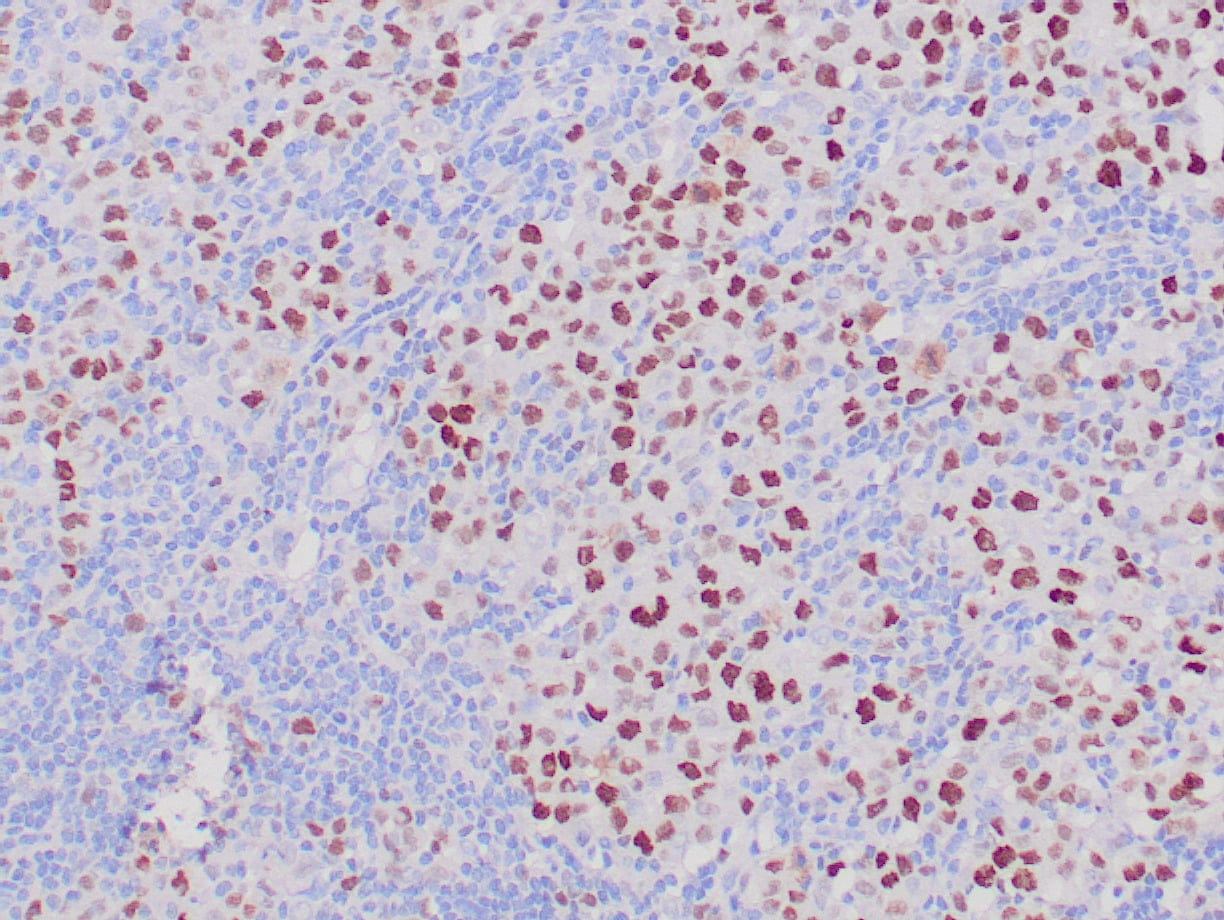 |
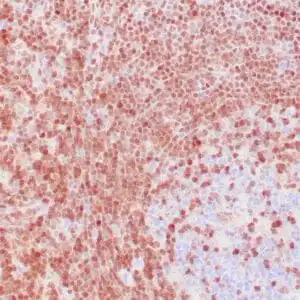
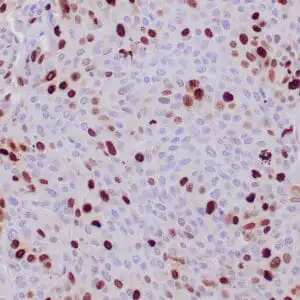
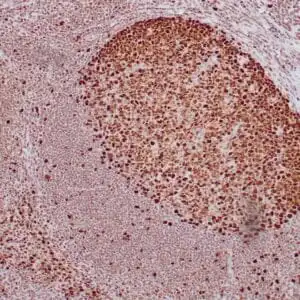
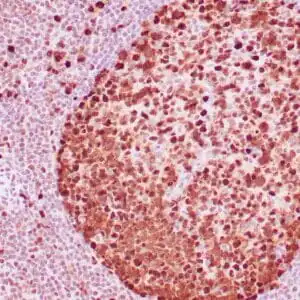
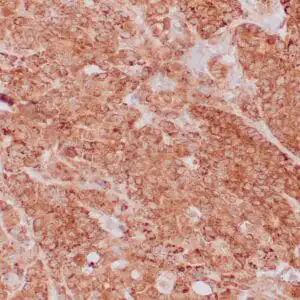
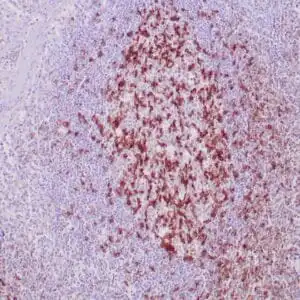
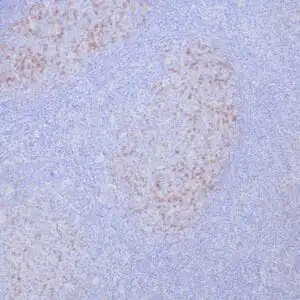
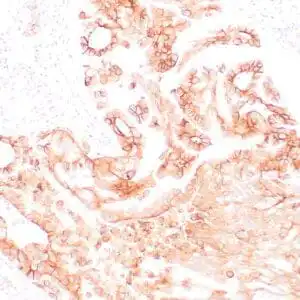
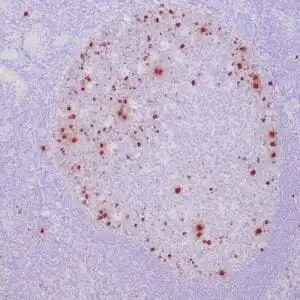
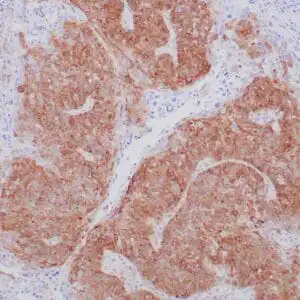
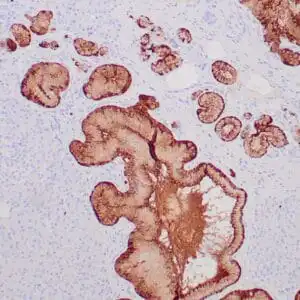
| Human breast ductal carcinoma stained with anti-EZH2 antibody using peroxidase-conjugate and DAB chromogen. Note nuclear staining of carcinoma cells. |
FAQ & Publications
Frequently Asked Questions
What applications is the rabbit anti-EZH2 monoclonal antibody (ZR150) suitable for?
This antibody is suitable for immunohistochemistry (IHC) on formalin-fixed, paraffin-embedded human tissue samples.
How should the rabbit anti-EZH2 monoclonal antibody be stored to maintain its stability?
For short-term storage, keep the antibody at 2-8°C. For longer-term storage, it should be kept at -20°C while avoiding freeze/thaw cycles.
What is the recommended dilution range for using the concentrated form of this antibody in IHC?
The recommended dilution range for the concentrated antibody in immunohistochemistry is between 1:25 and 1:100.
Which species does this rabbit monoclonal antibody specifically react with?
This antibody specifically reacts with human EZH2 protein.
Publications
| pmid | title | authors | citation |
|---|---|---|---|
| We haven't added any publications to our database yet. | |||
Published literature highly relevant to the biological target of this product and referencing this antibody or clone are retrieved from the PubMed database provided by the United States National Library of Medicine at the National Institutes of Health.
Protocols
| relevant to this product |
|---|
| IHC |
Documents
| Batch Number | QC File | SDS |
|---|---|---|
| To view batch-specific Safety Datasheets and Quality Certificates associated with your account, please Log In. | ||
Only logged in customers who have purchased this product may leave a review.
Reviews
There are no reviews yet.