| Weight | 1 lbs |
|---|---|
| Dimensions | 9 × 5 × 2 in |
| host | rabbit |
| isotype | IgG |
| clonality | monoclonal |
| concentration | 1 mg/mL |
| applications | ICC/IF, IHC, WB |
| available sizes | 100 µg |

rabbit anti-Doublecortin monoclonal antibody 9059
$409.00
Antibody summary
- Rabbit monoclonal to Doublecortin
- Suitable for: WB, ICC/IF, IHC
- Reacts with: human, mouse, rat
- Isotype: IgG
- 100 µg
rabbit anti-Doublecortin monoclonal antibody 9059
| target relevance |
|---|
| Homo sapiens DCX Neuronal migration protein doublecortin |
| Protein names Neuronal migration protein doublecortin |
| Alternative names Doublin, Lissencephalin-X |
| Gene names DCX |
| Function Microtubule-associated protein required for initial steps of neuronal dispersion and cortex lamination during cerebral cortex development. May act by competing with the putative neuronal protein kinase DCLK1 in binding to a target protein. May in that way participate in a signaling pathway that is crucial for neuronal interaction before and during migration, possibly as part of a calcium ion-dependent signal transduction pathway. May be part with PAFAH1B1/LIS-1 of overlapping, but distinct, signaling pathways that promote neuronal migration |
| Subcellular location Cytoplasm, Cell projection, neuron projection |
| Structure Interacts with tubulin (PubMed:27292316). Interacts with USP9X (PubMed:24607389) |
| Post-translational modification Phosphorylation by MARK1, MARK2 and PKA regulates its ability to bind microtubules (By similarity). Phosphorylation at Ser-265 and Ser-297 seems to occur only in neonatal brain, the levels falling precipitously by postnatal day 21 (By similarity) Ubiquitinated by MDM2, leading to its degradation by the proteasome. Ubiquitinated by MDM2 and subsequent degradation leads to reduce the dendritic spine density of olfactory bulb granule cells |
| Involvement in disease Lissencephaly, X-linked 1 A classic lissencephaly characterized by intellectual disability and seizures that are more severe in male patients. Affected boys show an abnormally thick cortex with absent or severely reduced gyri. Clinical manifestations include feeding problems, abnormal muscular tone, seizures and severe to profound psychomotor retardation. Female patients display a less severe phenotype referred to as 'doublecortex'. Subcortical band heterotopia X-linked SBHX is a mild brain malformation of the lissencephaly spectrum. It is characterized by bilateral and symmetric plates or bands of gray matter found in the central white matter between the cortex and cerebral ventricles, cerebral convolutions usually appearing normal. |
| Keywords 3D-structure, Alternative splicing, Cell projection, Chromosomal rearrangement, Cytoplasm, Developmental protein, Differentiation, Disease variant, Epilepsy, Lissencephaly, Microtubule, Neurogenesis, Phosphoprotein, Proteomics identification, Reference proteome, Repeat, Ubl conjugation |
| Sequence MELDFGHFDERDKTSRNMRGSRMNGLPSPTHSAHCSFYRTRTLQALSNEKKAKKVRFYRN GDRYFKGIVYAVSSDRFRSFDALLADLTRSLSDNINLPQGVRYIYTIDGSRKIGSMDELE EGESYVCSSDNFFKKVEYTKNVNPNWSVNVKTSANMKAPQSLASSNSAQARENKDFVRPK LVTIIRSGVKPRKAVRVLLNKKTAHSFEQVLTDITEAIKLETGVVKKLYTLDGKQVTCLH DFFGDDDVFIACGPEKFRYAQDDFSLDENECRVMKGNPSATAGPKASPTPQKTSAKSPGP MRRSKSPADSGNDQDANGTSSSQLSTPKSKQSPISTPTSPGSLRKHKDLYLPLSLDDSDS LGDSM |
| UniProt accession: O43602 |
Data
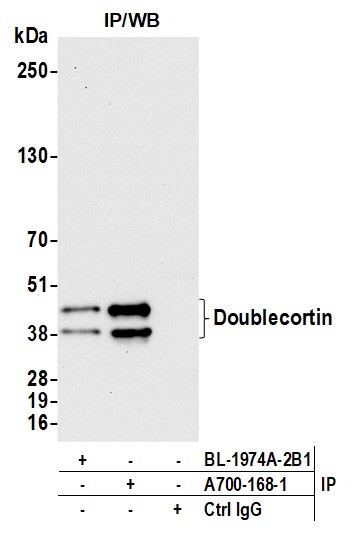 |
| Detection of human Doublecortin by Western blot of immunoprecipitates. Samples: Whole cell lysate (1.0 mg per IP reaction; 20% of IP loaded) from SK-N-BE(2) cells prepared using NETN lysis buffer. Antibodies: Rabbit anti-Doublecortin recombinant monoclonal antibody 9059 used for IP at 20 µl/mg lysate. Doublecortin was also immunoprecipitated by a second antibody against a different epitope of Doublecortin. For blotting immunoprecipitated Doublecortin, 9059 was used at 1:1000. Detection: Chemiluminescence with an exposure time of 10 seconds. |
FAQ & Publications
Frequently Asked Questions
What species does the rabbit anti-Doublecortin monoclonal antibody 9059 react with?
This antibody reacts with human, mouse, and rat species.
Which applications is the rabbit anti-Doublecortin monoclonal antibody 9059 validated for?
It is suitable for Western blot (WB), immunocytochemistry/immunofluorescence (ICC/IF), and immunohistochemistry (IHC) applications.
How should the rabbit anti-Doublecortin monoclonal antibody 9059 be stored to maintain stability?
For short-term storage, keep the antibody at 2-8°C. For long-term storage, it should be stored at -20°C and freeze/thaw cycles should be avoided.
What is the concentration and form of the rabbit anti-Doublecortin monoclonal antibody 9059 provided?
The antibody is supplied as a liquid at a concentration of 1 mg/mL, with a size of 100 µg.
What immunogen was used to generate the rabbit anti-Doublecortin monoclonal antibody 9059?
The immunogen is the recombinant full-length human Lis-A isoform of Doublecortin expressed in and purified from E. coli.
Publications
| pmid | title | authors | citation |
|---|---|---|---|
| We haven't added any publications to our database yet. | |||
Published literature highly relevant to the biological target of this product and referencing this antibody or clone are retrieved from the PubMed database provided by the United States National Library of Medicine at the National Institutes of Health.
Protocols
| relevant to this product |
|---|
| Western blot IHC ICC |
Documents
| Batch Number | QC File | SDS |
|---|---|---|
| To view batch-specific Safety Datasheets and Quality Certificates associated with your account, please Log In. | ||
Only logged in customers who have purchased this product may leave a review.

Reviews
There are no reviews yet.