| Weight | 1 lbs |
|---|---|
| Dimensions | 9 × 5 × 2 in |
| host | mouse |
| isotype | IgG |
| clonality | monoclonal |
| concentration | concentrate, predilute |
| applications | IHC |
| reactivity | human |
| available size | 0.1 mL, 0.5 mL, 1 mL concentrated, 7 mL prediluted |

rabbit anti-Chromogranin A monoclonal antibody (ZR427) 6124
Price range: $160.00 through $528.00
Antibody summary
- Rabbit monoclonal to Chromogranin A
- Suitable for: Immunohistochemistry (formalin-fixed, paraffin-embedded tissues)
- Reacts with: Human
- Isotype:IgG
- Control: Pancreas or neuroendocrine tumor
- Visualization: Cytoplasmic
- 0.1, 0.5, 1.0 mL concentrated, 7 mL prediluted
rabbit anti-Chromogranin A monoclonal antibody ZR427 6124
| target relevance |
|---|
| Homo sapiens CHGA Chromogranin-A |
| Protein names Chromogranin-A |
| Alternative names Pituitary secretory protein I |
| Gene names CHGA |
| Protein family Belongs to the chromogranin/secretogranin protein family |
| Function Strongly inhibits glucose induced insulin release from the pancreas |
| Subcellular location Cytoplasmic vesicle, secretory vesicle, Cytoplasmic vesicle, secretory vesicle, neuronal dense core vesicle, Secreted |
| Structure Self-interacts; self-assembly is promoted in vitro by chondroitin sulfate attachment which occurs at mildly acidic pH conditions (PubMed:25326458). Interacts with SCG3 (By similarity). Interacts with ITPR1 in the secretory granules (By similarity) |
| Post-translational modification Sulfated on tyrosine residues and/or contains sulfated glycans O-glycosylated with core 1 or possibly core 8 glycans (PubMed:19838169, PubMed:23234360, PubMed:9852066). Contains chondroitin sulfate (CS); CS attachment is pH-dependent, being observed at mildly acidic conditions of pH 5 but not at neutral pH, and promotes self-assembly in vitro (PubMed:25326458) Proteolytic processing gives rise to an additional longer form of catestatin (residues 358-390) which displays a less potent catecholamine release-inhibitory activity (PubMed:10781584). Plasmin-mediated proteolytic processing can give rise to additional shorter and longer forms of catestatin peptides (PubMed:17991725) |
| Keywords 3D-structure, Amidation, Antibiotic, Antimicrobial, Calcium, Cleavage on pair of basic residues, Cytoplasmic vesicle, Direct protein sequencing, Disulfide bond, Fungicide, Glycoprotein, Oxidation, Phosphoprotein, Proteoglycan, Proteomics identification, Reference proteome, Secreted, Signal, Sulfation |
| Sequence MRSAAVLALLLCAGQVTALPVNSPMNKGDTEVMKCIVEVISDTLSKPSPMPVSQECFETL RGDERILSILRHQNLLKELQDLALQGAKERAHQQKKHSGFEDELSEVLENQSSQAELKEA VEEPSSKDVMEKREDSKEAEKSGEATDGARPQALPEPMQESKAEGNNQAPGEEEEEEEEA TNTHPPASLPSQKYPGPQAEGDSEGLSQGLVDREKGLSAEPGWQAKREEEEEEEEEAEAG EEAVPEEEGPTVVLNPHPSLGYKEIRKGESRSEALAVDGAGKPGAEEAQDPEGKGEQEHS QQKEEEEEMAVVPQGLFRGGKSGELEQEEERLSKEWEDSKRWSKMDQLAKELTAEKRLEG QEEEEDNRDSSMKLSFRARAYGFRGPGPQLRRGWRPSSREDSLEAGLPLQVRGYPEEKKE EEGSANRRPEDQELESLSAIEAELEKVAHQLQALRRG |
| UniProt accession: P10645 |
Data
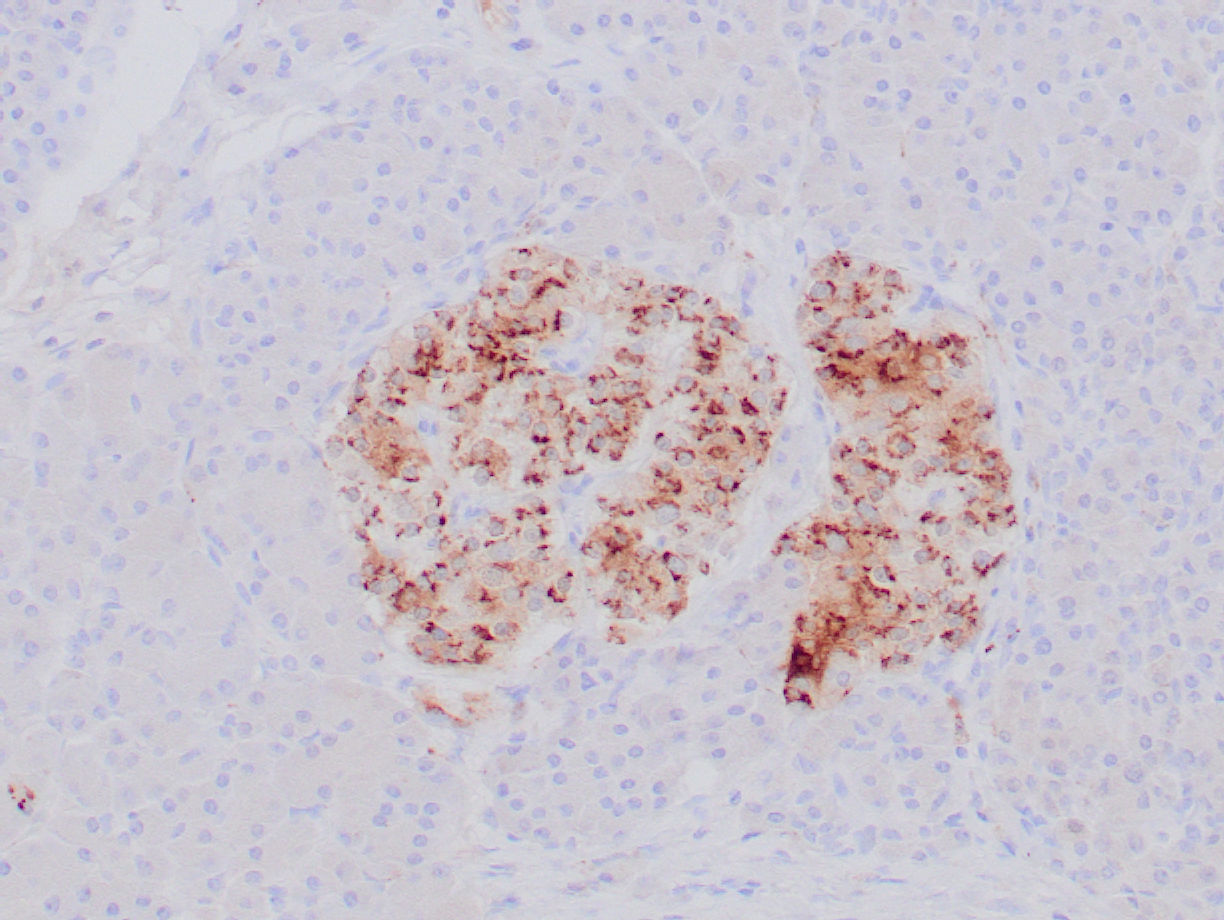 |
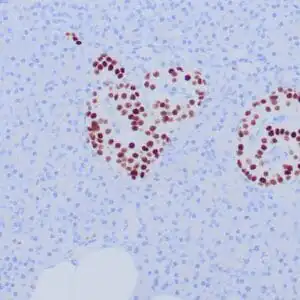
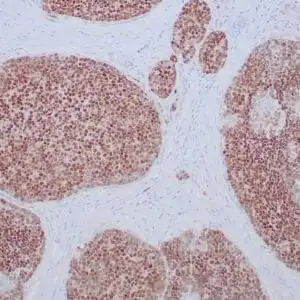
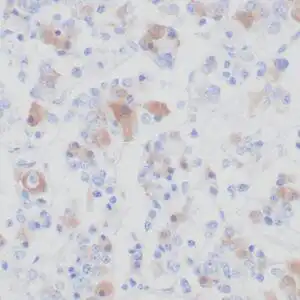
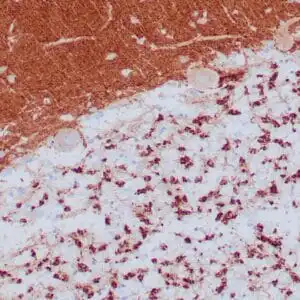
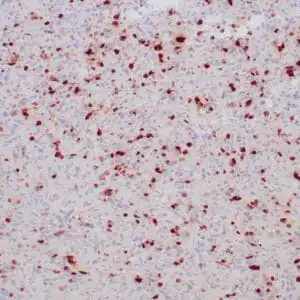
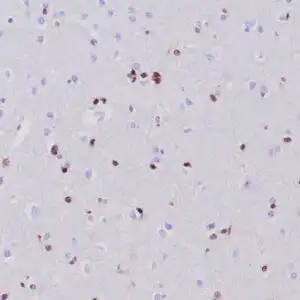
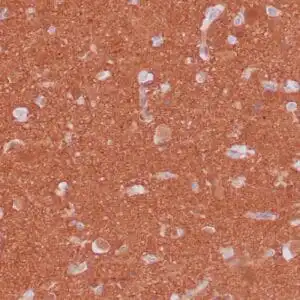
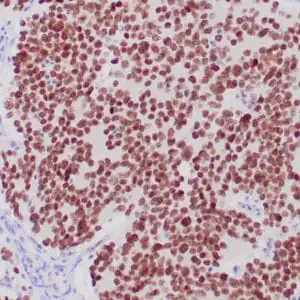
| Human neuroendocrine tumor stained with anti-Chromogranin A antibody using peroxidase-conjugate and DAB chromogen. Note cytoplasmic tumor cells. |
FAQ & Publications
Frequently Asked Questions
What species does the rabbit anti-Chromogranin A monoclonal antibody (ZR427) specifically react with?
This antibody specifically reacts with human tissues.
For which application is the rabbit anti-Chromogranin A monoclonal antibody (ZR427) validated and recommended?
It is validated and recommended for immunohistochemistry (IHC) on formalin-fixed, paraffin-embedded tissues.
How should the rabbit anti-Chromogranin A monoclonal antibody be stored to maintain its stability?
Store the antibody at 2-8°C for short-term use and at -20°C for long-term storage, avoiding freeze/thaw cycles.
What is the recommended dilution range for using the concentrated form of this antibody in IHC?
The recommended dilution for the concentrated antibody is between 1:100 and 1:200 for immunohistochemistry applications.
Publications
| pmid | title | authors | citation |
|---|---|---|---|
| We haven't added any publications to our database yet. | |||
Published literature highly relevant to the biological target of this product and referencing this antibody or clone are retrieved from the PubMed database provided by the United States National Library of Medicine at the National Institutes of Health.
Protocols
| relevant to this product |
|---|
| IHC |
Documents
| Batch Number | QC File | SDS |
|---|---|---|
| To view batch-specific Safety Datasheets and Quality Certificates associated with your account, please Log In. | ||
Only logged in customers who have purchased this product may leave a review.

Reviews
There are no reviews yet.