| Weight | 1 lbs |
|---|---|
| Dimensions | 9 × 5 × 2 in |
| host | mouse |
| isotype | IgG |
| clonality | monoclonal |
| concentration | concentrate, predilute |
| applications | IHC |
| reactivity | human |
| available size | 0.1 mL, 0.5 mL, 1 mL concentrated, 7 mL prediluted |

rabbit anti-CD56 monoclonal antibody (ZR421) 6103
Price range: $160.00 through $528.00
Antibody summary
- Rabbit monoclonal to CD56
- Suitable for: Immunohistochemistry (formalin-fixed, paraffin-embedded tissues)
- Reacts with: Human
- Isotype:IgG
- Control: Neuroblastoma, neuroendocrine carcinoma
- Visualization: Cell membrane
- 0.1, 0.5, 1.0 mL concentrated, 7 mL prediluted
rabbit anti-CD56 monoclonal antibody ZR421 6103
| antibody |
|---|
| Database link: human P13591 |
| Tested applications IHC |
| Recommended dilutions Concentrated 1:100-200 |
| Application Notes Positive control: Neuroblastoma, neuroendocrine carcinoma |
| Immunogen Recombinant fragment (around aa600-800) of human NCAM1 (CD56) protein |
| Size and concentration 7 mL prediluted or 0.1, 0.5, 1.0 mL and concentrated |
| Form liquid |
| Storage Instructions 2-8°C for short term, for longer term at -20°C. Avoid freeze / thaw cycles. |
| Purity affinity purified |
| Clonality monoclonal |
| Isotype IgG |
| Compatible secondaries goat anti-rabbit IgG, H&L chain specific, peroxidase conjugated, conjugated polyclonal antibody 9512 goat anti-rabbit IgG, H&L chain specific, biotin conjugated polyclonal antibody 2079 goat anti-rabbit IgG, H&L chain specific, FITC conjugated polyclonal antibody 7863 goat anti-rabbit IgG, H&L chain specific, Cross Absorbed polyclonal antibody 2371 goat anti-rabbit IgG, H&L chain specific, biotin conjugated polyclonal antibody, crossabsorbed 1715 goat anti-rabbit IgG, H&L chain specific, FITC conjugated polyclonal antibody, crossabsorbed 1720 |
| Isotype control Rabbit polyclonal - Isotype Control |
| target relevance |
|---|
| Homo sapiens NCAM1 Neural cell adhesion molecule 1 |
| Protein names Neural cell adhesion molecule 1 |
| Gene names NCAM1 |
| Function This protein is a cell adhesion molecule involved in neuron-neuron adhesion, neurite fasciculation, outgrowth of neurites, etc |
| Subcellular location Secreted |
| Structure Interacts with MDK. Found in a complex with SLC39A6, SLC39A10 and with NCAM1; this complex controls NCAM1 phosphorylation and integration into focal adhesion complexes during epithelial-tomesenchymal transition. Interacts with synaptic plasticity regulator PANTS |
| Post-translational modification Polysialylated at Asn-459 and Asn-488 by ST8SIA2 and ST8SIA4 (PubMed:28810663). Polysialylation modulates cell interactions by confering both attractive and repulsive properties that are highly regulated by ST8SIA2 and ST8SIA4 (PubMed:28810663). Polysialylation is formed on a-2,3-linked sialic acid of core glycans (PubMed:9774483) |
| Keywords 3D-structure, Alternative splicing, Cell adhesion, Cell membrane, Disulfide bond, Glycoprotein, GPI-anchor, Host cell receptor for virus entry, Host-virus interaction, Immunoglobulin domain, Lipoprotein, Membrane, Phosphoprotein, Proteomics identification, Receptor, Reference proteome, Repeat, Secreted, Signal, Transmembrane, Transmembrane helix |
| Sequence MLQTKDLIWTLFFLGTAVSLQVDIVPSQGEISVGESKFFLCQVAGDAKDKDISWFSPNGE KLTPNQQRISVVWNDDSSSTLTIYNANIDDAGIYKCVVTGEDGSESEATVNVKIFQKLMF KNAPTPQEFREGEDAVIVCDVVSSLPPTIIWKHKGRDVILKKDVRFIVLSNNYLQIRGIK KTDEGTYRCEGRILARGEINFKDIQVIVNVPPTIQARQNIVNATANLGQSVTLVCDAEGF PEPTMSWTKDGEQIEQEEDDEKYIFSDDSSQLTIKKVDKNDEAEYICIAENKAGEQDATI HLKVFAKPKITYVENQTAMELEEQVTLTCEASGDPIPSITWRTSTRNISSEEKASWTRPE KQETLDGHMVVRSHARVSSLTLKSIQYTDAGEYICTASNTIGQDSQSMYLEVQYAPKLQG PVAVYTWEGNQVNITCEVFAYPSATISWFRDGQLLPSSNYSNIKIYNTPSASYLEVTPDS ENDFGNYNCTAVNRIGQESLEFILVQADTPSSPSIDQVEPYSSTAQVQFDEPEATGGVPI LKYKAEWRAVGEEVWHSKWYDAKEASMEGIVTIVGLKPETTYAVRLAALNGKGLGEISAA SEFKTQPVQGEPSAPKLEGQMGEDGNSIKVNLIKQDDGGSPIRHYLVRYRALSSEWKPEI RLPSGSDHVMLKSLDWNAEYEVYVVAENQQGKSKAAHFVFRTSAQPTAIPANGSPTSGLS TGAIVGILIVIFVLLLVVVDITCYFLNKCGLFMCIAVNLCGKAGPGAKGKDMEEGKAAFS KDESKEPIVEVRTEEERTPNHDGGKHTEPNETTPLTEPEKGPVEAKPECQETETKPAPAE VKTVPNDATQTKENESKA |
| UniProt accession: P13591 |
Data
 |
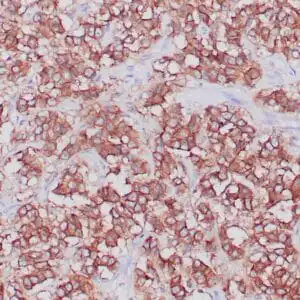
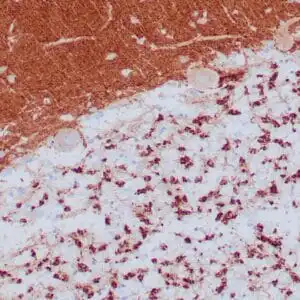
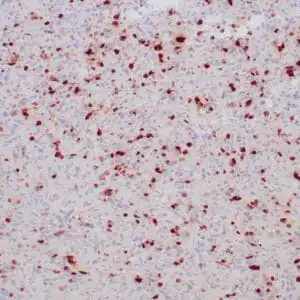
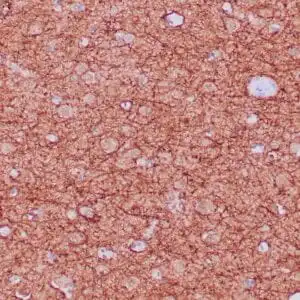
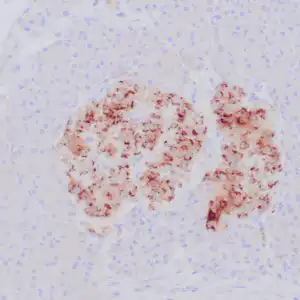
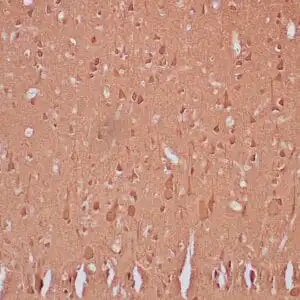
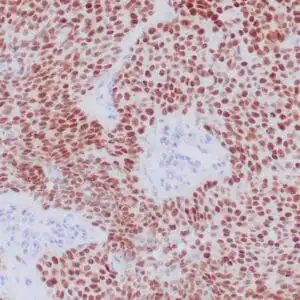
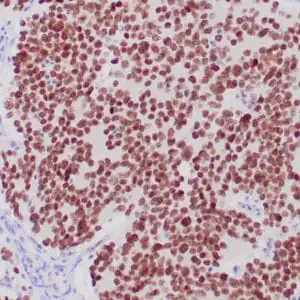
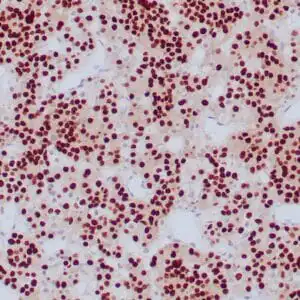
| Human neuroendocrine carcinoma stained with anti-CD56 antibody using peroxidase-conjugate and DAB chromogen. Note cell membrane staining of tumor cells. |
FAQ & Publications
Frequently Asked Questions
What species does the rabbit anti-CD56 monoclonal antibody (ZR421) specifically react with?
This antibody is reactive with human tissues, making it suitable for applications involving human samples.
How should the rabbit anti-CD56 monoclonal antibody be stored to maintain its stability?
For short-term storage, keep the antibody at 2-8°C. For longer-term storage, it should be kept at -20°C while avoiding freeze/thaw cycles to preserve antibody integrity.
Which application is the rabbit anti-CD56 monoclonal antibody (ZR421) validated for, and what are the recommended dilution factors?
This antibody has been tested and is suitable for immunohistochemistry (IHC) on formalin-fixed, paraffin-embedded tissues. The recommended dilution for the concentrated antibody is between 1:100 and 1:200.
Publications
| pmid | title | authors | citation |
|---|---|---|---|
| We haven't added any publications to our database yet. | |||
Published literature highly relevant to the biological target of this product and referencing this antibody or clone are retrieved from the PubMed database provided by the United States National Library of Medicine at the National Institutes of Health.
Protocols
| relevant to this product |
|---|
| IHC |
Documents
| Batch Number | QC File | SDS |
|---|---|---|
| To view batch-specific Safety Datasheets and Quality Certificates associated with your account, please Log In. | ||
Only logged in customers who have purchased this product may leave a review.

Reviews
There are no reviews yet.