| Weight | 1 lbs |
|---|---|
| Dimensions | 9 × 5 × 2 in |
| host | mouse |
| isotype | IgG1 |
| clonality | monoclonal |
| concentration | concentrate, predilute |
| applications | IHC |
| reactivity | human |
| available size | 0.1 mL, 0.5 mL, 1 mL concentrated, 7 mL prediluted |

mouse anti-WT-1 monoclonal antibody (6F-H2) 6404
Price range: $160.00 through $528.00
Antibody summary
- Mouse monoclonal to WT-1
- Suitable for: Immunohistochemistry (formalin-fixed, paraffin-embedded tissues)
- Reacts with: Human
- Isotype:IgG1
- Control: Malignant mesothelioma
- Visualization: Nuclear
- 0.1, 0.5, 1.0 mL concentrated, 7 mL prediluted
mouse anti-WT-1 monoclonal antibody 6F-H2 6404
| target relevance |
|---|
| Protein names Wilms tumor protein (WT33) |
| Gene names WT1,WT1 |
| Protein family EGR C2H2-type zinc-finger protein family |
| Mass 49188Da |
| Function FUNCTION: Transcription factor that plays an important role in cellular development and cell survival (PubMed:7862533). Recognizes and binds to the DNA sequence 5'-GCG(T/G)GGGCG-3' (PubMed:17716689, PubMed:25258363, PubMed:7862533). Regulates the expression of numerous target genes, including EPO. Plays an essential role for development of the urogenital system. It has a tumor suppressor as well as an oncogenic role in tumor formation. Function may be isoform-specific: isoforms lacking the KTS motif may act as transcription factors (PubMed:15520190). Isoforms containing the KTS motif may bind mRNA and play a role in mRNA metabolism or splicing (PubMed:16934801). Isoform 1 has lower affinity for DNA, and can bind RNA (PubMed:19123921). {ECO:0000269|PubMed:15520190, ECO:0000269|PubMed:16934801, ECO:0000269|PubMed:17716689, ECO:0000269|PubMed:19123921, ECO:0000269|PubMed:19416806, ECO:0000269|PubMed:25258363, ECO:0000269|PubMed:7862533}. |
| Subellular location SUBCELLULAR LOCATION: Nucleus {ECO:0000269|PubMed:15520190}. Nucleus, nucleolus. Cytoplasm {ECO:0000250}. Note=Isoforms lacking the KTS motif have a diffuse nuclear location (PubMed:15520190). Shuttles between nucleus and cytoplasm. {ECO:0000250, ECO:0000269|PubMed:15520190}.; SUBCELLULAR LOCATION: [Isoform 1]: Nucleus speckle {ECO:0000269|PubMed:15520190}.; SUBCELLULAR LOCATION: [Isoform 4]: Nucleus, nucleoplasm {ECO:0000269|PubMed:15520190}. |
| Tissues TISSUE SPECIFICITY: Expressed in the kidney and a subset of hematopoietic cells. |
| Structure SUBUNIT: Homodimer. Interacts with WTIP. Interacts with actively translating polysomes. Detected in nuclear ribonucleoprotein (mRNP) particles. Interacts with HNRNPU via the zinc-finger region. Interacts with U2AF2. Interacts with CITED2 (By similarity). Interacts with ZNF224 via the zinc-finger region. Interacts with WTAP and SRY. Interacts with AMER1. Interacts with RBM4. {ECO:0000250, ECO:0000269|PubMed:11001926, ECO:0000269|PubMed:12239212, ECO:0000269|PubMed:12970737, ECO:0000269|PubMed:15518539, ECO:0000269|PubMed:16934801, ECO:0000269|PubMed:17716689, ECO:0000269|PubMed:19416806}. |
| Domain DOMAIN: Binds to DNA motifs with the sequence 5'-GCG(T/G)GGGCG-3' via its C2H2-type zinc fingers. Starting from the N-terminus, the second zinc finger binds to the 3'-GCG motif, the middle zinc finger interacts with the central TGG motif, and the C-terminal zinc finger binds to the 5'-GCG motif. Binds double-stranded target DNA, irrespective of the cytosine methylation status. Has reduced affinity for target DNA where the cytosines have been oxidized to 5-hydroxymethylcytosine, 5-formylcytosine or 5-carboxylcytosine. {ECO:0000269|PubMed:25258363}.; DOMAIN: The 9aaTAD motif is a transactivation domain present in a large number of yeast and animal transcription factors. {ECO:0000269|PubMed:31375868}. |
| Involvement in disease DISEASE: Frasier syndrome (FS) [MIM:136680]: Characterized by a slowly progressing nephropathy leading to renal failure in adolescence or early adulthood, male pseudohermaphroditism, and no Wilms tumor. As for histological findings of the kidneys, focal glomerular sclerosis is often observed. There is phenotypic overlap with Denys-Drash syndrome. Inheritance is autosomal dominant. {ECO:0000269|PubMed:10571943}. Note=The disease is caused by variants affecting the gene represented in this entry.; DISEASE: Wilms tumor 1 (WT1) [MIM:194070]: Embryonal malignancy of the kidney that affects approximately 1 in 10'000 infants and young children. It occurs both in sporadic and hereditary forms. {ECO:0000269|PubMed:1317572, ECO:0000269|PubMed:15150775, ECO:0000269|PubMed:9108089, ECO:0000269|PubMed:9529364}. Note=The disease is caused by variants affecting the gene represented in this entry.; DISEASE: Denys-Drash syndrome (DDS) [MIM:194080]: Typical nephropathy characterized by diffuse mesangial sclerosis, genital abnormalities, and/or Wilms tumor. There is phenotypic overlap with WAGR syndrome and Frasier syndrome. Inheritance is autosomal dominant, but most cases are sporadic. {ECO:0000269|PubMed:10738002, ECO:0000269|PubMed:10799199, ECO:0000269|PubMed:11182928, ECO:0000269|PubMed:11519891, ECO:0000269|PubMed:1302008, ECO:0000269|PubMed:1338906, ECO:0000269|PubMed:15349765, ECO:0000269|PubMed:1655284, ECO:0000269|PubMed:8111391, ECO:0000269|PubMed:8112732, ECO:0000269|PubMed:8295405, ECO:0000269|PubMed:8388765, ECO:0000269|PubMed:8411073, ECO:0000269|PubMed:8741319, ECO:0000269|PubMed:8956030, ECO:0000269|PubMed:9475094, ECO:0000269|PubMed:9529364}. Note=The disease is caused by variants affecting the gene represented in this entry.; DISEASE: Nephrotic syndrome 4 (NPHS4) [MIM:256370]: A form of nephrotic syndrome, a renal disease clinically characterized by severe proteinuria, resulting in complications such as hypoalbuminemia, hyperlipidemia and edema. Kidney biopsies show non-specific histologic changes such as focal segmental glomerulosclerosis and diffuse mesangial proliferation. Some affected individuals have an inherited steroid-resistant form and progress to end-stage renal failure. Most patients with NPHS4 show diffuse mesangial sclerosis on renal biopsy, which is a pathologic entity characterized by mesangial matrix expansion with no mesangial hypercellularity, hypertrophy of the podocytes, vacuolized podocytes, thickened basement membranes, and diminished patency of the capillary lumen. {ECO:0000269|PubMed:11182928, ECO:0000269|PubMed:15253707, ECO:0000269|PubMed:20798252, ECO:0000269|PubMed:9529364, ECO:0000269|PubMed:9607189}. Note=The disease is caused by variants affecting the gene represented in this entry.; DISEASE: Meacham syndrome (MEACHS) [MIM:608978]: Rare sporadically occurring multiple malformation syndrome characterized by male pseudohermaphroditism with abnormal internal female genitalia comprising a uterus and double or septate vagina, complex congenital heart defect and diaphragmatic abnormalities. {ECO:0000269|PubMed:17853480}. Note=The disease is caused by variants affecting the gene represented in this entry.; DISEASE: Note=A chromosomal aberration involving WT1 may be a cause of desmoplastic small round cell tumor (DSRCT). Translocation t(11;22)(p13;q12) with EWSR1.; DISEASE: Mesothelioma, malignant (MESOM) [MIM:156240]: An aggressive neoplasm of the serosal lining of the chest. It appears as broad sheets of cells, with some regions containing spindle-shaped, sarcoma-like cells and other regions showing adenomatous patterns. Pleural mesotheliomas have been linked to exposure to asbestos. {ECO:0000269|PubMed:8401592}. Note=The disease may be caused by variants affecting the gene represented in this entry. |
| Target Relevance information above includes information from UniProt accession: P19544 |
| The UniProt Consortium |
Data
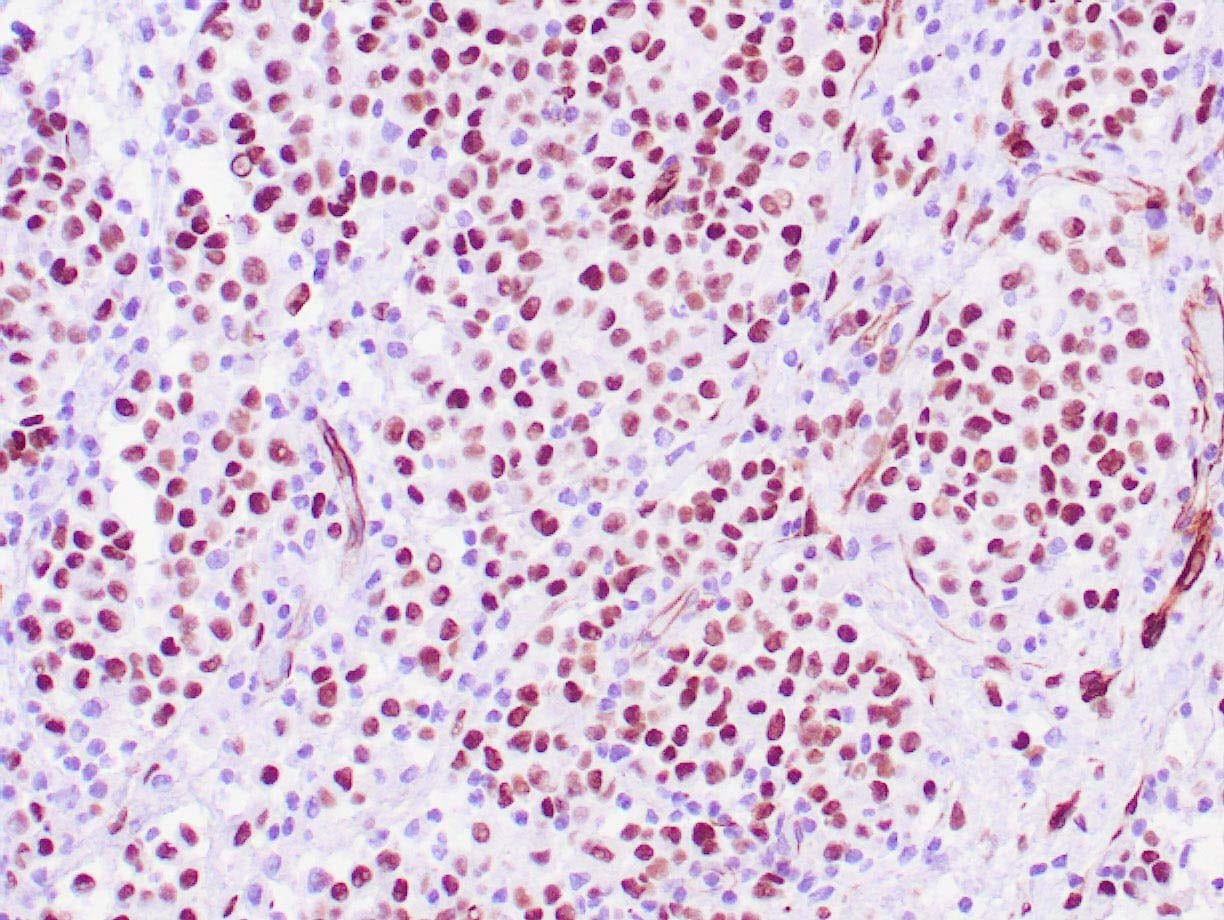 |
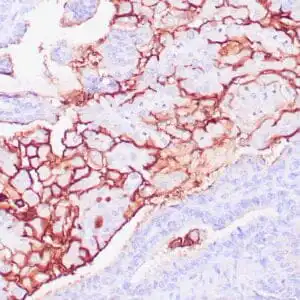
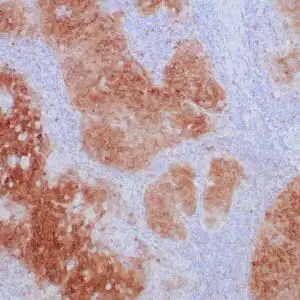
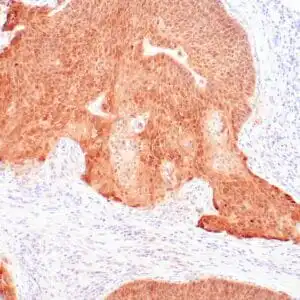
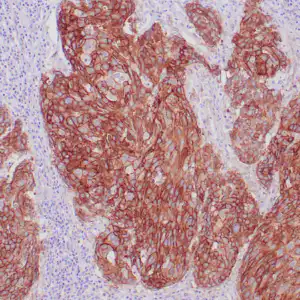
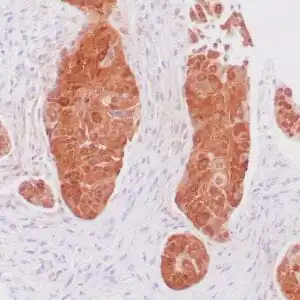
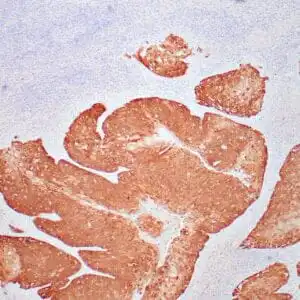
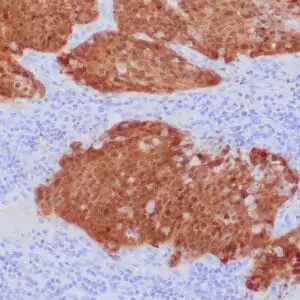
| Human ovarian adenocarcinoma stained with anti-WT-1 antibody using peroxidase-conjugate and DAB chromogen. Note the nuclear staining of tumor cells. |
FAQ & Publications
Frequently Asked Questions
What species does the mouse anti-WT-1 monoclonal antibody (6F-H2) specifically react with?
This antibody specifically reacts with human tissue.
For which application has the mouse anti-WT-1 monoclonal antibody (6F-H2) been validated?
It has been tested and validated for use in immunohistochemistry (IHC) on formalin-fixed, paraffin-embedded tissues.
What are the recommended storage conditions for this WT-1 monoclonal antibody?
For short-term storage, keep the antibody at 2-8°C. For long-term storage, it should be kept at -20°C. Avoid repeated freeze-thaw cycles.
What is the host species and clonality of the anti-WT-1 antibody 6F-H2?
The antibody is a mouse monoclonal antibody of the IgG1 isotype.
What positive control is recommended when using the mouse anti-WT-1 monoclonal antibody in IHC?
Malignant mesothelioma tissue is recommended as a positive control for this antibody in immunohistochemistry assays.
Publications
| pmid | title | authors | citation |
|---|---|---|---|
| We haven't added any publications to our database yet. | |||
Published literature highly relevant to the biological target of this product and referencing this antibody or clone are retrieved from the PubMed database provided by the United States National Library of Medicine at the National Institutes of Health.
Protocols
| relevant to this product |
|---|
| IHC |
Documents
| Batch Number | QC File | SDS |
|---|---|---|
| To view batch-specific Safety Datasheets and Quality Certificates associated with your account, please Log In. | ||
Only logged in customers who have purchased this product may leave a review.
Reviews
There are no reviews yet.