| Weight | 1 lbs |
|---|---|
| Dimensions | 9 × 5 × 2 in |
| host | mouse |
| isotype | IgG1/K |
| clonality | monoclonal |
| concentration | concentrate, predilute |
| applications | IHC |
| reactivity | human |
| available size | 0.1 mL, 0.5 mL, 1 mL concentrated, 7 mL prediluted |

mouse anti-ER monoclonal antibody (ZM319) 6175
Price range: $160.00 through $528.00
Antibody summary
- Mouse monoclonal to ER
- Suitable for: Immunohistochemistry (formalin-fixed, paraffin-embedded tissues)
- Reacts with: Human
- Isotype:IgG1/K
- Control: Breast carcinoma
- Visualization: Nuclear
- 0.1, 0.5, 1.0 mL concentrated, 7 mL prediluted
mouse anti-ER monoclonal antibody ZM319 6175
| target relevance |
|---|
| Homo sapiens ESR1 Estrogen receptor |
| Protein names Estrogen receptor |
| Alternative names ER-alpha, Estradiol receptor, Nuclear receptor subfamily 3 group A member 1 |
| Gene names ESR1 |
| Protein family Belongs to the nuclear hormone receptor family. NR3 subfamily |
| Function Nuclear hormone receptor. The steroid hormones and their receptors are involved in the regulation of eukaryotic gene expression and affect cellular proliferation and differentiation in target tissues. Ligand-dependent nuclear transactivation involves either direct homodimer binding to a palindromic estrogen response element (ERE) sequence or association with other DNA-binding transcription factors, such as AP-1/c-Jun, c-Fos, ATF-2, Sp1 and Sp3, to mediate ERE-independent signaling. Ligand binding induces a conformational change allowing subsequent or combinatorial association with multiprotein coactivator complexes through LXXLL motifs of their respective components. Mutual transrepression occurs between the estrogen receptor (ER) and NF-kappa-B in a cell-type specific manner. Decreases NF-kappa-B DNA-binding activity and inhibits NF-kappa-B-mediated transcription from the IL6 promoter and displace RELA/p65 and associated coregulators from the promoter. Recruited to the NF-kappa-B response element of the CCL2 and IL8 promoters and can displace CREBBP. Present with NF-kappa-B components RELA/p65 and NFKB1/p50 on ERE sequences. Can also act synergistically with NF-kappa-B to activate transcription involving respective recruitment adjacent response elements; the function involves CREBBP. Can activate the transcriptional activity of TFF1. Also mediates membrane-initiated estrogen signaling involving various kinase cascades. Essential for MTA1-mediated transcriptional regulation of BRCA1 and BCAS3 (PubMed:17922032). Maintains neuronal survival in response to ischemic reperfusion injury when in the presence of circulating estradiol (17-beta-estradiol/E2) (By similarity) |
| Subcellular location Nucleus, Golgi apparatus, Cell membrane |
| Structure Probably homodimerizes or heterodimerizes with isoform 1 and ESR2 |
| Post-translational modification Phosphorylated by cyclin A/CDK2 and CK1. Phosphorylation probably enhances transcriptional activity. Self-association induces phosphorylation. Dephosphorylation at Ser-118 by PPP5C inhibits its transactivation activity. Phosphorylated by LMTK3 in vitro Glycosylated; contains N-acetylglucosamine, probably O-linked Ubiquitinated; regulated by LATS1 via DCAF1 it leads to ESR1 proteasomal degradation (PubMed:21602804, PubMed:28068668). Deubiquitinated by OTUB1 (PubMed:19383985). Ubiquitinated by STUB1/CHIP; in the CA1 hippocampal region following loss of endogenous circulating estradiol (17-beta-estradiol/E2) (By similarity). Ubiquitinated by UBR5, leading to its degradation: UBR5 specifically recognizes and binds ligand-bound ESR1 when it is not associated with coactivators (NCOAs) (PubMed:37478846). In presence of NCOAs, the UBR5-degron is not accessible, preventing its ubiquitination and degradation (PubMed:37478846) Dimethylated by PRMT1 at Arg-260. The methylation may favor cytoplasmic localization (PubMed:18657504, PubMed:24498420). Demethylated by JMJD6 at Arg-260 (PubMed:24498420) Palmitoylated (isoform 3). Not biotinylated (isoform 3) Palmitoylated by ZDHHC7 and ZDHHC21. Palmitoylation is required for plasma membrane targeting and for rapid intracellular signaling via ERK and AKT kinases and cAMP generation, but not for signaling mediated by the nuclear hormone receptor |
| Involvement in disease Estrogen resistance A disorder characterized by partial or complete resistance to estrogens, in the presence of elevated estrogen serum levels. Clinical features include absence of the pubertal growth spurt, delayed bone maturation, unfused epiphyses, reduced bone mineral density, osteoporosis, continued growth into adulthood and very tall adult stature. Glucose intolerance, hyperinsulinemia and lipid abnormalities may also be present. |
| Keywords 3D-structure, Activator, Alternative promoter usage, Alternative splicing, Cell membrane, Cytoplasm, Direct protein sequencing, Disease variant, DNA-binding, Glycoprotein, Golgi apparatus, Lipid-binding, Lipoprotein, Membrane, Metal-binding, Methylation, Nucleus, Osteoporosis, Palmitate, Phosphoprotein, Proteomics identification, Receptor, Reference proteome, Steroid-binding, Transcription, Transcription regulation, Transmembrane, Ubl conjugation, Zinc, Zinc-finger |
| Sequence MTMTLHTKASGMALLHQIQGNELEPLNRPQLKIPLERPLGEVYLDSSKPAVYNYPEGAAY EFNAAAAANAQVYGQTGLPYGPGSEAAAFGSNGLGGFPPLNSVSPSPLMLLHPPPQLSPF LQPHGQQVPYYLENEPSGYTVREAGPPAFYRPNSDNRRQGGRERLASTNDKGSMAMESAK ETRYCAVCNDYASGYHYGVWSCEGCKAFFKRSIQGHNDYMCPATNQCTIDKNRRKSCQAC RLRKCYEVGMMKGGIRKDRRGGRMLKHKRQRDDGEGRGEVGSAGDMRAANLWPSPLMIKR SKKNSLALSLTADQMVSALLDAEPPILYSEYDPTRPFSEASMMGLLTNLADRELVHMINW AKRVPGFVDLTLHDQVHLLECAWLEILMIGLVWRSMEHPGKLLFAPNLLLDRNQGKCVEG MVEIFDMLLATSSRFRMMNLQGEEFVCLKSIILLNSGVYTFLSSTLKSLEEKDHIHRVLD KITDTLIHLMAKAGLTLQQQHQRLAQLLLILSHIRHMSNKGMEHLYSMKCKNVVPLYDLL LEMLDAHRLHAPTSRGGASVEETDQSHLATAGSTSSHSLQKYYITGEAEGFPATV |
| UniProt accession: P03372 |
Data
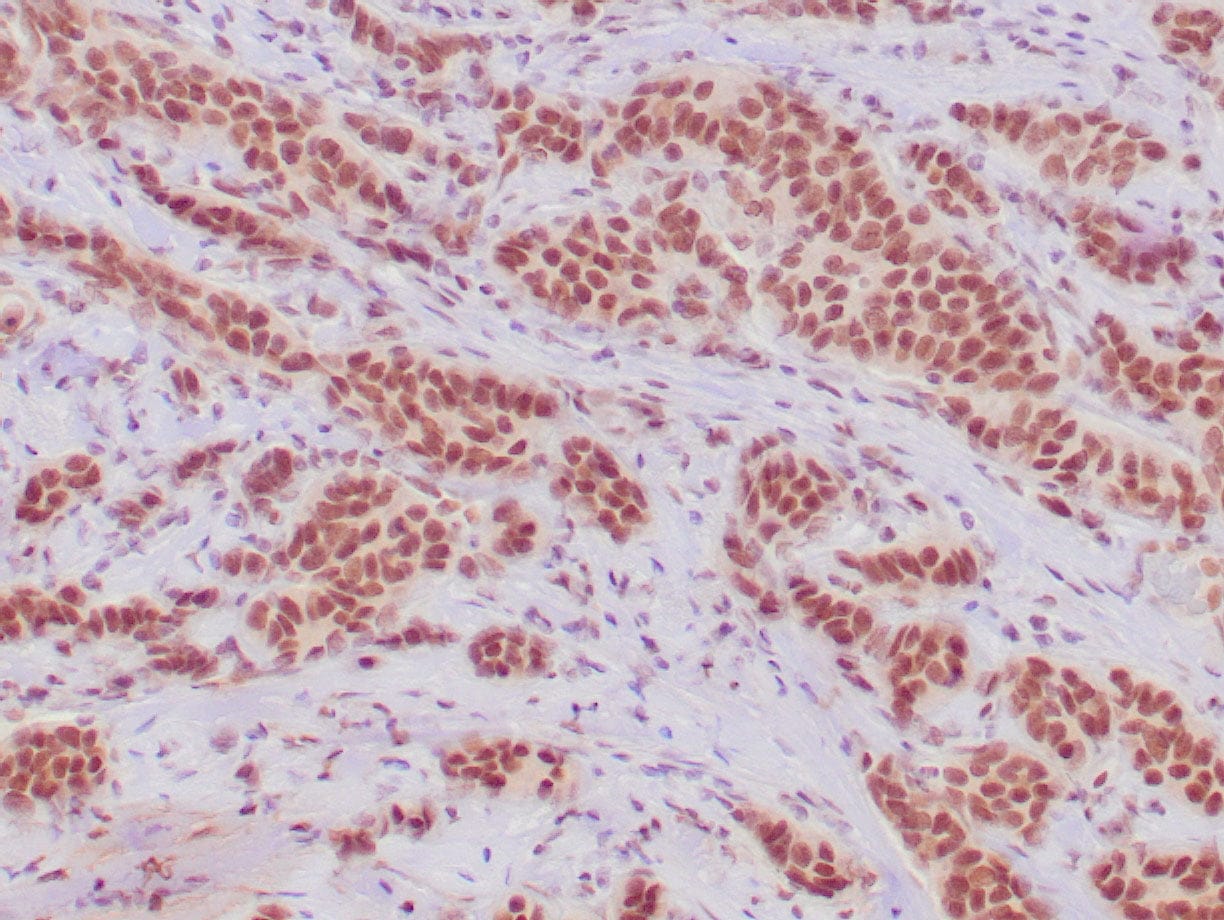 |
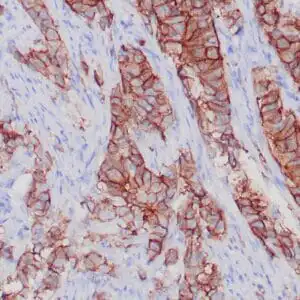
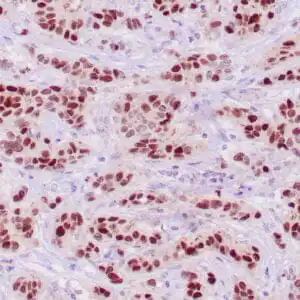
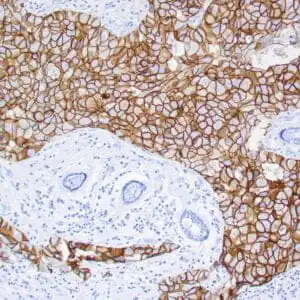
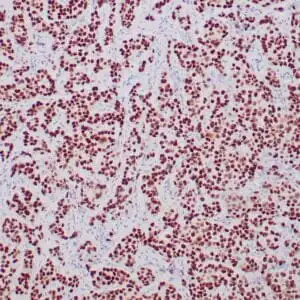
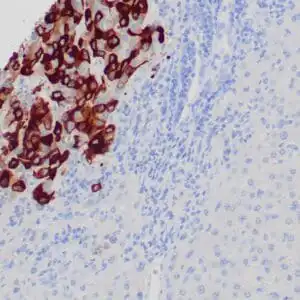
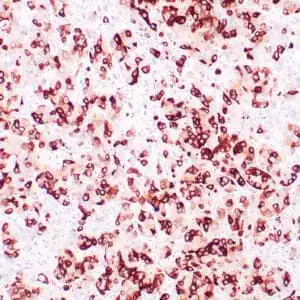
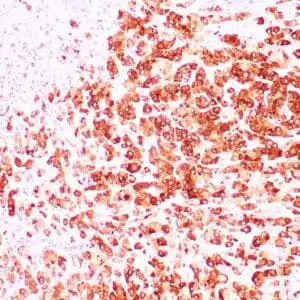
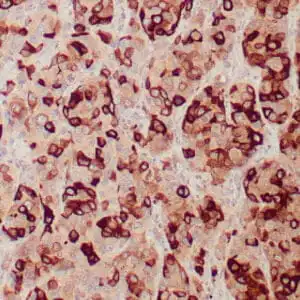
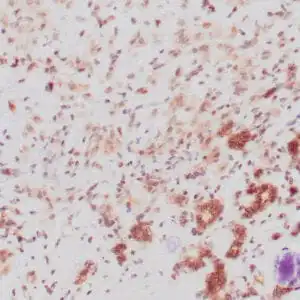
| Human breast adenocarcinoma stained with anti-ER antibody using peroxidase-conjugate and DAB chromogen. Note the strong nuclear staining of tumor cells. |
FAQ & Publications
Frequently Asked Questions
What is the recommended application and dilution for the mouse anti-ER monoclonal antibody ZM319?
This antibody is suitable for immunohistochemistry (IHC) on formalin-fixed, paraffin-embedded human tissue sections, with a recommended dilution of 1:200 when using the concentrated form.
How should the mouse anti-ER monoclonal antibody (ZM319) be stored to maintain its stability?
For short-term storage, keep the antibody at 2-8°C. For long-term preservation, store at -20°C and avoid repeated freeze/thaw cycles to maintain antibody integrity.
Is the mouse anti-ER monoclonal antibody ZM319 reactive with species other than human?
The antibody is reactive specifically with human estrogen receptor (ER) and has been validated for use on human tissues.
Publications
| pmid | title | authors | citation |
|---|---|---|---|
| We haven't added any publications to our database yet. | |||
Published literature highly relevant to the biological target of this product and referencing this antibody or clone are retrieved from the PubMed database provided by the United States National Library of Medicine at the National Institutes of Health.
Protocols
| relevant to this product |
|---|
| IHC |
Documents
| Batch Number | QC File | SDS |
|---|---|---|
| To view batch-specific Safety Datasheets and Quality Certificates associated with your account, please Log In. | ||
Only logged in customers who have purchased this product may leave a review.
Reviews
There are no reviews yet.