| Weight | 1 lbs |
|---|---|
| Dimensions | 9 × 5 × 2 in |
| host | mouse |
| isotype | IgG |
| clonality | monoclonal |
| concentration | concentrate, predilute |
| applications | IHC |
| reactivity | human |
| available size | 0.1 mL, 0.5 mL, 1 mL concentrated, 7 mL prediluted |

rabbit anti-PR monoclonal antibody (ZR4) 6434
Price range: $160.00 through $528.00
Antibody summary
- Rabbit monoclonal to PR
- Suitable for: Immunohistochemistry (formalin-fixed, paraffin-embedded tissues)
- Reacts with: Human
- Isotype:IgG
- Control: Breast carcinomas
- Visualization: Nuclear
- 0.1, 0.5, 1.0 mL concentrated, 7 mL prediluted
rabbit anti-PR monoclonal antibody ZR4 6434
| target relevance |
|---|
| Homo sapiens PGR Progesterone receptor |
| Protein names Progesterone receptor |
| Alternative names Nuclear receptor subfamily 3 group C member 3 |
| Gene names PGR |
| Protein family Belongs to the nuclear hormone receptor family. NR3 subfamily |
| Function The steroid hormones and their receptors are involved in the regulation of eukaryotic gene expression and affect cellular proliferation and differentiation in target tissues. Depending on the isoform, progesterone receptor functions as a transcriptional activator or repressor |
| Subcellular location Mitochondrion outer membrane |
| Structure Interacts with SMARD1 and UNC45A. Interacts with CUEDC2; the interaction promotes ubiquitination, decreases sumoylation, and represses transcriptional activity. Interacts with PIAS3; the interaction promotes sumoylation of PR in a hormone-dependent manner, inhibits DNA-binding, and alters nuclear export. Interacts with SP1; the interaction requires ligand-induced phosphorylation on Ser-345 by ERK1/2 MAPK. Interacts with PRMT2. Isoform A interacts with NCOR2. Isoform B (but not isoform A) interacts with NCOA2 and NCOA1. Isoform B (but not isoform A) interacts with KLF9. Interacts with GTF2B (PubMed:1517211) |
| Post-translational modification Phosphorylated on multiple serine sites. Several of these sites are hormone-dependent. Phosphorylation on Ser-294 occurs preferentially on isoform B, is highly hormone-dependent and modulates ubiquitination and sumoylation on Lys-388. Phosphorylation on Ser-102 and Ser-345 also requires induction by hormone. Basal phosphorylation on Ser-81, Ser-162, Ser-190 and Ser-400 is increased in response to progesterone and can be phosphorylated in vitro by the CDK2-A1 complex. Increased levels of phosphorylation on Ser-400 also in the presence of EGF, heregulin, IGF, PMA and FBS. Phosphorylation at this site by CDK2 is ligand-independent, and increases nuclear translocation and transcriptional activity. Phosphorylation at Ser-162 and Ser-294, but not at Ser-190, is impaired during the G(2)/M phase of the cell cycle. Phosphorylation on Ser-345 by ERK1/2 MAPK is required for interaction with SP1 Sumoylation is hormone-dependent and represses transcriptional activity. Sumoylation on all three sites is enhanced by PIAS3. Desumoylated by SENP1. Sumoylation on Lys-388, the main site of sumoylation, is repressed by ubiquitination on the same site, and modulated by phosphorylation at Ser-294 Ubiquitination is hormone-dependent and represses sumoylation on the same site (PubMed:10628747, PubMed:10655479, PubMed:15798179, PubMed:17173941, PubMed:17717077, PubMed:18202149, PubMed:8702648). Promoted by MAPK-mediated phosphorylation on Ser-294 (PubMed:10628747, PubMed:10655479, PubMed:15798179, PubMed:17173941, PubMed:17717077, PubMed:18202149, PubMed:8702648). Ubiquitinated by UBR5, leading to its degradation: UBR5 specifically recognizes and binds ligand-bound PGR when it is not associated with coactivators (NCOAs) (PubMed:37478846). In presence of NCOAs, the UBR5-degron is not accessible, preventing its ubiquitination and degradation (PubMed:37478846) Palmitoylated by ZDHHC7 and ZDHHC21. Palmitoylation is required for plasma membrane targeting and for rapid intracellular signaling via ERK and AKT kinases and cAMP generation |
| Keywords 3D-structure, Alternative promoter usage, Alternative splicing, Cytoplasm, Direct protein sequencing, DNA-binding, Isopeptide bond, Lipid-binding, Lipoprotein, Membrane, Metal-binding, Mitochondrion, Mitochondrion outer membrane, Nucleus, Palmitate, Phosphoprotein, Proteomics identification, Receptor, Reference proteome, Steroid-binding, Transcription, Transcription regulation, Ubl conjugation, Zinc, Zinc-finger |
| Sequence MTELKAKGPRAPHVAGGPPSPEVGSPLLCRPAAGPFPGSQTSDTLPEVSAIPISLDGLLF PRPCQGQDPSDEKTQDQQSLSDVEGAYSRAEATRGAGGSSSSPPEKDSGLLDSVLDTLLA PSGPGQSQPSPPACEVTSSWCLFGPELPEDPPAAPATQRVLSPLMSRSGCKVGDSSGTAA AHKVLPRGLSPARQLLLPASESPHWSGAPVKPSPQAAAVEVEEEDGSESEESAGPLLKGK PRALGGAAAGGGAAAVPPGAAAGGVALVPKEDSRFSAPRVALVEQDAPMAPGRSPLATTV MDFIHVPILPLNHALLAARTRQLLEDESYDGGAGAASAFAPPRSSPCASSTPVAVGDFPD CAYPPDAEPKDDAYPLYSDFQPPALKIKEEEEGAEASARSPRSYLVAGANPAAFPDFPLG PPPPLPPRATPSRPGEAAVTAAPASASVSSASSSGSTLECILYKAEGAPPQQGPFAPPPC KAPGASGCLLPRDGLPSTSASAAAAGAAPALYPALGLNGLPQLGYQAAVLKEGLPQVYPP YLNYLRPDSEASQSPQYSFESLPQKICLICGDEASGCHYGVLTCGSCKVFFKRAMEGQHN YLCAGRNDCIVDKIRRKNCPACRLRKCCQAGMVLGGRKFKKFNKVRVVRALDAVALPQPV GVPNESQALSQRFTFSPGQDIQLIPPLINLLMSIEPDVIYAGHDNTKPDTSSSLLTSLNQ LGERQLLSVVKWSKSLPGFRNLHIDDQITLIQYSWMSLMVFGLGWRSYKHVSGQMLYFAP DLILNEQRMKESSFYSLCLTMWQIPQEFVKLQVSQEEFLCMKVLLLLNTIPLEGLRSQTQ FEEMRSSYIRELIKAIGLRQKGVVSSSQRFYQLTKLLDNLHDLVKQLHLYCLNTFIQSRA LSVEFPEMMSEVIAAQLPKILAGMVKPLLFHKK |
| UniProt accession: P06401 |
Data
 |
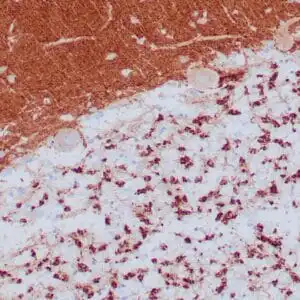
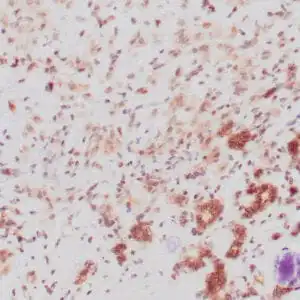
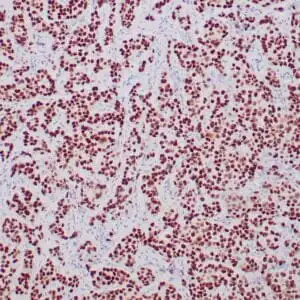
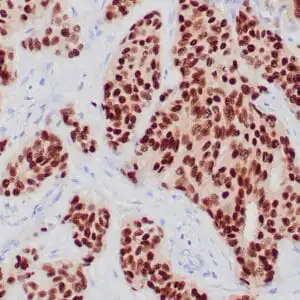
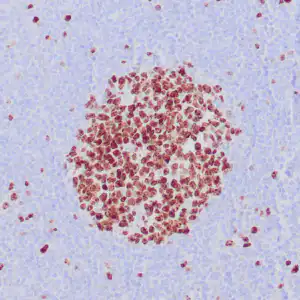
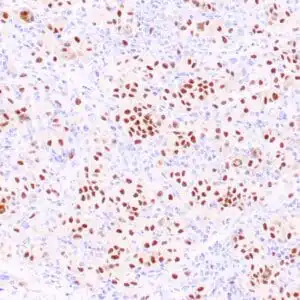
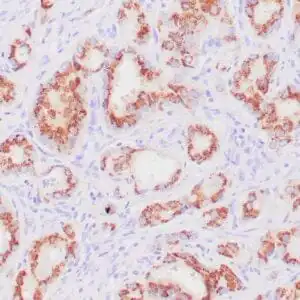
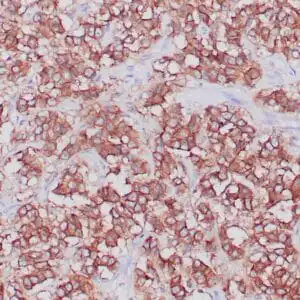
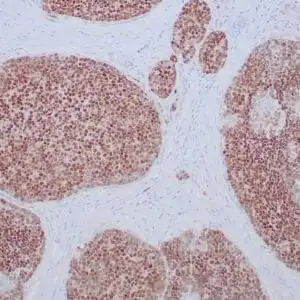
| Human breast carcinoma stained with anti-PR antibody using peroxidase-conjugate and DAB chromogen. Note the nuclear staining of tumor cells. |
FAQ & Publications
Frequently Asked Questions
What species does the rabbit anti-PR monoclonal antibody (ZR4) 6434 react with?
This antibody is reactive with human tissues, making it suitable for studies involving human samples.
What are the recommended storage conditions for the rabbit anti-PR monoclonal antibody (ZR4) 6434?
For short-term storage, keep the antibody at 2-8°C. For long-term storage, it should be stored at -20°C, and freeze/thaw cycles should be avoided to maintain antibody integrity.
Which application and sample type is the rabbit anti-PR monoclonal antibody (ZR4) 6434 validated for?
This antibody is validated for immunohistochemistry (IHC) using formalin-fixed, paraffin-embedded human tissue sections, particularly breast carcinomas.
Publications
| pmid | title | authors | citation |
|---|---|---|---|
| We haven't added any publications to our database yet. | |||
Published literature highly relevant to the biological target of this product and referencing this antibody or clone are retrieved from the PubMed database provided by the United States National Library of Medicine at the National Institutes of Health.
Protocols
| relevant to this product |
|---|
| IHC |
Documents
| Batch Number | QC File | SDS |
|---|---|---|
| To view batch-specific Safety Datasheets and Quality Certificates associated with your account, please Log In. | ||
Only logged in customers who have purchased this product may leave a review.

Reviews
There are no reviews yet.