| Weight | 1 lbs |
|---|---|
| Dimensions | 9 × 5 × 2 in |
| host | mouse |
| isotype | IgG |
| clonality | monoclonal |
| concentration | concentrate, predilute |
| applications | IHC |
| reactivity | human |
| available size | 0.1 mL, 0.5 mL, 1 mL concentrated, 7 mL prediluted |

rabbit anti-TRPS1 monoclonal antibody (ZR382) 6394
Price range: $160.00 through $528.00
Antibody summary
- Rabbit monoclonal to TRPS1
- Suitable for: Immunohistochemistry (formalin-fixed, paraffin-embedded tissues)
- Reacts with: Human
- Isotype:IgG
- Control: Normal breast or breast carcinoma
- Visualization: Nucleus
- 0.1, 0.5, 1.0 mL concentrated, 7 mL prediluted
rabbit anti-TRPS1 monoclonal antibody ZR382 6394
| antibody |
|---|
| Database link: human Q9UHF7 |
| Tested applications IHC |
| Recommended dilutions Concentrated 1:100-200 |
| Application Notes Positive control: Normal breast or breast carcinoma |
| Immunogen Synthesized peptide corresponding to the C-terminus of human TRPS1 protein |
| Size and concentration 7 mL prediluted or 0.1, 0.5, 1.0 mL and concentrated |
| Form liquid |
| Storage Instructions 2-8°C for short term, for longer term at -20°C. Avoid freeze / thaw cycles. |
| Purity affinity purified |
| Clonality monoclonal |
| Isotype IgG |
| Compatible secondaries goat anti-rabbit IgG, H&L chain specific, peroxidase conjugated, conjugated polyclonal antibody 9512 goat anti-rabbit IgG, H&L chain specific, biotin conjugated polyclonal antibody 2079 goat anti-rabbit IgG, H&L chain specific, FITC conjugated polyclonal antibody 7863 goat anti-rabbit IgG, H&L chain specific, Cross Absorbed polyclonal antibody 2371 goat anti-rabbit IgG, H&L chain specific, biotin conjugated polyclonal antibody, crossabsorbed 1715 goat anti-rabbit IgG, H&L chain specific, FITC conjugated polyclonal antibody, crossabsorbed 1720 |
| Isotype control Rabbit polyclonal - Isotype Control |
| target relevance |
|---|
| Homo sapiens TRPS1 Zinc finger transcription factor Trps1 |
| Protein names Zinc finger transcription factor Trps1 |
| Alternative names Tricho-rhino-phalangeal syndrome type I protein, Zinc finger protein GC79 |
| Gene names TRPS1 |
| Function Transcriptional repressor. Binds specifically to GATA sequences and represses expression of GATA-regulated genes at selected sites and stages in vertebrate development. Regulates chondrocyte proliferation and differentiation. Executes multiple functions in proliferating chondrocytes, expanding the region of distal chondrocytes, activating proliferation in columnar cells and supporting the differentiation of columnar into hypertrophic chondrocytes |
| Subcellular location Nucleus |
| Structure Interacts with RNF4; regulates TRPS1 repressor activity. Interacts specifically with the activator form of GLI3 (GLI3A) but not with the repressor form (GLI3R) |
| Post-translational modification Sumoylated. Sumoylation in the repressor domain inhibits the transcription repression activity. Sumoylation on Lys-1201 is the major site. Appears to be sumoylated on multiple sites |
| Involvement in disease Tricho-rhino-phalangeal syndrome 1 Autosomal dominant disorder characterized by craniofacial and skeletal abnormalities. It is allelic with tricho-rhino-phalangeal type 3. Typical features include sparse scalp hair, a bulbous tip of the nose, protruding ears, a long flat philtrum and a thin upper vermilion border. Skeletal defects include cone-shaped epiphyses at the phalanges, hip malformations and short stature. Tricho-rhino-phalangeal syndrome 2 A syndrome that combines the clinical features of tricho-rhino-phalangeal syndrome type 1 and multiple exostoses type 1. Affected individuals manifest multiple dysmorphic facial features including large, laterally protruding ears, a bulbous nose, an elongated upper lip, as well as sparse scalp hair, winged scapulae, multiple cartilaginous exostoses, redundant skin, and intellectual disability. Tricho-rhino-phalangeal syndrome 3 Autosomal dominant disorder characterized by craniofacial and skeletal abnormalities. It is allelic with tricho-rhino-phalangeal type 1. In TRPS3 a more severe brachydactyly and growth retardation are observed. |
| Keywords Alternative splicing, Disease variant, DNA-binding, Isopeptide bond, Metal-binding, Nucleus, Phosphoprotein, Proteomics identification, Reference proteome, Repeat, Repressor, Transcription, Transcription regulation, Ubl conjugation, Zinc, Zinc-finger |
| Sequence MVRKKNPPLRNVASEGEGQILEPIGTESKVSGKNKEFSADQMSENTDQSDAAELNHKEEH SLHVQDPSSSSKKDLKSAVLSEKAGFNYESPSKGGNFPSFPHDEVTDRNMLAFSSPAAGG VCEPLKSPQRAEADDPQDMACTPSGDSLETKEDQKMSPKATEETGQAQSGQANCQGLSPV SVASKNPQVPSDGGVRLNKSKTDLLVNDNPDPAPLSPELQDFKCNICGYGYYGNDPTDLI KHFRKYHLGLHNRTRQDAELDSKILALHNMVQFSHSKDFQKVNRSVFSGVLQDINSSRPV LLNGTYDVQVTSGGTFIGIGRKTPDCQGNTKYFRCKFCNFTYMGNSSTELEQHFLQTHPN KIKASLPSSEVAKPSEKNSNKSIPALQSSDSGDLGKWQDKITVKAGDDTPVGYSVPIKPL DSSRQNGTEATSYYWCKFCSFSCESSSSLKLLEHYGKQHGAVQSGGLNPELNDKLSRGSV INQNDLAKSSEGETMTKTDKSSSGAKKKDFSSKGAEDNMVTSYNCQFCDFRYSKSHGPDV IVVGPLLRHYQQLHNIHKCTIKHCPFCPRGLCSPEKHLGEITYPFACRKSNCSHCALLLL HLSPGAAGSSRVKHQCHQCSFTTPDVDVLLFHYESVHESQASDVKQEANHLQGSDGQQSV KESKEHSCTKCDFITQVEEEISRHYRRAHSCYKCRQCSFTAADTQSLLEHFNTVHCQEQD ITTANGEEDGHAISTIKEEPKIDFRVYNLLTPDSKMGEPVSESVVKREKLEEKDGLKEKV WTESSSDDLRNVTWRGADILRGSPSYTQASLGLLTPVSGTQEQTKTLRDSPNVEAAHLAR PIYGLAVETKGFLQGAPAGGEKSGALPQQYPASGENKSKDESQSLLRRRRGSGVFCANCL TTKTSLWRKNANGGYVCNACGLYQKLHSTPRPLNIIKQNNGEQIIRRRTRKRLNPEALQA EQLNKQQRGSNEEQVNGSPLERRSEDHLTESHQREIPLPSLSKYEAQGSLTKSHSAQQPV LVSQTLDIHKRMQPLHIQIKSPQESTGDPGNSSSVSEGKGSSERGSPIEKYMRPAKHPNY SPPGSPIEKYQYPLFGLPFVHNDFQSEADWLRFWSKYKLSVPGNPHYLSHVPGLPNPCQN YVPYPTFNLPPHFSAVGSDNDIPLDLAIKHSRPGPTANGASKEKTKAPPNVKNEGPLNVV KTEKVDRSTQDELSTKCVHCGIVFLDEVMYALHMSCHGDSGPFQCSICQHLCTDKYDFTT HIQRGLHRNNAQVEKNGKPKE |
| UniProt accession: Q9UHF7 |
Data
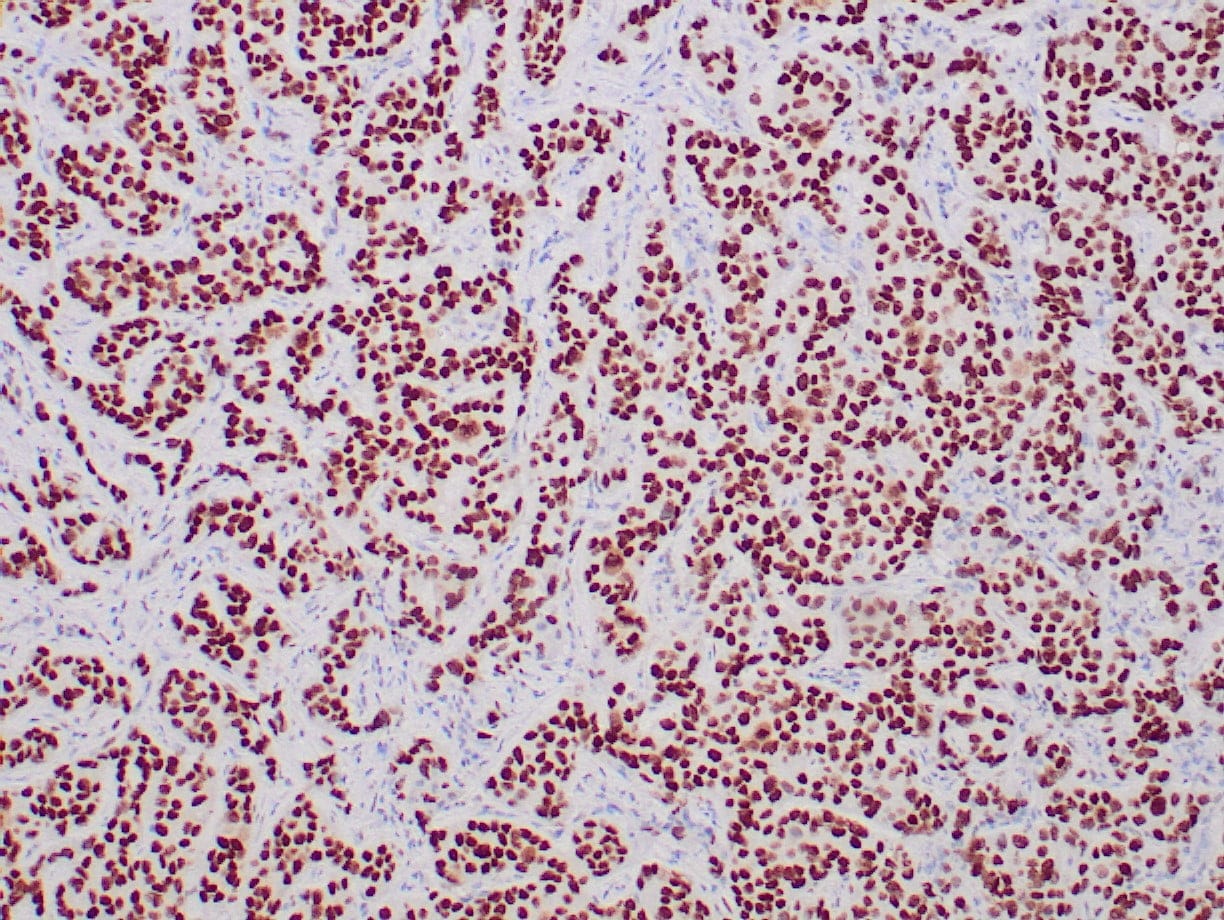 |
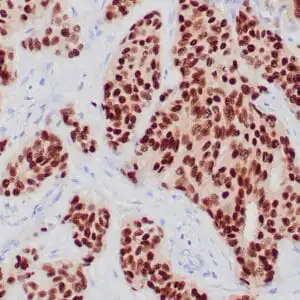
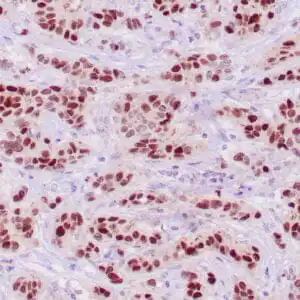
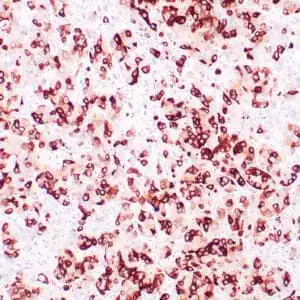
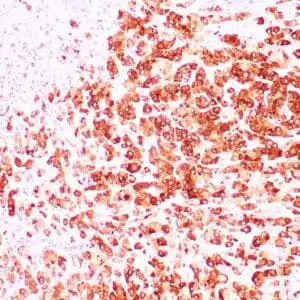
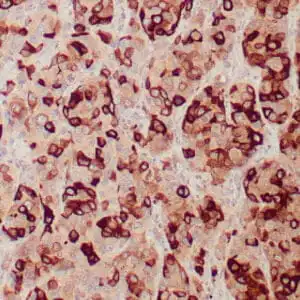
| Formalin-fixed, paraffin-embedded human breast carcinoma stained with anti-TRPS1 antibody using peroxidase-conjugate and DAB chromogen. Note the nuclear staining of tumor cells |
FAQ & Publications
Frequently Asked Questions
What is the recommended dilution for using the rabbit anti-TRPS1 monoclonal antibody (ZR382) in immunohistochemistry?
For immunohistochemistry applications, the concentrated rabbit anti-TRPS1 monoclonal antibody (ZR382) is recommended to be diluted between 1:100 and 1:200.
How should the rabbit anti-TRPS1 monoclonal antibody (ZR382) be stored to maintain its stability?
The antibody should be stored at 2-8°C for short-term use and at -20°C for long-term storage. It is important to avoid freeze/thaw cycles to preserve antibody integrity.
Publications
| pmid | title | authors | citation |
|---|---|---|---|
| We haven't added any publications to our database yet. | |||
Published literature highly relevant to the biological target of this product and referencing this antibody or clone are retrieved from the PubMed database provided by the United States National Library of Medicine at the National Institutes of Health.
Protocols
| relevant to this product |
|---|
| IHC |
Documents
| Batch Number | QC File | SDS |
|---|---|---|
| To view batch-specific Safety Datasheets and Quality Certificates associated with your account, please Log In. | ||
Only logged in customers who have purchased this product may leave a review.

Reviews
There are no reviews yet.