| Weight | 1 lbs |
|---|---|
| Dimensions | 9 × 5 × 2 in |
| host | mouse |
| isotype | IgG1 |
| clonality | monoclonal |
| concentration | concentrate, predilute |
| applications | IHC |
| reactivity | human |
| available size | 0.1 mL, 0.5 mL, 1 mL concentrated, 7 mL prediluted |

mouse anti-ALDH1A1 monoclonal antibody (ZM71) 6015
Price range: $160.00 through $528.00
Antibody summary
- Mouse monoclonal to ALDH1A1
- Suitable for: Immunohistochemistry (formalin-fixed, paraffin-embedded tissues)
- Reacts with: Human
- Isotype:IgG1
- Control: Solitary fibrous tumor
- Visualization: Cytoplasmic and nuclear
- 0.1, 0.5, 1.0 mL concentrated, 7 mL prediluted
mouse anti-ALDH1A1 monoclonal antibody ZM71 6015
| target relevance |
|---|
| Homo sapiens ALDH1A1 Aldehyde dehydrogenase 1A1 |
| Protein names Aldehyde dehydrogenase 1A1 |
| Alternative names 3-deoxyglucosone dehydrogenase, ALDH-E1, ALHDII, Aldehyde dehydrogenase family 1 member A1, Aldehyde dehydrogenase, cytosolic, Retinal dehydrogenase 1 |
| Gene names ALDH1A1 |
| Protein family Belongs to the aldehyde dehydrogenase family |
| Function Cytosolic dehydrogenase that catalyzes the irreversible oxidation of a wide range of aldehydes to their corresponding carboxylic acid (PubMed:12941160, PubMed:15623782, PubMed:17175089, PubMed:19296407, PubMed:25450233, PubMed:26373694). Functions downstream of retinol dehydrogenases and catalyzes the oxidation of retinaldehyde into retinoic acid, the second step in the oxidation of retinol/vitamin A into retinoic acid (By similarity). This pathway is crucial to control the levels of retinol and retinoic acid, two important molecules which excess can be teratogenic and cytotoxic (By similarity). Also oxidizes aldehydes resulting from lipid peroxidation like (E)-4-hydroxynon-2-enal/HNE, malonaldehyde and hexanal that form protein adducts and are highly cytotoxic. By participating for instance to the clearance of (E)-4-hydroxynon-2-enal/HNE in the lens epithelium prevents the formation of HNE-protein adducts and lens opacification (PubMed:12941160, PubMed:15623782, PubMed:19296407). Also functions downstream of fructosamine-3-kinase in the fructosamine degradation pathway by catalyzing the oxidation of 3-deoxyglucosone, the carbohydrate product of fructosamine 3-phosphate decomposition, which is itself a potent glycating agent that may react with lysine and arginine side-chains of proteins (PubMed:17175089). Also has an aminobutyraldehyde dehydrogenase activity and is probably part of an alternative pathway for the biosynthesis of GABA/4-aminobutanoate in midbrain, thereby playing a role in GABAergic synaptic transmission (By similarity) |
| Catalytic activity an aldehyde + NAD(+) + H2O = a carboxylate + NADH + 2 H(+) all-trans-retinal + NAD(+) + H2O = all-trans-retinoate + NADH + 2 H(+) 9-cis-retinal + NAD(+) + H2O = 9-cis-retinoate + NADH + 2 H(+) 11-cis-retinal + NAD(+) + H2O = 11-cis-retinoate + NADH + 2 H(+) 13-cis-retinal + NAD(+) + H2O = 13-cis-retinoate + NADH + 2 H(+) 3-deoxyglucosone + NAD(+) + H2O = 2-dehydro-3-deoxy-D-gluconate + NADH + 2 H(+) (E)-4-hydroxynon-2-enal + NAD(+) + H2O = (E)-4-hydroxynon-2-enoate + NADH + 2 H(+) malonaldehyde + NAD(+) + H2O = 3-oxopropanoate + NADH + 2 H(+) hexanal + NAD(+) + H2O = hexanoate + NADH + 2 H(+) propanal + NAD(+) + H2O = propanoate + NADH + 2 H(+) acetaldehyde + NAD(+) + H2O = acetate + NADH + 2 H(+) benzaldehyde + NAD(+) + H2O = benzoate + NADH + 2 H(+) 4-aminobutanal + NAD(+) + H2O = 4-aminobutanoate + NADH + 2 H(+) |
| Subcellular location Cytoplasm, cytosol, Cell projection, axon |
| Structure Homotetramer (By similarity). Interacts with PRMT3; the interaction is direct, inhibits ALDH1A1 aldehyde dehydrogenase activity and is independent of the methyltransferase activity of PRMT3 (PubMed:33495566) |
| Post-translational modification The N-terminus is blocked most probably by acetylation |
| Keywords 3D-structure, Acetylation, Cell projection, Cytoplasm, Direct protein sequencing, Lipid metabolism, NAD, Nucleotide-binding, Oxidoreductase, Phosphoprotein, Proteomics identification, Reference proteome |
| Sequence MSSSGTPDLPVLLTDLKIQYTKIFINNEWHDSVSGKKFPVFNPATEEELCQVEEGDKEDV DKAVKAARQAFQIGSPWRTMDASERGRLLYKLADLIERDRLLLATMESMNGGKLYSNAYL NDLAGCIKTLRYCAGWADKIQGRTIPIDGNFFTYTRHEPIGVCGQIIPWNFPLVMLIWKI GPALSCGNTVVVKPAEQTPLTALHVASLIKEAGFPPGVVNIVPGYGPTAGAAISSHMDID KVAFTGSTEVGKLIKEAAGKSNLKRVTLELGGKSPCIVLADADLDNAVEFAHHGVFYHQG QCCIAASRIFVEESIYDEFVRRSVERAKKYILGNPLTPGVTQGPQIDKEQYDKILDLIES GKKEGAKLECGGGPWGNKGYFVQPTVFSNVTDEMRIAKEEIFGPVQQIMKFKSLDDVIKR ANNTFYGLSAGVFTKDIDKAITISSALQAGTVWVNCYGVVSAQCPFGGFKMSGNGRELGE YGFHEYTEVKTVTVKISQKNS |
| UniProt accession: P00352 |
Data
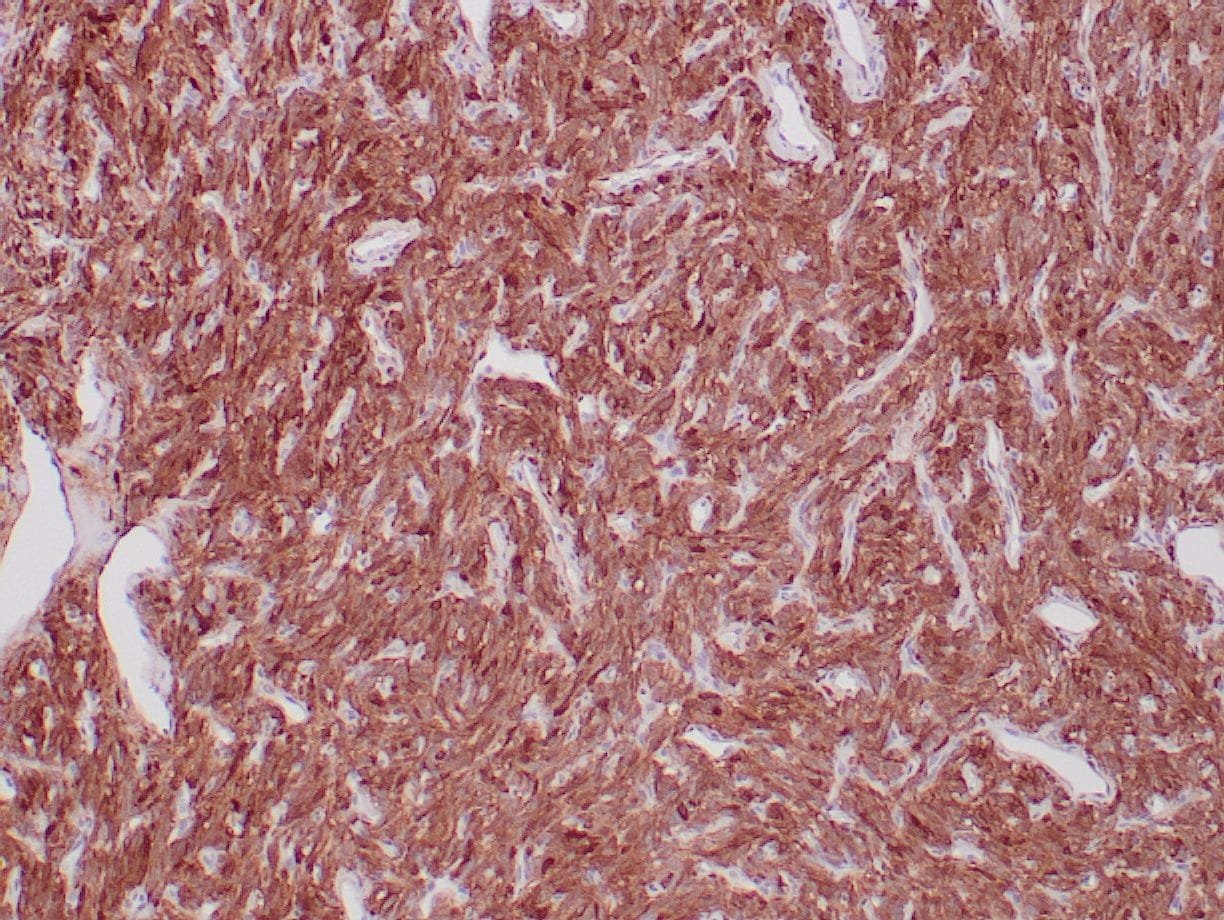 |
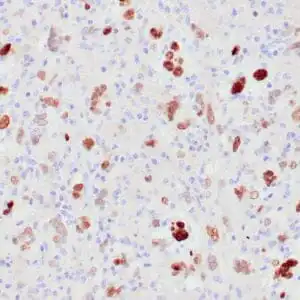
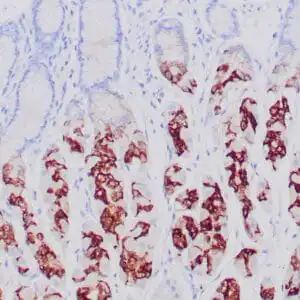
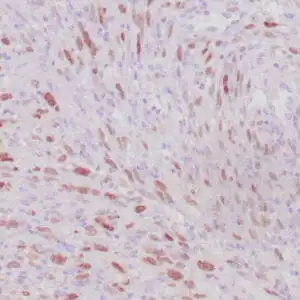
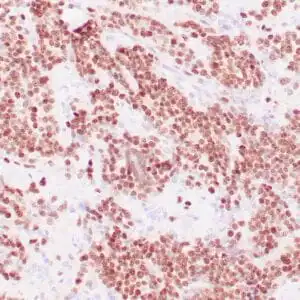
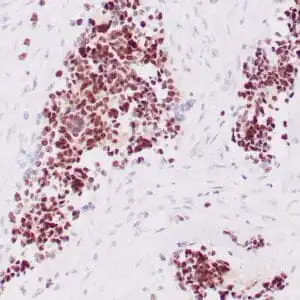
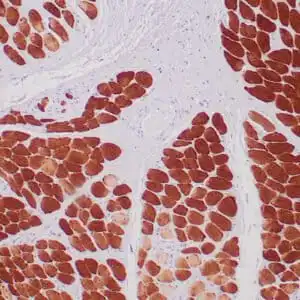
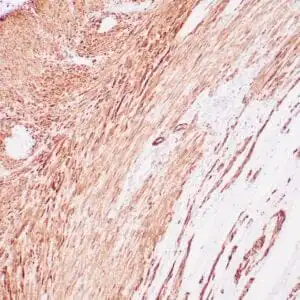
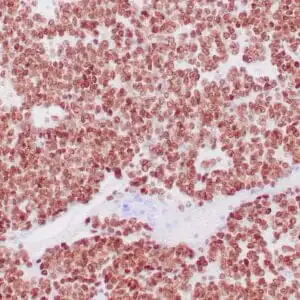
| Formalin-fixed, paraffin-embedded human solitary fibrous tumor stained with anti-ALDH1A1 monoclonal antibody using peroxidase-conjugate and DAB chromogen. Note the cytoplasmic/nuclear staining of tumor cells |
FAQ & Publications
Frequently Asked Questions
What species does the mouse anti-ALDH1A1 monoclonal antibody (ZM71) specifically react with?
This antibody is reactive with human tissues.
What are the recommended storage conditions for the mouse anti-ALDH1A1 monoclonal antibody to maintain stability?
For short-term storage, keep the antibody at 2-8°C. For long-term storage, it should be stored at -20°C, and freeze/thaw cycles should be avoided.
Which applications and sample types has this antibody been validated for?
The mouse anti-ALDH1A1 monoclonal antibody (ZM71) is suitable for immunohistochemistry (IHC) on formalin-fixed, paraffin-embedded human tissue samples.
Publications
| pmid | title | authors | citation |
|---|---|---|---|
| We haven't added any publications to our database yet. | |||
Published literature highly relevant to the biological target of this product and referencing this antibody or clone are retrieved from the PubMed database provided by the United States National Library of Medicine at the National Institutes of Health.
Protocols
| relevant to this product |
|---|
| IHC |
Documents
| Batch Number | QC File | SDS |
|---|---|---|
| To view batch-specific Safety Datasheets and Quality Certificates associated with your account, please Log In. | ||
Only logged in customers who have purchased this product may leave a review.

Reviews
There are no reviews yet.