| Weight | 1 lbs |
|---|---|
| Dimensions | 9 × 5 × 2 in |
| target | gastroplexVirus |
| species reactivity | For the detection of Norovirus (Genogroup I & II), Adenovirus, Rotavirus |
| applications | RT PCR |
| assay type | direct & qualitative |
| available sizes | 96 tests |

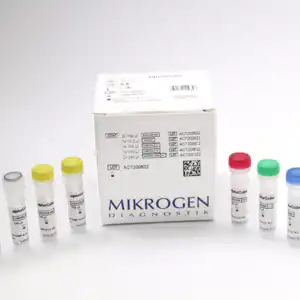
gastroplexVirus RT-PCR test Mikrogen 830501
$487.00
Summary
- Mikrogen diagnostik RT PCR kit for research use (RUO)
- Direct Adenovirus, Norovirus, Rotavirus detection
- High sensitivity and specificity
- Internal control for monitoring nucleic acid extraction
(RNA/DNA) and real-time PCR inhibition in each reaction - Compatible with most common real-time PCR cyclers & RNA/DNA extraction methods
- 96 tests
gastroplexVirus RT-PCR test Mikrogen 830501
| kit | |||||||||||||||
|---|---|---|---|---|---|---|---|---|---|---|---|---|---|---|---|
| Assay type RT PCR | |||||||||||||||
| Research area Infectious Disease | |||||||||||||||
| Sample type whole blood, serum, plasma, urine, tissue, stool, etc., food and environmental samples or from the carrier material | |||||||||||||||
Notes
| |||||||||||||||
Components
| |||||||||||||||
| Storage Store at -20°C. | |||||||||||||||
| Additional information Highly sensitive and specific direct detection of pathogens that can cause tick-borne infections
Applicable to human starting material as well as RNA/DNA from the tick |
| target relevance |
|---|
| Adenovirus |
| Description Virus that causes respiratory, ocular, and gastrointestinal infections |
| Structure Adenoviruses are non-enveloped, double-stranded DNA viruses belonging to the family Adenoviridae. The viral genome is enclosed within an icosahedral capsid composed of hexon and penton proteins, with characteristic fiber proteins projecting from the vertices that mediate attachment to host cells. Adenoviruses are highly stable in the environment and resistant to many physical and chemical agents, allowing transmission through respiratory droplets, direct contact, contaminated surfaces, and fecal-oral routes. More than 100 adenovirus types have been identified, with numerous species capable of infecting humans. Adenoviruses primarily infect epithelial cells of the respiratory tract, gastrointestinal tract, urinary tract, and conjunctiva, and certain serotypes can establish persistent infections in lymphoid tissues. |
| Diagnosis The diagnosis of adenovirus infection is performed through the detection of viral DNA, viral antigens, or adenovirus-specific antibodies. Polymerase chain reaction (PCR) assays are the most sensitive and specific diagnostic methods and are widely used for the detection and typing of adenoviruses from respiratory secretions, stool samples, conjunctival swabs, blood, and other clinical specimens. Antigen detection assays and viral culture may also be used in selected clinical settings. Serological methods, including ELISA, can be employed to detect adenovirus-specific antibodies and assess previous exposure or immune responses. Laboratory confirmation is particularly important in immunocompromised patients, transplant recipients, and individuals with severe or disseminated disease. |
| Symptoms Adenovirus infections can produce a broad range of clinical manifestations depending on the infecting serotype and the affected organ system. Respiratory infections commonly present with fever, sore throat, cough, nasal congestion, and pharyngitis and may progress to bronchitis or pneumonia. Ocular infections can cause conjunctivitis or epidemic keratoconjunctivitis characterized by eye redness, irritation, tearing, and photophobia. Gastrointestinal infections may result in diarrhea, vomiting, abdominal pain, and fever, particularly in young children. Although most infections are self-limiting, severe disease may occur in infants, elderly individuals, and immunocompromised patients, where adenovirus can cause disseminated infection involving multiple organ systems. |
Data
| No results found |
FAQ & Publications
Frequently Asked Questions
What pathogens can the gastroplexVirus RT-PCR test Mikrogen 830501 detect?
This test allows for the direct detection of Norovirus (Genogroup I & II), Adenovirus, and Rotavirus.
Which sample types are compatible with this RT-PCR assay?
The assay can be used with whole blood, serum, plasma, urine, tissue, stool, as well as food, environmental samples, or carrier material.
Is the gastroplexVirus RT-PCR test compatible with common real-time PCR cyclers?
Yes, it is validated or compatible with several real-time PCR cyclers including Roche LightCycler 480 Instrument II, Roche cobas z 480 Analyzer, Qiagen Rotor-Gene Q, Bio-Rad CFX 96, Applied Biosystems QuantStudio 5 Dx, and Stratagene Mx3000P.
How should the gastroplexVirus RT-PCR test kit be stored to maintain stability?
The kit components should be stored at -20°C to ensure reagent stability.
Does the test include internal controls for quality assurance during nucleic acid extraction and PCR?
Yes, each reaction contains an internal control to monitor nucleic acid extraction (RNA/DNA) and to detect any real-time PCR inhibition.
Publications
| pmid | title | authors | citation |
|---|---|---|---|
| We haven't added any publications to our database yet. | |||
Published literature highly relevant to the biological target of this product and referencing this antibody or clone are retrieved from the PubMed database provided by the United States National Library of Medicine at the National Institutes of Health.
Protocols
| relevant to this product |
|---|
| This product has moved to a digital protocol. Please use the URL provided on the product packaging to access the electronic Instructions for Use (eIFU). 830501 protocol |
Only logged in customers who have purchased this product may leave a review.
Reviews
There are no reviews yet.