| Weight | 1 lbs |
|---|---|
| Dimensions | 9 × 5 × 2 in |
| target | FLAG-Tag (DYKDDDDK-Tag Protein) |
| species reactivity | universal |
| applications | competition (cELISA) |
| assay type | direct & quantitative |
| available size | 96 tests |
| sensitivity | 9.375 ng/ml |
| range | 15.625–1000 ng/ml |
FLAG-Tag (DYKDDDDK-Tag Protein) ELISA Kit 60811
$570.00
Summary
- ELISA kit for research use (RUO)
- Reactivity: DYKDDDDK-tag (FLAG)
- Suitable for: ELISA
- Time:3 hours
- Sample types: Serum, plasma, tissue homogenates and other biological fluids
FLAG-Tag (DYKDDDDK-Tag Protein) ELISA Kit
| kit | ||||||||||||||||||||||
|---|---|---|---|---|---|---|---|---|---|---|---|---|---|---|---|---|---|---|---|---|---|---|
| Assay type competition (cELISA) | ||||||||||||||||||||||
| Research area host cell protein | ||||||||||||||||||||||
| Sample type Serum, plasma, tissue homogenates and other biological fluids | ||||||||||||||||||||||
Components
| ||||||||||||||||||||||
| Storage Store at 2-8°C. |
| target relevance |
|---|
| DDDDK |
| Protein names FLAG tag |
| Alternative names FLAG tag, FLAG epitope, DYKDDDDK tag, DYDDDDK tag, FLAG peptide |
| Function The FLAG tag serves as an affinity and detection tag that can be fused to recombinant proteins. It is recognized by anti-FLAG antibodies and affinity reagents for purification, immunoprecipitation, western blotting, immunofluorescence, flow cytometry, and ELISA. |
| Description The FLAG tag is a short artificial peptide epitope widely used in recombinant protein expression, purification, detection, and localization studies. The canonical FLAG sequence is DYKDDDDK. |
| Biological role Recombinant protein detection Affinity purification Immunoprecipitation Protein localization studies |
| Research relevance FLAG-tagged proteins are extensively used in molecular biology and protein expression systems because the tag is small, highly immunogenic, and generally does not interfere with protein folding or function. |
| Keywords Epitope tag, Protein purification, Protein detection, Recombinant protein |
| Structure The FLAG tag is a synthetic peptide epitope with the canonical amino acid sequence DYKDDDDK. |
| Function FLAG serves as a molecular tag for detection, purification, and characterization of recombinant proteins. |
| Detection FLAG-tagged proteins are commonly detected using anti-FLAG antibodies such as M1 and M2 clones in western blotting, ELISA, immunofluorescence, and immunoprecipitation assays. |
| Purification FLAG affinity resins and magnetic beads enable rapid purification of FLAG-tagged proteins under native or denaturing conditions. |
| Research relevance The FLAG tag is one of the most widely used epitope tags in molecular biology, biotechnology, and recombinant protein production. |
Data
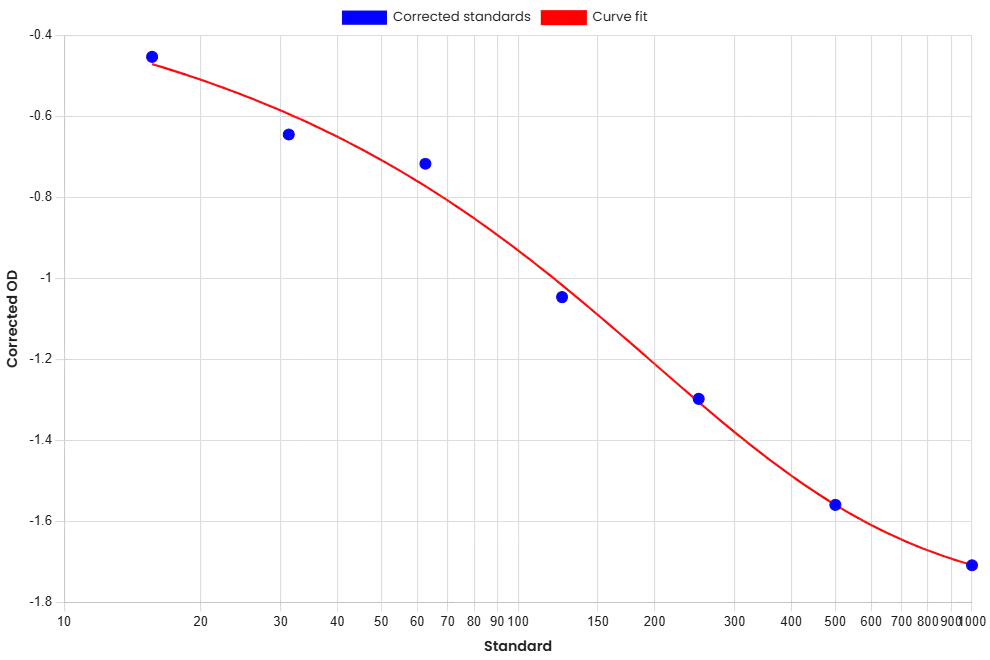
Standard Curve
X axis: log |
Y axis: linear
| Standard | STD [ng/mL] | OD1 | OD2 | Average OD | Corrected OD |
|---|---|---|---|---|---|
| Blank #8 | 0 | 2.28 | 2.39 | 2.34 | 0 |
| Standard #7 | 15.63 | 1.84 | 1.93 | 1.88 | -0.45 |
| Standard #6 | 31.25 | 1.65 | 1.73 | 1.69 | -0.65 |
| Standard #5 | 62.5 | 1.58 | 1.66 | 1.62 | -0.72 |
| Standard #4 | 125 | 1.26 | 1.32 | 1.29 | -1.05 |
| Standard #3 | 250 | 1.01 | 1.07 | 1.04 | -1.3 |
| Standard #2 | 500 | 0.76 | 0.8 | 0.78 | -1.56 |
| Standard #1 | 1000 | 0.61 | 0.64 | 0.63 | -1.71 |
Precision
| Sample | n | Mean | Standard Deviation | CV (%) |
|---|---|---|---|---|
| Intra Sample 1 | 20 | 30.63 | 1.38 | 4.51 |
| Inter Sample 1 | 20 | 31.16 | 1.4 | 4.48 |
| Intra Sample 2 | 20 | 121.9 | 6.02 | 4.94 |
| Inter Sample 2 | 20 | 125.3 | 6.01 | 4.8 |
| Intra Sample 3 | 20 | 518 | 25.23 | 4.87 |
| Inter Sample 3 | 20 | 523 | 23.22 | 4.44 |
Recovery
| Matrix | Recovery Range (%) | Average (%) |
|---|---|---|
| Cell Culture Lysate(n=5) | 85-105 | 95 |
Stability
| 37°C 1 Month (%) | 2–8°C 6 Months (%) | 2–8°C 12 Months (%) |
|---|---|---|
| 80 | 95-100 | 85-98 |
Linearity
| Sample | 1:2 Dilution (%) | 1:4 Dilution (%) | 1:8 Dilution (%) |
|---|---|---|---|
| Cell Culture Lysate(n=5) | 82-98% | 84-101% | 90-98% |
FAQ & Publications
Publications
| pmid | title | authors | citation |
|---|---|---|---|
| We haven't added any publications to our database yet. | |||
Published literature highly relevant to the biological target of this product and referencing this antibody or clone are retrieved from the PubMed database provided by the United States National Library of Medicine at the National Institutes of Health.
Protocols
| Relevant to this product |
|---|
| View Protocol | View PDF |
Documents
| # | ||
|---|---|---|
| Please enter your product and batch number here. | ||
Only logged in customers who have purchased this product may leave a review.









Reviews
There are no reviews yet.