| Weight | 1 lbs |
|---|---|
| Dimensions | 9 × 5 × 2 in |
| host | rabbit |
| isotype | IgG |
| clonality | polyclonal |
| concentration | 1 mg/mL |
| applications | ELISA, ICC/IF, WB |
| reactivity | VSV-G |
| available sizes | 100 µg |

rabbit anti-VSV-G polyclonal antibody 1440
$426.00
Antibody summary
- Rabbit polyclonal to VSV-G
- Suitable for: ELISA,ICC,IHC,WB
- Isotype: IgG
- 100 µg
rabbit anti-VSV-G polyclonal antibody 1440
| antibody |
|---|
| Tested applications WB,ICC/IF,ELISA,IP |
| Recommended dilutions Immunoblotting: use at a dilution of 1:1,000- 1:20,000. Immunocytochemistry: use at a dilution of 1:100-1:400. Immunoprecipitation: use 1-4ug/mg lysate. ELISA: for detection use at a dilution of 1:1,000-1:30,000 These are recommended dilutions. Endusers shoul |
| Immunogen Synthetic peptide YTDIEMNRLGK conjugated to KLH. |
| Size and concentration 100, 1000µg and 1 mg/mL |
| Form liquid |
| Storage Instructions This antibody is stable for at least one (1) year at 2-8°C. |
| Storage buffer PBS, pH 7.2, 0.09% NaN3. |
| Purity peptide affinity purification |
| Clonality polyclonal |
| Isotype IgG |
| Compatible secondaries goat anti-rabbit IgG, H&L chain specific, peroxidase conjugated, conjugated polyclonal antibody 9512 goat anti-rabbit IgG, H&L chain specific, biotin conjugated polyclonal antibody 2079 goat anti-rabbit IgG, H&L chain specific, FITC conjugated polyclonal antibody 7863 goat anti-rabbit IgG, H&L chain specific, Cross Absorbed polyclonal antibody 2371 goat anti-rabbit IgG, H&L chain specific, biotin conjugated polyclonal antibody, crossabsorbed 1715 goat anti-rabbit IgG, H&L chain specific, FITC conjugated polyclonal antibody, crossabsorbed 1720 |
| Isotype control Rabbit polyclonal - Isotype Control |
| target relevance |
|---|
| VSV-G tag |
| Protein names VSV-G epitope tag |
| Alternative names VSV-G tag, VSV epitope, Vesicular stomatitis virus glycoprotein tag, YTDIEMNRLGK tag |
| Function The VSV-G tag is an artificial peptide epitope used for detection and characterization of recombinant proteins using anti-VSV-G antibodies. |
| Description The VSV-G tag is a peptide epitope derived from the glycoprotein G of Vesicular stomatitis virus (VSV). It is commonly used as a recombinant protein tag for detection, localization, and characterization of fusion proteins. |
| Keywords Epitope tag, Protein detection, Immunoprecipitation, Protein localization, Recombinant protein |
| Sequence YTDIEMNRLGK |
| Structure The VSV-G tag is an 11-amino acid peptide epitope with the sequence YTDIEMNRLGK derived from the vesicular stomatitis virus glycoprotein G. |
| Function The VSV-G tag is used as a molecular epitope tag for detection, immunoprecipitation, purification, and localization of recombinant proteins. |
| Detection VSV-G-tagged proteins can be detected using anti-VSV-G monoclonal antibodies in western blotting, ELISA, immunofluorescence, immunocytochemistry, flow cytometry, and immunoprecipitation assays. |
| Applications The VSV-G tag is typically fused to recombinant proteins at the N- or C-terminus to facilitate detection while minimizing effects on protein function. |
| Research relevance The VSV-G tag is a well-established recombinant protein tag and is commonly used alongside FLAG, HA, Myc, V5, and His tags in molecular biology and biotechnology. |
Data
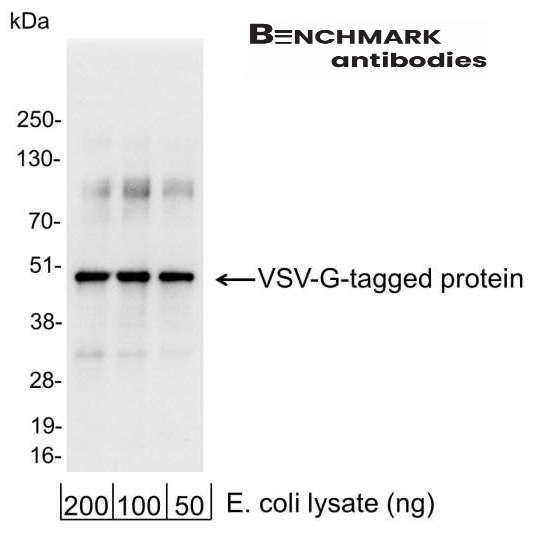 |
| Detection of VSV-G-tagged Protein by western blot. Samples: 200, 100, or 50 ng of E. coli whole cell lysate expressing a multi-tag fusion protein. Antibodies: Affinity purified, rabbit anti-VSV-G antibody 1440 used for WB at 0.04 µg /ml (1:25,000). Detection: Chemiluminescence with an exposure time of 3 seconds. |
|
| Detection of VSV-G-tagged Protein by western blot. Samples: 200, 100, or 50 ng of E. coli whole cell lysate expressing a multi-tag fusion protein. Antibodies: Affinity purified, rabbit anti-VSV-G antibody 1440 used for WB at 0.04 µg /ml (1:25,000). Detection: Chemiluminescence with an exposure time of 3 seconds. |
FAQ & Publications
Frequently Asked Questions
What applications is the rabbit anti-VSV-G polyclonal antibody 1440 validated for?
This antibody is validated for use in ELISA, immunocytochemistry (ICC/IF), immunohistochemistry (IHC), Western blotting (WB), and immunoprecipitation (IP).
How should the rabbit anti-VSV-G antibody 1440 be stored to maintain stability?
The antibody should be stored at 2-8°C, where it remains stable for at least one year. It is supplied in PBS buffer at pH 7.2 with 0.09% sodium azide (NaN3) as a preservative.
What is the recommended dilution for using this antibody in Western blotting?
For immunoblotting, the recommended dilution range is 1:1,000 to 1:20,000, with an example usage at 0.04 µg/mL (1:25,000) demonstrated for detection by chemiluminescence.
What is the immunogen used to generate the rabbit anti-VSV-G polyclonal antibody 1440?
The immunogen is a synthetic peptide with the sequence YTDIEMNRLGK conjugated to keyhole limpet hemocyanin (KLH).
Publications
| pmid | title | authors | citation |
|---|---|---|---|
| We haven't added any publications to our database yet. | |||
Published literature highly relevant to the biological target of this product and referencing this antibody or clone are retrieved from the PubMed database provided by the United States National Library of Medicine at the National Institutes of Health.
Protocols
| relevant to this product |
|---|
| Western blot IHC ICC |
Documents
| Batch Number | QC File | SDS |
|---|---|---|
| To view batch-specific Safety Datasheets and Quality Certificates associated with your account, please Log In. | ||
Only logged in customers who have purchased this product may leave a review.


Reviews
There are no reviews yet.