| Weight | 1 lbs |
|---|---|
| Dimensions | 9 × 5 × 2 in |
| host | rabbit |
| isotype | IgG |
| clonality | polyclonal |
| concentration | 1 mg/mL |
| applications | ICC/IF, WB |
| reactivity | RAIDD (CT) |
| available sizes | 100 µg |


rabbit anti-Raidd (CT) polyclonal antibody 8020
$445.00
Antibody summary
- Rabbit polyclonal to Raidd (CT)
- Suitable for: ELISA,WB,IHC-P,ICC,IF
- Isotype: IgG
- 100 µg
rabbit anti-Raidd (CT) polyclonal antibody 8020
| antibody |
|---|
| Tested applications WB,IHC,IHC,ICC/IF,ELISA |
| Recommended dilutions Immunoblotting : use at 1ug/mL. Positive control: HeLa cell lysate. Immunohistochemistry: use at 10ug/mL. These are recommended concentrations. Enduser should determine optimal concentrations for ther applications. |
| Immunogen Synthetic peptide corresponding to aa 181-199 at the C-terminus of human RAIDD (accession no. AAB42217). |
| Size and concentration 100µg and lot specific |
| Form liquid |
| Storage Instructions This antibody is stable for at least one (1) year at -20°C. Avoid multiple freeze-thaw cycles. |
| Storage buffer PBS, pH 7.4. |
| Purity peptide affinity purification |
| Clonality polyclonal |
| Isotype IgG |
| Compatible secondaries goat anti-rabbit IgG, H&L chain specific, peroxidase conjugated, conjugated polyclonal antibody 9512 goat anti-rabbit IgG, H&L chain specific, biotin conjugated polyclonal antibody 2079 goat anti-rabbit IgG, H&L chain specific, FITC conjugated polyclonal antibody 7863 goat anti-rabbit IgG, H&L chain specific, Cross Absorbed polyclonal antibody 2371 goat anti-rabbit IgG, H&L chain specific, biotin conjugated polyclonal antibody, crossabsorbed 1715 goat anti-rabbit IgG, H&L chain specific, FITC conjugated polyclonal antibody, crossabsorbed 1720 |
| Isotype control Rabbit polyclonal - Isotype Control |
| target relevance |
|---|
| Protein names Death domain-containing protein CRADD (Caspase and RIP adapter with death domain) (RIP-associated protein with a death domain) |
| Gene names CRADD,CRADD RAIDD |
| Mass 22745Da |
| Function FUNCTION: Adapter protein that associates with PIDD1 and the caspase CASP2 to form the PIDDosome, a complex that activates CASP2 and triggers apoptosis (PubMed:15073321, PubMed:16652156, PubMed:17159900, PubMed:17289572, PubMed:9044836). Also recruits CASP2 to the TNFR-1 signaling complex through its interaction with RIPK1 and TRADD and may play a role in the tumor necrosis factor-mediated signaling pathway (PubMed:8985253). {ECO:0000269|PubMed:15073321, ECO:0000269|PubMed:16652156, ECO:0000269|PubMed:17159900, ECO:0000269|PubMed:17289572, ECO:0000269|PubMed:8985253, ECO:0000269|PubMed:9044836}. |
| Subellular location SUBCELLULAR LOCATION: Cytoplasm {ECO:0000250|UniProtKB:O88843}. Nucleus {ECO:0000250|UniProtKB:O88843}. |
| Tissues TISSUE SPECIFICITY: Constitutively expressed in most tissues, with particularly high expression in adult heart, testis, liver, skeletal muscle, fetal liver and kidney. {ECO:0000269|PubMed:8985253, ECO:0000269|PubMed:9044836}. |
| Structure SUBUNIT: Forms a complex named the PIDDosome with PIDD1 and CASP2 (PubMed:15073321, PubMed:16652156, PubMed:17159900, PubMed:17289572, PubMed:8985253, PubMed:9044836). Interacts (via Death domain) with RIPK1 (via Death domain); the interaction is direct (PubMed:9044836). Interacts with TRADD (PubMed:8985253). Interacts with TNFRSF1A (PubMed:8985253). {ECO:0000269|PubMed:15073321, ECO:0000269|PubMed:16652156, ECO:0000269|PubMed:17159900, ECO:0000269|PubMed:17289572, ECO:0000269|PubMed:8985253, ECO:0000269|PubMed:9044836}. |
| Domain DOMAIN: The Death domain mediates the interaction with PIDD1 and the formation of a complex composed of 5 PIDD1 and 7 CRADD proteins which in turn probably recruit 7 CASP2 to form the PIDDosome (PubMed:17289572). The Death domain mediates a direct interaction with the Death domain of RIPK1 (PubMed:9044836). {ECO:0000269|PubMed:17289572, ECO:0000269|PubMed:9044836}.; DOMAIN: The CARD domain mediates a direct interaction with CASP2. {ECO:0000269|PubMed:8985253, ECO:0000269|PubMed:9044836}. |
| Involvement in disease DISEASE: Intellectual developmental disorder, autosomal recessive 34, with variant lissencephaly (MRT34) [MIM:614499]: A disorder characterized by mild to moderate intellectual disability, megalencephaly or enlarged head circumference, and a mild variant of lissencephaly with anterior-predominant pachygyria with shallow and unusually wide sulci and mildly thickened cortex. Some patients may have seizures. {ECO:0000269|PubMed:22279524}. Note=The disease is caused by variants affecting the gene represented in this entry. |
| Target Relevance information above includes information from UniProt accession: P78560 |
| The UniProt Consortium |
Data
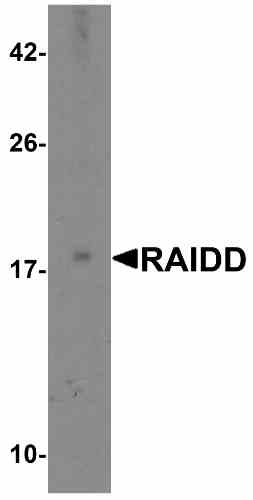 |
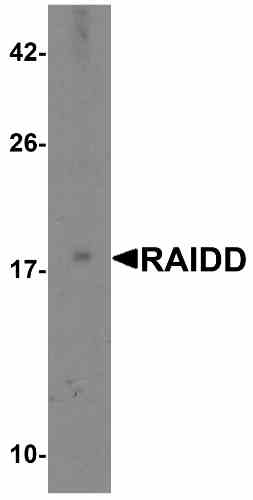
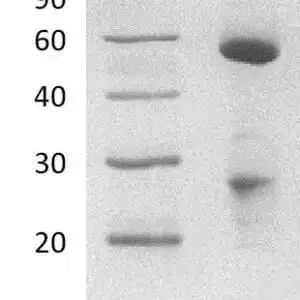
| Western blot analysis of RAIDD in MCF7 total cell lysate with RAIDD antibody at 2 µg/mL. |
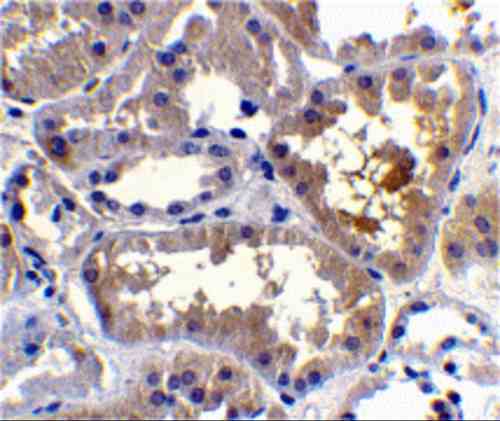 |
| Immunohistochemistry of RAIDD in human kidney tissue with RAIDD antibody at 10 µg/mL. |
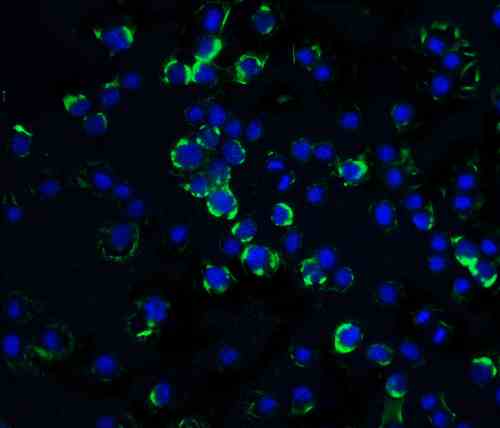 |
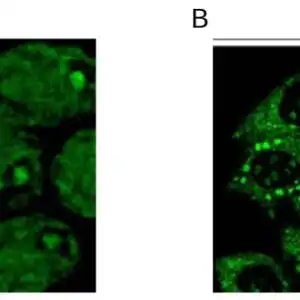
| Immunofluorescence of RAIDD in Hela cells with RAIDD antibody at 20 µg/mL.
Green: RAIDD Antibody (8020) Blue: DAPI staining |
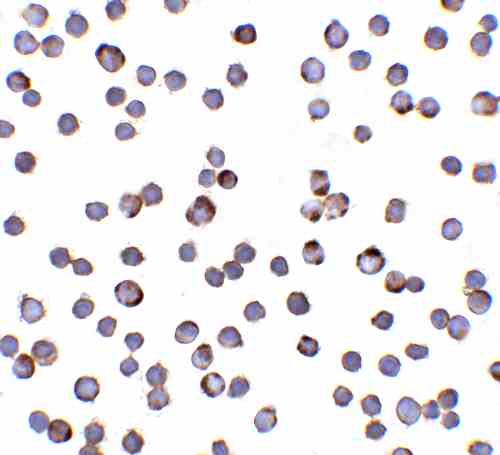 |
| Immunocytochemistry of RAIDD in Hela cells with RAIDD antibody at 10 µg/mL. |
FAQ & Publications
Frequently Asked Questions
What applications has the rabbit anti-Raidd (CT) polyclonal antibody 8020 been validated for?
This antibody has been validated for use in ELISA, Western blotting (WB), immunohistochemistry on paraffin-embedded tissues (IHC-P), immunocytochemistry (ICC), and immunofluorescence (IF). Recommended dilutions are 1 µg/mL for Western blot and 10 µg/mL for immunohistochemistry.
How should the rabbit anti-Raidd (CT) antibody 8020 be stored to maintain stability?
The antibody should be stored at -20°C and is stable for at least one year under these conditions. It is important to avoid multiple freeze-thaw cycles to preserve antibody integrity.
What is the immunogen used to generate the rabbit anti-Raidd (CT) polyclonal antibody 8020?
The immunogen is a synthetic peptide corresponding to amino acids 181-199 at the C-terminus of human RAIDD (accession number AAB42217).
Publications
| pmid | title | authors | citation |
|---|---|---|---|
| We haven't added any publications to our database yet. | |||
Published literature highly relevant to the biological target of this product and referencing this antibody or clone are retrieved from the PubMed database provided by the United States National Library of Medicine at the National Institutes of Health.
Protocols
| relevant to this product |
|---|
| Western blot IHC ICC |
Documents
| Batch Number | QC File | SDS |
|---|---|---|
| To view batch-specific Safety Datasheets and Quality Certificates associated with your account, please Log In. | ||
Only logged in customers who have purchased this product may leave a review.


Reviews
There are no reviews yet.