| Weight | 1 lbs |
|---|---|
| Dimensions | 9 × 5 × 2 in |
| host | rabbit |
| isotype | IgG |
| clonality | polyclonal |
| concentration | 1 mg/mL |
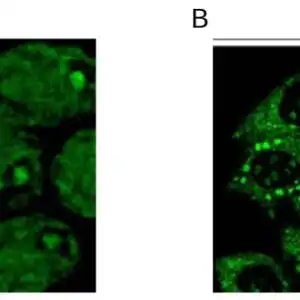
| applications | ICC/IF, WB |
| reactivity | NFkB-p105 (Phospho-Ser337) |
| available sizes | 100 µL |

rabbit anti-NFkB-p105 (Phospho-Ser337) polyclonal antibody 5539
$366.00
Antibody summary
- Rabbit polyclonal to NFkB-p105 (Phospho-Ser337)
- Suitable for: WB,IHC,IF
- Isotype: Whole IgG
- 100 µl
rabbit anti-NFkB-p105 (Phospho-Ser337) polyclonal antibody 5539
| antibody |
|---|
| Tested applications WB,IHC,IHC,ICC/IF |
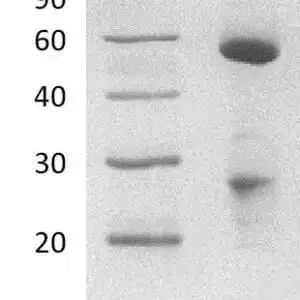
| Recommended dilutions Western blotting: use at dilution of 1:500. Bands of ~50kDa and ~120kDa are detected. Immunohistochemistry: use at dilution of 1:50-1:100. Immunofluorescence: use at dilution of 1:100-1:200 These are recommended working dilutions. End user should determine optimal dil |
| Immunogen Peptide sequence that includes phosphorylation site of Serine 337 (R-K-S(p)-D-L) derived from human NFkappaB-p105/p50 and conjugated to KLH. |
| Size and concentration 100µL and 1 mg/mL |
| Form liquid |
| Storage Instructions This antibody is stable for at least one (1) year at -20°C. |
| Storage buffer PBS (without Mg2 and Ca2 ), pH 7.4, 150mM NaCl, |
| Purity affinity purified |
| Clonality polyclonal |
| Isotype IgG |
| Compatible secondaries goat anti-rabbit IgG, H&L chain specific, peroxidase conjugated, conjugated polyclonal antibody 9512 goat anti-rabbit IgG, H&L chain specific, biotin conjugated polyclonal antibody 2079 goat anti-rabbit IgG, H&L chain specific, FITC conjugated polyclonal antibody 7863 goat anti-rabbit IgG, H&L chain specific, Cross Absorbed polyclonal antibody 2371 goat anti-rabbit IgG, H&L chain specific, biotin conjugated polyclonal antibody, crossabsorbed 1715 goat anti-rabbit IgG, H&L chain specific, FITC conjugated polyclonal antibody, crossabsorbed 1720 |
| Isotype control Rabbit polyclonal - Isotype Control |
| target relevance |
|---|
| Protein names Nuclear factor NF-kappa-B p105 subunit (DNA-binding factor KBF1) (EBP-1) (Nuclear factor of kappa light polypeptide gene enhancer in B-cells 1) [Cleaved into: Nuclear factor NF-kappa-B p50 subunit] |
| Gene names NFKB1,NFKB1 |
| Mass 105356Da |
| Function FUNCTION: NF-kappa-B is a pleiotropic transcription factor present in almost all cell types and is the endpoint of a series of signal transduction events that are initiated by a vast array of stimuli related to many biological processes such as inflammation, immunity, differentiation, cell growth, tumorigenesis and apoptosis. NF-kappa-B is a homo- or heterodimeric complex formed by the Rel-like domain-containing proteins RELA/p65, RELB, NFKB1/p105, NFKB1/p50, REL and NFKB2/p52 and the heterodimeric p65-p50 complex appears to be most abundant one. The dimers bind at kappa-B sites in the DNA of their target genes and the individual dimers have distinct preferences for different kappa-B sites that they can bind with distinguishable affinity and specificity. Different dimer combinations act as transcriptional activators or repressors, respectively. NF-kappa-B is controlled by various mechanisms of post-translational modification and subcellular compartmentalization as well as by interactions with other cofactors or corepressors. NF-kappa-B complexes are held in the cytoplasm in an inactive state complexed with members of the NF-kappa-B inhibitor (I-kappa-B) family. In a conventional activation pathway, I-kappa-B is phosphorylated by I-kappa-B kinases (IKKs) in response to different activators, subsequently degraded thus liberating the active NF-kappa-B complex which translocates to the nucleus. NF-kappa-B heterodimeric p65-p50 and RelB-p50 complexes are transcriptional activators. The NF-kappa-B p50-p50 homodimer is a transcriptional repressor, but can act as a transcriptional activator when associated with BCL3. NFKB1 appears to have dual functions such as cytoplasmic retention of attached NF-kappa-B proteins by p105 and generation of p50 by a cotranslational processing. The proteasome-mediated process ensures the production of both p50 and p105 and preserves their independent function, although processing of NFKB1/p105 also appears to occur post-translationally. p50 binds to the kappa-B consensus sequence 5'-GGRNNYYCC-3', located in the enhancer region of genes involved in immune response and acute phase reactions. In a complex with MAP3K8, NFKB1/p105 represses MAP3K8-induced MAPK signaling; active MAP3K8 is released by proteasome-dependent degradation of NFKB1/p105. {ECO:0000269|PubMed:15485931, ECO:0000269|PubMed:1740106, ECO:0000269|PubMed:2203531, ECO:0000269|PubMed:2234062, ECO:0000269|PubMed:7830764}.; FUNCTION: [Nuclear factor NF-kappa-B p105 subunit]: P105 is the precursor of the active p50 subunit (Nuclear factor NF-kappa-B p50 subunit) of the nuclear factor NF-kappa-B (PubMed:1423592). Acts as a cytoplasmic retention of attached NF-kappa-B proteins by p105 (PubMed:1423592). {ECO:0000269|PubMed:1423592}.; FUNCTION: [Nuclear factor NF-kappa-B p50 subunit]: Constitutes the active form, which associates with RELA/p65 to form the NF-kappa-B p65-p50 complex to form a transcription factor (PubMed:1740106, PubMed:7830764). Together with RELA/p65, binds to the kappa-B consensus sequence 5'-GGRNNYYCC-3', located in the enhancer region of genes involved in immune response and acute phase reactions (PubMed:1740106, PubMed:7830764). {ECO:0000269|PubMed:1740106, ECO:0000269|PubMed:7830764}. |
| Subellular location SUBCELLULAR LOCATION: [Nuclear factor NF-kappa-B p105 subunit]: Cytoplasm {ECO:0000269|PubMed:1423592}.; SUBCELLULAR LOCATION: [Nuclear factor NF-kappa-B p50 subunit]: Nucleus {ECO:0000269|PubMed:9865693}. Cytoplasm {ECO:0000269|PubMed:9865693}. Note=Association with NFKBIA inhibitor (I-kappa-B), promotes its retention in the cytoplasm in an inactive form (PubMed:9865693). Translocates into the nucleus following NFKBIA degradation (PubMed:9865693). {ECO:0000269|PubMed:9865693}. |
| Structure SUBUNIT: Component of the NF-kappa-B p65-p50 complex (PubMed:1740106, PubMed:7830764). Homodimer; component of the NF-kappa-B p50-p50 complex. Component of the NF-kappa-B p105-p50 complex (PubMed:1423592). Component of the NF-kappa-B p50-c-Rel complex (PubMed:15102766, PubMed:8152812). Component of a complex consisting of the NF-kappa-B p50-p50 homodimer and BCL3 (PubMed:10469655). Also interacts with MAP3K8 (PubMed:15485931, PubMed:9950430). NF-kappa-B p50 subunit interacts with NCOA3 coactivator, which may coactivate NF-kappa-B dependent expression via its histone acetyltransferase activity (PubMed:11094166). Interacts with TSC22D3; this interaction prevents nuclear translocation and DNA-binding (PubMed:11468175, PubMed:12393603). Interacts with SPAG9 and UNC5CL (PubMed:14743216, PubMed:14769797). NFKB1/p105 interacts with CFLAR; the interaction inhibits p105 processing into p50 (PubMed:13679070). NFKB1/p105 forms a ternary complex with MAP3K8 and TNIP2 (PubMed:15169888). Interacts with GSK3B; the interaction prevents processing of p105 to p50 (PubMed:12871932). NFKB1/p50 interacts with NFKBIE (PubMed:9315679). NFKB1/p50 interacts with NFKBIZ (By similarity). Nuclear factor NF-kappa-B p50 subunit interacts with NFKBID (By similarity). Directly interacts with MEN1 (PubMed:11526476). Interacts with HIF1AN (PubMed:17003112). Interacts with FEM1A; interaction is direct (By similarity). {ECO:0000250|UniProtKB:P25799, ECO:0000269|PubMed:10469655, ECO:0000269|PubMed:11094166, ECO:0000269|PubMed:11468175, ECO:0000269|PubMed:11526476, ECO:0000269|PubMed:12393603, ECO:0000269|PubMed:12871932, ECO:0000269|PubMed:13679070, ECO:0000269|PubMed:1423592, ECO:0000269|PubMed:14743216, ECO:0000269|PubMed:14769797, ECO:0000269|PubMed:15102766, ECO:0000269|PubMed:15169888, ECO:0000269|PubMed:15485931, ECO:0000269|PubMed:17003112, ECO:0000269|PubMed:1740106, ECO:0000269|PubMed:7830764, ECO:0000269|PubMed:8152812, ECO:0000269|PubMed:9315679, ECO:0000269|PubMed:9950430}. |
| Post-translational modification PTM: Generation of the NF-kappa-B p50 (Nuclear factor NF-kappa-B p50 subunit) transcription factor takes place both cotranslationally and post-translationally via non-mutually exclusive mechanisms (PubMed:10970863, PubMed:25860612, PubMed:8628291, PubMed:9529257). A cotranslational processing allows the production of both p50 and p105 (Nuclear factor NF-kappa-B p105 subunit) from a single NFKB1 mRNA (PubMed:10970863, PubMed:8628291, PubMed:9529257). While translation occurs, the particular unfolded structure after the GRR repeat region acts as a substrate for the proteasome, promoting degradation of the C-terminus (PubMed:10970863, PubMed:9529257). The GRR acts as a proteasomal 'stop signal', protecting the region upstream of the GRR from degradation and promoting generation of p50 (PubMed:10970863, PubMed:9529257). It is unclear if limited proteasome degradation during cotranslational processing depends on ubiquitination (PubMed:10970863, PubMed:9529257). NF-kappa-B p50 is also generated post-translationally following ubiquitination by the KPC complex, leading to limited processing by the proteasome downstream of the GRR region, thereby generating p50 (PubMed:25860612). {ECO:0000269|PubMed:10970863, ECO:0000269|PubMed:25860612, ECO:0000269|PubMed:8628291, ECO:0000269|PubMed:9529257}.; PTM: [Nuclear factor NF-kappa-B p105 subunit]: Phosphorylation at the C-terminus by IKBKB/IKKB acts as a signal for ubiquitination and promotes either complete degradation or processing to generate the NF-kappa-B p50 (Nuclear factor NF-kappa-B p50 subunit) (PubMed:10835356, PubMed:11158290, PubMed:11297557, PubMed:12482991, PubMed:14673179, PubMed:25860612, PubMed:8626394). Phosphorylation at Ser-903 and Ser-907 primes p105 for proteolytic processing in response to TNF-alpha stimulation (PubMed:12871932). Phosphorylation at Ser-923, Ser-927 and Ser-932 are required for BTRC/BTRCP-mediated ubiquitination and proteolysis (PubMed:10835356, PubMed:11158290, PubMed:11297557, PubMed:12482991, PubMed:14673179). Phosphorylation at Ser-927 is also required for ubiquitination by the KPC complex and limited processing to generate NF-kappa-B p50 (Nuclear factor NF-kappa-B p50 subunit) (PubMed:25860612). {ECO:0000269|PubMed:10835356, ECO:0000269|PubMed:11158290, ECO:0000269|PubMed:11297557, ECO:0000269|PubMed:12482991, ECO:0000269|PubMed:12871932, ECO:0000269|PubMed:14673179, ECO:0000269|PubMed:25860612, ECO:0000269|PubMed:8626394}.; PTM: [Nuclear factor NF-kappa-B p105 subunit]: Polyubiquitinated at multiple Lys residues in the C-terminus (PubMed:11158290, PubMed:14673179, PubMed:25860612). Polyubiquitinated by the SCF(FBXW11) and SCF(BTRC) complexes following phosphorylation at Ser-923, Ser-927 and Ser-932, leading to its complete degradation (PubMed:11158290). In contrast, polyubiquitination by the KPC complex following phosphorylation at Ser-927 leads to limited proteosomal processing and generation of the active NF-kappa-B p50 (Nuclear factor NF-kappa-B p50 subunit) (PubMed:25860612). {ECO:0000269|PubMed:11158290, ECO:0000269|PubMed:14673179, ECO:0000269|PubMed:25860612}.; PTM: S-nitrosylation of Cys-61 affects DNA binding. {ECO:0000269|PubMed:11327828, ECO:0000269|PubMed:8710491}.; PTM: The covalent modification of cysteine by 15-deoxy-Delta12,14-prostaglandin-J2 is autocatalytic and reversible. It may occur as an alternative to other cysteine modifications, such as S-nitrosylation and S-palmitoylation. {ECO:0000269|PubMed:11466314}. |
| Domain DOMAIN: The C-terminus of p105 might be involved in cytoplasmic retention, inhibition of DNA-binding, and transcription activation. {ECO:0000269|PubMed:1423592}.; DOMAIN: Glycine-rich region (GRR) is a critical element in the generation of p50 (Nuclear factor NF-kappa-B p50 subunit) by acting as a proteasomal 'stop signal', which leads to limited proteasomal degradation of the C-terminus, while generating p50. {ECO:0000269|PubMed:8628291, ECO:0000269|PubMed:9529257}. |
| Involvement in disease DISEASE: Immunodeficiency, common variable, 12, with autoimmunity (CVID12) [MIM:616576]: A primary immunodeficiency characterized by hypogammaglobulinemia and recurrent bacterial infections. About half of patients develop autoimmune features, including cytopenia, as well as generalized inflammation and lymphoproliferation manifest as lymphadenopathy or hepatosplenomegaly. {ECO:0000269|PubMed:26279205}. Note=The disease is caused by variants affecting the gene represented in this entry. |
| Target Relevance information above includes information from UniProt accession: P19838 |
| The UniProt Consortium |
Data
| No results found |
FAQ & Publications
Frequently Asked Questions
What applications is the rabbit anti-NFkB-p105 (Phospho-Ser337) polyclonal antibody 5539 validated for?
This antibody is suitable for Western blotting (WB), immunohistochemistry (IHC), and immunofluorescence (IF) applications.
How should I store the rabbit anti-NFkB-p105 (Phospho-Ser337) antibody to maintain its stability?
The antibody should be stored at -20°C, where it is stable for at least one year. It is supplied in PBS buffer without magnesium and calcium ions, at pH 7.4 with 150mM NaCl.
What is the immunogen used to generate the rabbit anti-NFkB-p105 (Phospho-Ser337) polyclonal antibody?
The immunogen is a peptide sequence containing the phosphorylation site at serine 337 (R-K-S(p)-D-L) derived from human NF-kappaB-p105/p50, conjugated to keyhole limpet hemocyanin (KLH).
Publications
| pmid | title | authors | citation |
|---|---|---|---|
| We haven't added any publications to our database yet. | |||
Published literature highly relevant to the biological target of this product and referencing this antibody or clone are retrieved from the PubMed database provided by the United States National Library of Medicine at the National Institutes of Health.
Protocols
| relevant to this product |
|---|
| Western blot IHC ICC |
Documents
| Batch Number | QC File | SDS |
|---|---|---|
| To view batch-specific Safety Datasheets and Quality Certificates associated with your account, please Log In. | ||
Only logged in customers who have purchased this product may leave a review.


Reviews
There are no reviews yet.