| Weight | 1 lbs |
|---|---|
| Dimensions | 9 × 5 × 2 in |
| host | mouse |
| isotype | IgG |
| clonality | monoclonal |
| concentration | concentrate, predilute |
| applications | IHC |
| reactivity | human |
| available size | 0.1 mL, 0.5 mL, 1 mL concentrated, 7 mL prediluted |

rabbit anti-MyoD1 monoclonal antibody (ZR262) 6277
Price range: $160.00 through $528.00
Antibody summary
- Rabbit monoclonal to MyoD1
- Suitable for: Immunohistochemistry (formalin-fixed, paraffin-embedded tissues)
- Reacts with: Human
- Isotype:IgG
- Control: Rhabdomyosarcoma
- Visualization: Nuclear and cytoplasmic
- 0.1, 0.5, 1.0 mL concentrated, 7 mL prediluted
rabbit anti-MyoD1 monoclonal antibody ZR262 6277
| target relevance |
|---|
| Homo sapiens MYOD1 Myoblast determination protein 1 |
| Protein names Myoblast determination protein 1 |
| Alternative names Class C basic helix-loop-helix protein 1, Myogenic factor 3 |
| Gene names MYOD1 |
| Function Acts as a transcriptional activator that promotes transcription of muscle-specific target genes and plays a role in muscle differentiation. Together with MYF5 and MYOG, co-occupies muscle-specific gene promoter core region during myogenesis. Induces fibroblasts to differentiate into myoblasts. Interacts with and is inhibited by the twist protein. This interaction probably involves the basic domains of both proteins (By similarity) |
| Subcellular location Nucleus |
| Structure Efficient DNA binding requires dimerization with another bHLH protein. Seems to form active heterodimers with ITF-2. Interacts with SUV39H1. Interacts with DDX5. Interacts with CHD2. Interacts with TSC22D3 (By similarity). Interacts with SETD3 (By similarity). Interacts with P-TEFB complex; promotes the transcriptional activity of MYOD1 through its CDK9-mediated phosphorylation (By similarity) (PubMed:12037670). Interacts with CSRP3. Interacts with NUPR1 (By similarity) |
| Post-translational modification Phosphorylated by CDK9. This phosphorylation promotes its function in muscle differentiation Acetylated by a complex containing EP300 and PCAF. The acetylation is essential to activate target genes. Conversely, its deacetylation by SIRT1 inhibits its function (By similarity) Ubiquitinated on the N-terminus; which is required for proteasomal degradation Methylation at Lys-104 by EHMT2/G9a inhibits myogenic activity |
| Involvement in disease Congenital myopathy 17 An autosomal recessive muscular disorder characterized by hypotonia and respiratory insufficiency apparent soon after birth, high diaphragmatic dome on imaging, poor overall growth, pectus excavatum, dysmorphic facies, and renal anomalies in some affected individuals. Additional variable features include delayed motor development, mildly decreased endurance, distal arthrogryposis, and lung hypoplasia resulting in early death. |
| Keywords Acetylation, Activator, Developmental protein, Differentiation, Disease variant, DNA-binding, Methylation, Myogenesis, Nucleus, Phosphoprotein, Proteomics identification, Reference proteome, Transcription, Transcription regulation, Ubl conjugation |
| Sequence MELLSPPLRDVDLTAPDGSLCSFATTDDFYDDPCFDSPDLRFFEDLDPRLMHVGALLKPE EHSHFPAAVHPAPGAREDEHVRAPSGHHQAGRCLLWACKACKRKTTNADRRKAATMRERR RLSKVNEAFETLKRCTSSNPNQRLPKVEILRNAIRYIEGLQALLRDQDAAPPGAAAAFYA PGPLPPGRGGEHYSGDSDASSPRSNCSDGMMDYSGPPSGARRRNCYEGAYYNEAPSEPRP GKSAAVSSLDCLSSIVERISTESPAAPALLLADVPSESPPRRQEAAAPSEGESSGDPTQS PDAAPQCPAGANPNPIYQVL |
| UniProt accession: P15172 |
Data
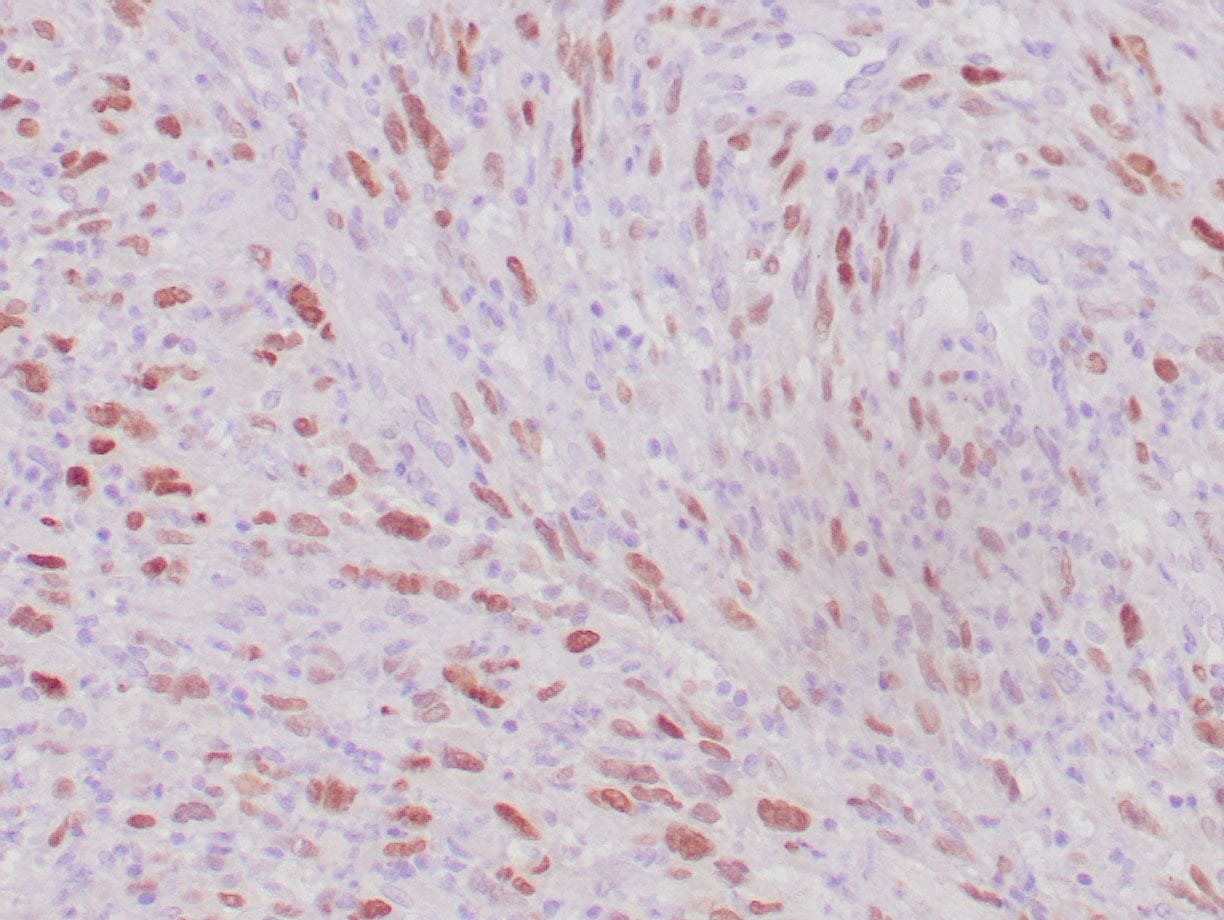 |
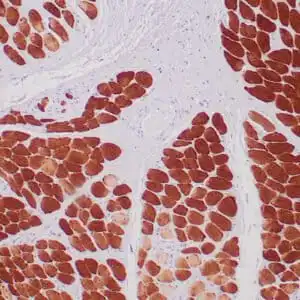
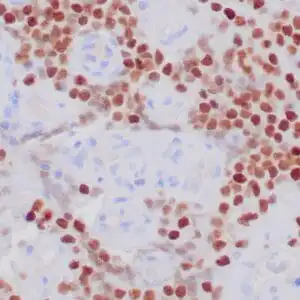
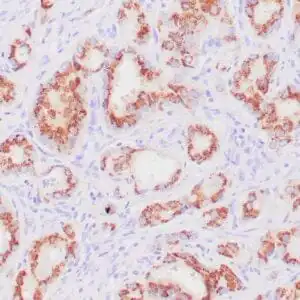
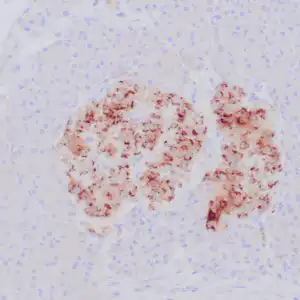
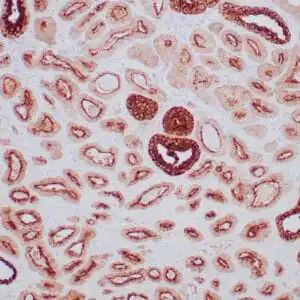
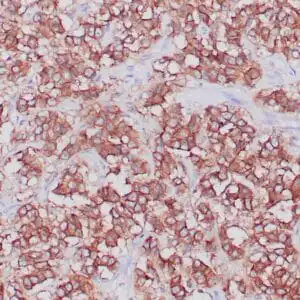
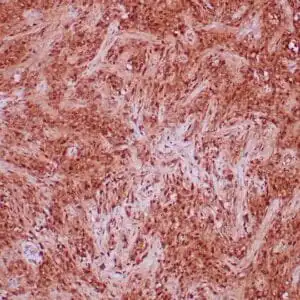
| Human rhabdomyosarcoma stained with anti-MyoD1 antibody using peroxidase-conjugate and DAB chromogen. Note the nuclear staining of sarcoma cells. |
FAQ & Publications
Frequently Asked Questions
What applications is the rabbit anti-MyoD1 monoclonal antibody (ZR262) suitable for?
This antibody is validated for use in immunohistochemistry (IHC) on formalin-fixed, paraffin-embedded human tissue samples.
How should the rabbit anti-MyoD1 monoclonal antibody be stored to maintain stability?
For short-term storage, keep the antibody at 2-8°C. For longer-term preservation, store at -20°C and avoid repeated freeze/thaw cycles to maintain antibody integrity.
What species does the rabbit anti-MyoD1 monoclonal antibody specifically react with?
This monoclonal antibody is reactive with human MyoD1 protein.
What is the recommended dilution for using the concentrated form of the rabbit anti-MyoD1 antibody in IHC?
The concentrated antibody should be diluted between 1:100 and 1:200 for optimal immunohistochemical staining.
Publications
| pmid | title | authors | citation |
|---|---|---|---|
| We haven't added any publications to our database yet. | |||
Published literature highly relevant to the biological target of this product and referencing this antibody or clone are retrieved from the PubMed database provided by the United States National Library of Medicine at the National Institutes of Health.
Protocols
| relevant to this product |
|---|
| IHC |
Documents
| Batch Number | QC File | SDS |
|---|---|---|
| To view batch-specific Safety Datasheets and Quality Certificates associated with your account, please Log In. | ||
Only logged in customers who have purchased this product may leave a review.


Reviews
There are no reviews yet.