| Weight | 1 lbs |
|---|---|
| Dimensions | 9 × 5 × 2 in |
| host | rabbit |
| isotype | IgG |
| clonality | polyclonal |
| concentration | 1 mg/mL |
| applications | ICC/IF, WB |
| reactivity | MEF2a (phospho-Thr312) |
| available sizes | 100 µL |

rabbit anti-MEF2a (phospho-Thr312) polyclonal antibody 6318
$366.00
Antibody summary
- Rabbit polyclonal to MEF2a (phospho-Thr312)
- Suitable for: IHC,IF
- Isotype: Whole IgG
- 100 µl
rabbit anti-MEF2a (phospho-Thr312) polyclonal antibody 6318
| antibody |
|---|
| Tested applications IHC,IHC,ICC/IF |
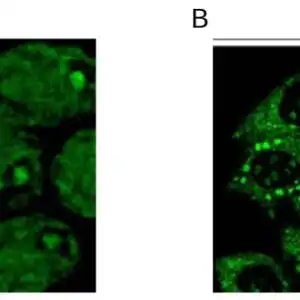
| Recommended dilutions Immunohistochemistry: use at dilution of 1:50- 1:100. Immunofluorescence: use at dilution of 1:100- 1:200. These are recommended working dilutions. End user should determine optimal dilutions for their applications. |
| Immunogen Peptide sequence that includes phosphorylation site of threonine 312 (L-A-T(p)-P-V) derived from human MEF2a and conjugated to KLH. |
| Size and concentration 100µL and 1 mg/mL |
| Form liquid |
| Storage Instructions This antibody is stable for at least one (1) year at -20°C. |
| Storage buffer PBS (without Mg2 and Ca2 ), pH 7.4, 150mM NaCl, |
| Purity affinity purified |
| Clonality polyclonal |
| Isotype IgG |
| Compatible secondaries goat anti-rabbit IgG, H&L chain specific, peroxidase conjugated, conjugated polyclonal antibody 9512 goat anti-rabbit IgG, H&L chain specific, biotin conjugated polyclonal antibody 2079 goat anti-rabbit IgG, H&L chain specific, FITC conjugated polyclonal antibody 7863 goat anti-rabbit IgG, H&L chain specific, Cross Absorbed polyclonal antibody 2371 goat anti-rabbit IgG, H&L chain specific, biotin conjugated polyclonal antibody, crossabsorbed 1715 goat anti-rabbit IgG, H&L chain specific, FITC conjugated polyclonal antibody, crossabsorbed 1720 |
| Isotype control Rabbit polyclonal - Isotype Control |
| target relevance |
|---|
| Homo sapiens MEF2A Myocyte-specific enhancer factor 2A |
| Protein names Myocyte-specific enhancer factor 2A |
| Alternative names Serum response factor-like protein 1 |
| Gene names MEF2A |
| Protein family Belongs to the MEF2 family |
| Function Transcriptional activator which binds specifically to the MEF2 element, 5'-YTA[AT](4)TAR-3', found in numerous muscle-specific genes. Also involved in the activation of numerous growth factor- and stress-induced genes. Mediates cellular functions not only in skeletal and cardiac muscle development, but also in neuronal differentiation and survival. Plays diverse roles in the control of cell growth, survival and apoptosis via p38 MAPK signaling in muscle-specific and/or growth factor-related transcription. In cerebellar granule neurons, phosphorylated and sumoylated MEF2A represses transcription of NUR77 promoting synaptic differentiation. Associates with chromatin to the ZNF16 promoter |
| Subcellular location Nucleus |
| Structure Binds DNA as a homo- or heterodimer. Dimerizes with MEF2D. Interacts with HDAC7 (By similarity). Interacts with PIAS1; the interaction enhances sumoylation. Interacts with HDAC4, HDAC9 and SLC2A4RG. Interacts (via the N-terminal) with MAPK7; the interaction results in the phosphorylation and transcriptional activity of MEF2A |
| Post-translational modification Constitutive phosphorylation on Ser-408 promotes Lys-403 sumoylation thus preventing acetylation at this site. Dephosphorylation on Ser-408 by PPP3CA upon neuron depolarization promotes a switch from sumoylation to acetylation on residue Lys-403 leading to inhibition of dendrite claw differentiation. Phosphorylation on Thr-312 and Thr-319 are the main sites involved in p38 MAPK signaling and activate transcription. Phosphorylated on these sites by MAPK14/p38alpha and MAPK11/p38beta, but not by MAPK13/p38delta nor by MAPK12/p38gamma. Phosphorylation on Ser-408 by CDK5 induced by neurotoxicity inhibits MEF2A transcriptional activation leading to apoptosis of cortical neurons. Phosphorylation on Thr-312, Thr-319 and Ser-355 can be induced by EGF Sumoylation on Lys-403 is enhanced by PIAS1 and represses transcriptional activity. Phosphorylation on Ser-408 is required for sumoylation. Has no effect on nuclear location nor on DNA binding. Sumoylated with SUMO1 and, to a lesser extent with SUMO2 and SUMO3. PIASx facilitates sumoylation in postsynaptic dendrites in the cerebellar cortex and promotes their morphogenesis (By similarity) Acetylation on Lys-403 activates transcriptional activity. Acetylated by p300 on several sites in diffentiating myocytes. Acetylation on Lys-4 increases DNA binding and transactivation (By similarity). Hyperacetylation by p300 leads to enhanced cardiac myocyte growth and heart failure Proteolytically cleaved in cerebellar granule neurons on several sites by caspase 3 and caspase 7 following neurotoxicity. Preferentially cleaves the CDK5-mediated hyperphosphorylated form which leads to neuron apoptosis and transcriptional inactivation |
| Involvement in disease Coronary artery disease, autosomal dominant, 1 A common heart disease characterized by reduced or absent blood flow in one or more of the arteries that encircle and supply the heart. Its most important complication is acute myocardial infarction. |
| Keywords 3D-structure, Acetylation, Activator, Alternative splicing, Apoptosis, Developmental protein, Differentiation, Disease variant, DNA-binding, Isopeptide bond, Neurogenesis, Nucleus, Phosphoprotein, Proteomics identification, Reference proteome, Transcription, Transcription regulation, Ubl conjugation |
| Sequence MGRKKIQITRIMDERNRQVTFTKRKFGLMKKAYELSVLCDCEIALIIFNSSNKLFQYAST DMDKVLLKYTEYNEPHESRTNSDIVEALNKKEHRGCDSPDPDTSYVLTPHTEEKYKKINE EFDNMMRNHKIAPGLPPQNFSMSVTVPVTSPNALSYTNPGSSLVSPSLAASSTLTDSSML SPPQTTLHRNVSPGAPQRPPSTGNAGGMLSTTDLTVPNGAGSSPVGNGFVNSRASPNLIG ATGANSLGKVMPTKSPPPPGGGNLGMNSRKPDLRVVIPPSSKGMMPPLSEEEELELNTQR ISSSQATQPLATPVVSVTTPSLPPQGLVYSAMPTAYNTDYSLTSADLSALQGFNSPGMLS LGQVSAWQQHHLGQAALSSLVAGGQLSQGSNLSINTNQNISIKSEPISPPRDRMTPSGFQ QQQQQQQQQQPPPPPQPQPQPPQPQPRQEMGRSPVDSLSSSSSSYDGSDREDPRGDFHSP IVLGRPPNTEDRESPSVKRMRMDAWVT |
| UniProt accession: Q02078 |
Data
| No results found |
FAQ & Publications
Frequently Asked Questions
What are the recommended dilution ranges for using the rabbit anti-MEF2a (phospho-Thr312) antibody in immunohistochemistry and immunofluorescence?
For immunohistochemistry (IHC), the recommended dilution range is 1:50 to 1:100. For immunofluorescence (IF), use a dilution range of 1:100 to 1:200. These are suggested working dilutions, and optimal concentrations should be determined by the end user for their specific applications.
How should the rabbit anti-MEF2a (phospho-Thr312) polyclonal antibody be stored to maintain stability?
This antibody should be stored at -20°C, where it remains stable for at least one year. It is supplied in a liquid form with a storage buffer of PBS (without Mg2+ and Ca2+), pH 7.4, containing 150mM NaCl.
What is the host species and clonality of the anti-MEF2a (phospho-Thr312) antibody with SKU 6318?
The antibody is a rabbit polyclonal antibody of the IgG isotype.
What immunogen was used to generate the rabbit anti-MEF2a (phospho-Thr312) antibody?
The immunogen is a peptide sequence derived from human MEF2a that includes the phosphorylation site at threonine 312 (sequence L-A-T(p)-P-V), conjugated to keyhole limpet hemocyanin (KLH).
Publications
| pmid | title | authors | citation |
|---|---|---|---|
| We haven't added any publications to our database yet. | |||
Published literature highly relevant to the biological target of this product and referencing this antibody or clone are retrieved from the PubMed database provided by the United States National Library of Medicine at the National Institutes of Health.
Protocols
| relevant to this product |
|---|
| Western blot IHC ICC |
Documents
| Batch Number | QC File | SDS |
|---|---|---|
| To view batch-specific Safety Datasheets and Quality Certificates associated with your account, please Log In. | ||
Only logged in customers who have purchased this product may leave a review.


Reviews
There are no reviews yet.