| Weight | 1 lbs |
|---|---|
| Dimensions | 9 × 5 × 2 in |
| host | rabbit |
| isotype | IgG |
| clonality | polyclonal |
| concentration | 1 mg/mL |
| applications | ICC/IF, WB |
| reactivity | MADD |
| available sizes | 100 µg |


rabbit anti-MADD (CT) polyclonal antibody 3638
$445.00
Antibody summary
- Rabbit polyclonal to MADD (CT)
- Suitable for: ELISA,WB,ICC,IF
- Isotype: IgG
- 100 µg
rabbit anti-MADD (CT) polyclonal antibody 3638
| antibody |
|---|
| Tested applications WB,ICC/IF,ELISA |
| Recommended dilutions Immunoblotting : use at 1:250-1:500 dilution. Positive control: Whole cell lysate from HeLa or NIH3T3 cells. |
| Immunogen Peptide corresponding to aa 1570-1588 of human MADD. This peptide sequence is identical to that of DENN and differs by one amino acid with rat GDP/GTP exchange protein RAB3-GEP. |
| Size and concentration 100µg and lot specific |
| Form liquid |
| Storage Instructions This antibody is stable for at least one (1) year at -20°C. Avoid multiple freeze-thaw cycles. |
| Storage buffer PBS, pH 7.4. |
| Purity peptide affinity purification |
| Clonality polyclonal |
| Isotype IgG |
| Compatible secondaries goat anti-rabbit IgG, H&L chain specific, peroxidase conjugated, conjugated polyclonal antibody 9512 goat anti-rabbit IgG, H&L chain specific, biotin conjugated polyclonal antibody 2079 goat anti-rabbit IgG, H&L chain specific, FITC conjugated polyclonal antibody 7863 goat anti-rabbit IgG, H&L chain specific, Cross Absorbed polyclonal antibody 2371 goat anti-rabbit IgG, H&L chain specific, biotin conjugated polyclonal antibody, crossabsorbed 1715 goat anti-rabbit IgG, H&L chain specific, FITC conjugated polyclonal antibody, crossabsorbed 1720 |
| Isotype control Rabbit polyclonal - Isotype Control |
| target relevance |
|---|
| Homo sapiens MADD MAP kinase-activating death domain protein |
| Protein names MAP kinase-activating death domain protein |
| Alternative names Differentially expressed in normal and neoplastic cells, Insulinoma glucagonoma clone 20, Rab3 GDP/GTP exchange factor, Rab3 GDP/GTP exchange protein |
| Gene names MADD |
| Protein family Belongs to the MADD family |
| Function Guanyl-nucleotide exchange factor that regulates small GTPases of the Rab family (PubMed:18559336, PubMed:20937701). Converts GDP-bound inactive form of RAB27A and RAB27B to the GTP-bound active forms (PubMed:18559336, PubMed:20937701). Converts GDP-bound inactive form of RAB3A, RAB3C and RAB3D to the GTP-bound active forms, GTPases involved in synaptic vesicle exocytosis and vesicle secretion (By similarity). Plays a role in synaptic vesicle formation and in vesicle trafficking at the neuromuscular junction (By similarity). Involved in up-regulating a post-docking step of synaptic exocytosis in central synapses (By similarity). Probably by binding to the motor proteins KIF1B and KIF1A, mediates motor-dependent transport of GTP-RAB3A-positive vesicles to the presynaptic nerve terminals (By similarity). Plays a role in TNFA-mediated activation of the MAPK pathway, including ERK1/2 (PubMed:32761064). May link TNFRSF1A with MAP kinase activation (PubMed:9115275). May be involved in the regulation of TNFA-induced apoptosis (PubMed:11577081, PubMed:32761064) |
| Subcellular location Cell membrane, Cytoplasm, Cell projection, axon |
| Structure Interacts (via death domain) with TNFRSF1A (via death domain) (PubMed:11577081, PubMed:9115275). Interacts with PIDD1 (PubMed:10825539). Interacts with YWHAZ (PubMed:16959763). Interacts (via death domain) with KIF1B; links the motor KIF1B to Rab3-carrying vesicles in anterograde synaptic vesicle transport (By similarity). Interacts with KIF1A (By similarity). Interacts (via uDENN domain) with RAB3A, RAB3B, RAB3C and RAB3D; the GTP-bound form of the Rab proteins is preferred for interaction (By similarity) |
| Involvement in disease DEEAH syndrome An autosomal recessive disorder characterized by moderate to severe global developmental delay, impaired intellectual development, poor or absent speech, and endocrine, pancreatic exocrine and autonomic dysfunction, as well as hematologic abnormalities. Additional features include facial dysmorphism, seizures, undescended testes, and distal skeletal anomalies. Death in early childhood may occur. Neurodevelopmental disorder with dysmorphic facies, impaired speech, and hypotonia An autosomal recessive disorder characterized by global developmental delay, mildly to severely impaired intellectual development, poor speech and language acquisition. Some patients may have early normal development with onset of the disorder in the first years of life. More variable neurologic abnormalities include hypotonia, seizures, apnea, mild signs of autonomic or peripheral neuropathy, and autism. |
| Keywords Alternative splicing, Apoptosis, Cell membrane, Cell projection, Cytoplasm, Guanine-nucleotide releasing factor, Intellectual disability, Membrane, Phosphoprotein, Proteomics identification, Reference proteome |
| Sequence MVQKKKFCPRLLDYLVIVGARHPSSDSVAQTPELLRRYPLEDHTEFPLPPDVVFFCQPEG CLSVRQRRMSLRDDTSFVFTLTDKDTGVTRYGICVNFYRSFQKRISKEKGEGGAGSRGKE GTHATCASEEGGTESSESGSSLQPLSADSTPDVNQSPRGKRRAKAGSRSRNSTLTSLCVL SHYPFFSTFRECLYTLKRLVDCCSERLLGKKLGIPRGVQRDTMWRIFTGSLLVEEKSSAL LHDLREIEAWIYRLLRSPVPVSGQKRVDIEVLPQELQPALTFALPDPSRFTLVDFPLHLP LELLGVDACLQVLTCILLEHKVVLQSRDYNALSMSVMAFVAMIYPLEYMFPVIPLLPTCM ASAEQLLLAPTPYIIGVPASFFLYKLDFKMPDDVWLVDLDSNRVIAPTNAEVLPILPEPE SLELKKHLKQALASMSLNTQPILNLEKFHEGQEIPLLLGRPSNDLQSTPSTEFNPLIYGN DVDSVDVATRVAMVRFFNSANVLQGFQMHTRTLRLFPRPVVAFQAGSFLASRPRQTPFAE KLARTQAVEYFGEWILNPTNYAFQRIHNNMFDPALIGDKPKWYAHQLQPIHYRVYDSNSQ LAEALSVPPERDSDSEPTDDSGSDSMDYDDSSSSYSSLGDFVSEMMKCDINGDTPNVDPL THAALGDASEVEIDELQNQKEAEEPGPDSENSQENPPLRSSSSTTASSSPSTVIHGANSE PADSTEMDDKAAVGVSKPLPSVPPSIGKSNVDRRQAEIGEGSVRRRIYDNPYFEPQYGFP PEEDEDEQGESYTPRFSQHVSGNRAQKLLRPNSLRLASDSDAESDSRASSPNSTVSNTST EGFGGIMSFASSLYRNHSTSFSLSNLTLPTKGAREKATPFPSLKVFGLNTLMEIVTEAGP GSGEGNRRALVDQKSSVIKHSPTVKREPPSPQGRSSNSSENQQFLKEVVHSVLDGQGVGW LNMKKVRRLLESEQLRVFVLSKLNRMVQSEDDARQDIIPDVEISRKVYKGMLDLLKCTVL SLEQSYAHAGLGGMASIFGLLEIAQTHYYSKEPDKRKRSPTESVNTPVGKDPGLAGRGDP KAMAQLRVPQLGPRAPSATGKGPKELDTRSLKEENFIASIELWNKHQEVKKQKALEKQRP EVIKPVFDLGETEEKKSQISADSGVSLTSSSQRTDQDSVIGVSPAVMIRSSSQDSEVSTV VSNSSGETLGADSDLSSNAGDGPGGEGSVHLASSRGTLSDSEIETNSATSTIFGKAHSLK PSIKEKLAGSPIRTSEDVSQRVYLYEGLLGRDKGSMWDQLEDAAMETFSISKERSTLWDQ MQFWEDAFLDAVMLEREGMGMDQGPQEMIDRYLSLGEHDRKRLEDDEDRLLATLLHNLIS YMLLMKVNKNDIRKKVRRLMGKSHIGLVYSQQINEVLDQLANLNGRDLSIWSSGSRHMKK QTFVVHAGTDTNGDIFFMEVCDDCVVLRSNIGTVYERWWYEKLINMTYCPKTKVLCLWRR NGSETQLNKFYTKKCRELYYCVKDSMERAAARQQSIKPGPELGGEFPVQDLKTGEGGLLQ VTLEGINLKFMHNQVFIELNHIKKCNTVRGVFVLEEFVPEIKEVVSHKYKTPMAHEICYS VLCLFSYVAAVHSSEEDLRTPPRPVSS |
| UniProt accession: Q8WXG6 |
Data
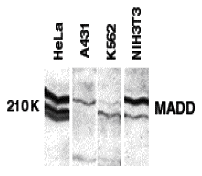 |
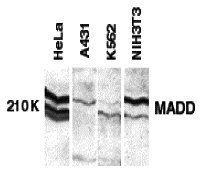
| Western blot analysis of MADD in whole cell lysates from the indicated cell lines with MADD antibody at 1:250 dilution. |
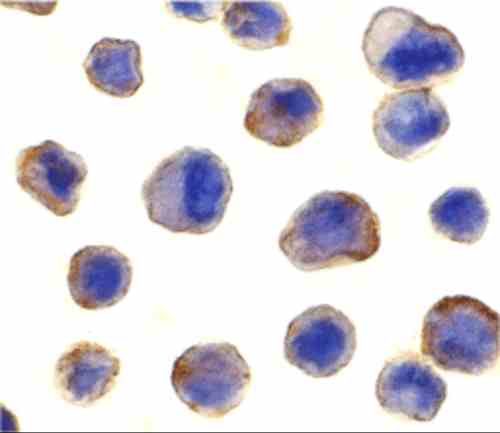 |
| Immunocytochemistry of MADD in human spleen tissue with MADD antibody at 10 µg/mL. |
 |
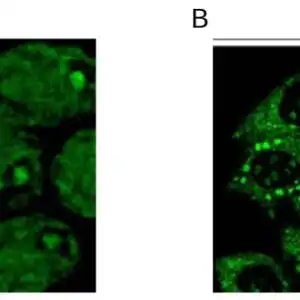
| Immunofluorescence of MADD in Hela cells with MADD antibody at 20 µg/mL. |
FAQ & Publications
Frequently Asked Questions
What applications is the rabbit anti-MADD (CT) polyclonal antibody suitable for?
This antibody is suitable for ELISA, Western blotting (WB), immunocytochemistry (ICC), and immunofluorescence (IF) applications.
How should the rabbit anti-MADD (CT) antibody be stored to maintain stability?
The antibody should be stored at -20°C and is stable for at least one year. It is important to avoid multiple freeze-thaw cycles to preserve its activity.
What is the recommended dilution for using this antibody in Western blotting?
For immunoblotting, the antibody should be used at a dilution ranging from 1:250 to 1:500. Whole cell lysate from HeLa or NIH3T3 cells is recommended as a positive control.
What is the immunogen used to generate this rabbit polyclonal antibody?
The immunogen is a peptide corresponding to amino acids 1570-1588 of human MADD. This sequence is identical to that of DENN and differs by one amino acid from the rat GDP/GTP exchange protein RAB3-GEP.
Is this antibody monoclonal or polyclonal, and what is the host species?
This antibody is a rabbit polyclonal antibody with an IgG isotype.
Publications
| pmid | title | authors | citation |
|---|---|---|---|
| We haven't added any publications to our database yet. | |||
Published literature highly relevant to the biological target of this product and referencing this antibody or clone are retrieved from the PubMed database provided by the United States National Library of Medicine at the National Institutes of Health.
Protocols
| relevant to this product |
|---|
| Western blot IHC ICC |
Documents
| Batch Number | QC File | SDS |
|---|---|---|
| To view batch-specific Safety Datasheets and Quality Certificates associated with your account, please Log In. | ||
Only logged in customers who have purchased this product may leave a review.


Reviews
There are no reviews yet.