| Weight | 1 lbs |
|---|---|
| Dimensions | 9 × 5 × 2 in |
| host | rabbit |
| isotype | IgG |
| clonality | polyclonal |
| concentration | 1 mg/mL |
| applications | ICC/IF, WB |
| reactivity | GPR15/BOB |
| available sizes | 100 µg |
rabbit anti-GPR15 (NT) polyclonal antibody 1208
$445.00
Antibody summary
- Rabbit polyclonal to GPR15 (NT)
- Suitable for: ELISA,WB,ICC
- Isotype: IgG
- 100 µg
rabbit anti-GPR15 (NT) polyclonal antibody 1208
| antibody |
|---|
| Tested applications WB,ICC/IF,ELISA |
| Recommended dilutions Immunoblotting: use at 1:500-1:2,000 dilution. Positive control: Jurkat or A549 cell lysate. |
| Immunogen Peptide corresponding to aa 13- 28 of human GPR15. This sequence differs from those of African green monkey and pig-tailed macaque BOB by one amino acid. |
| Size and concentration 100µg and lot specific |
| Form liquid |
| Storage Instructions This antibody is stable for at least one (1) year at -20°C. Avoid multiple freeze-thaw cycles. |
| Storage buffer PBS, pH 7.4. |
| Purity peptide affinity purification |
| Clonality polyclonal |
| Isotype IgG |
| Compatible secondaries goat anti-rabbit IgG, H&L chain specific, peroxidase conjugated, conjugated polyclonal antibody 9512 goat anti-rabbit IgG, H&L chain specific, biotin conjugated polyclonal antibody 2079 goat anti-rabbit IgG, H&L chain specific, FITC conjugated polyclonal antibody 7863 goat anti-rabbit IgG, H&L chain specific, Cross Absorbed polyclonal antibody 2371 goat anti-rabbit IgG, H&L chain specific, biotin conjugated polyclonal antibody, crossabsorbed 1715 goat anti-rabbit IgG, H&L chain specific, FITC conjugated polyclonal antibody, crossabsorbed 1720 |
| Isotype control Rabbit polyclonal - Isotype Control |
| target relevance |
|---|
| Homo sapiens GPR15 G-protein coupled receptor 15 |
| Protein names G-protein coupled receptor 15 |
| Alternative names Brother of Bonzo |
| Gene names GPR15 |
| Protein family Belongs to the G-protein coupled receptor 1 family |
| Function G protein-coupled receptor that plays an important role in immune homeostasis (PubMed:33758080, PubMed:38918398). Acts via its natural ligand GPR15LG, a chemokine-like polypeptide strongly expressed in gastrointestinal tissues. GPR15-GPR15LG signaling axis regulates intestinal homeostasis and inflammation through the migration of immune cells (PubMed:33758080, PubMed:38918398). Controls thereby the specific homing of T-cells, particularly FOXP3+ regulatory T-cells (Tregs), to the large intestine lamina propria (By similarity). Also required for skin localization of thymus-derived dendritic epidermal T-cells (By similarity). Plays an important role in mediating cytoprotective function as well as angiogenesis of thrombomodulin (By similarity). Mechanistically, preferentially signals through the Gi/o pathway to inhibit adenylate cyclase activity and activate a phosphatidylinositol-calcium second messenger system that regulates the release of Ca(2+) ions from intracellular stores (PubMed:35510660) |
| Subcellular location Cell membrane |
| Structure Interacts with adapter YWHAE; this interaction promotes ER-to-Golgi transport of GPR15. Interacts with GNAI1; this interaction initiates the signaling pathway |
| Post-translational modification Phosphorylation is necessary for YWHAE binding and efficient surface expression O-glycosylated (PubMed:21189250). Sialylated O-glycans in the N-terminal tail inhibits binding of GPR15LG (PubMed:33758080) Sulfation is required for efficient binding of GPR15LG |
| Keywords 3D-structure, Cell membrane, G-protein coupled receptor, Membrane, Phosphoprotein, Proteomics identification, Receptor, Reference proteome, Transducer, Transmembrane, Transmembrane helix |
| Sequence MDPEETSVYLDYYYATSPNSDIRETHSHVPYTSVFLPVFYTAVFLTGVLGNLVLMGALHF KPGSRRLIDIFIINLAASDFIFLVTLPLWVDKEASLGLWRTGSFLCKGSSYMISVNMHCS VLLLTCMSVDRYLAIVWPVVSRKFRRTDCAYVVCASIWFISCLLGLPTLLSRELTLIDDK PYCAEKKATPIKLIWSLVALIFTFFVPLLSIVTCYCCIARKLCAHYQQSGKHNKKLKKSI KIIFIVVAAFLVSWLPFNTFKFLAIVSGLRQEHYLPSAILQLGMEVSGPLAFANSCVNPF IYYIFDSYIRRAIVHCLCPCLKNYDFGSSTETSDSHLTKALSTFIHAEDFARRRKRSVSL |
| UniProt accession: P49685 |
Data
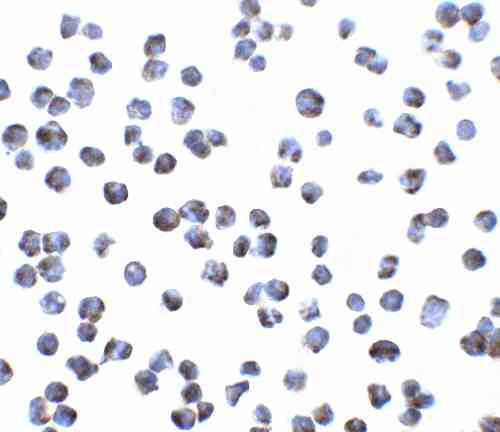
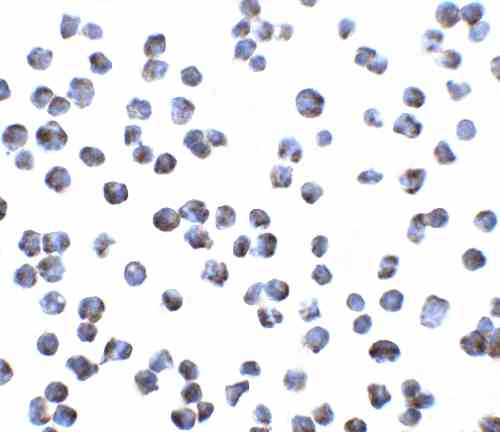 |
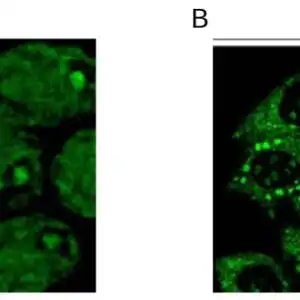
| Immunocytochemistry of GPR15 in A431 cells with GPR15 antibody at 5 µg/mL. |
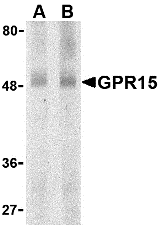
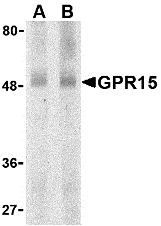 |
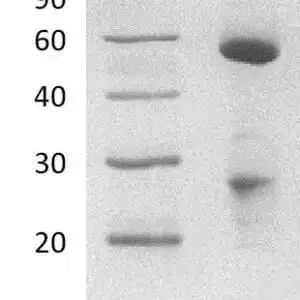
| Western blot analysis of GPR15 in human spleen lysate with GPR15 antibody at (A) 0.5 and (B) 1 µg/mL. |
FAQ & Publications
Frequently Asked Questions
What applications has the rabbit anti-GPR15 (NT) polyclonal antibody 1208 been tested for, and what are the recommended dilution ranges?
The rabbit anti-GPR15 (NT) polyclonal antibody 1208 has been tested for Western blot (WB), immunocytochemistry/immunofluorescence (ICC/IF), and ELISA. For immunoblotting, it is recommended to use the antibody at a dilution range of 1:500 to 1:2,000.
How should the rabbit anti-GPR15 (NT) polyclonal antibody 1208 be stored to maintain its stability, and what is its concentration and form?
This antibody is provided as a liquid at a concentration of 1 mg/mL. It should be stored at -20°C and is stable for at least one year under these conditions. To preserve antibody integrity, avoid multiple freeze-thaw cycles.
Publications
| pmid | title | authors | citation |
|---|---|---|---|
| We haven't added any publications to our database yet. | |||
Published literature highly relevant to the biological target of this product and referencing this antibody or clone are retrieved from the PubMed database provided by the United States National Library of Medicine at the National Institutes of Health.
Protocols
| relevant to this product |
|---|
| Western blot IHC ICC |
Documents
| Batch Number | QC File | SDS |
|---|---|---|
| To view batch-specific Safety Datasheets and Quality Certificates associated with your account, please Log In. | ||
Only logged in customers who have purchased this product may leave a review.


Reviews
There are no reviews yet.