| Weight | 1 lbs |
|---|---|
| Dimensions | 9 × 5 × 2 in |
| host | rabbit |
| isotype | IgG |
| clonality | polyclonal |
| concentration | 1 mg/mL |
| applications | ICC/IF, WB |
| reactivity | GFRα-1 |
| available sizes | 100 µg |


rabbit anti-GFR-1 (IN) polyclonal antibody 8851
$469.00
Antibody summary
- Rabbit polyclonal to GFR-1 (IN)
- Suitable for: ELISA,WB,IHC-P,IF
- Isotype: IgG
- 100 µg
rabbit anti-GFR-1 (IN) polyclonal antibody 8851
| antibody |
|---|
| Tested applications WB,IHC,IHC,ICC/IF,ELISA |
| Recommended dilutions Immunoblotting: use at 1:500 dilution. |
| Immunogen Peptide corresponding to aa 369- 382 of human GFRa-1. This peptide sequence is identical to those of mouse and rat. |
| Size and concentration 100µg and lot specific |
| Form liquid |
| Storage Instructions This antibody is stable for at least one (1) year at -20°C. Avoid multiple freeze-thaw cycles. |
| Storage buffer PBS, pH 7.4. |
| Purity peptide affinity purification |
| Clonality polyclonal |
| Isotype IgG |
| Compatible secondaries goat anti-rabbit IgG, H&L chain specific, peroxidase conjugated, conjugated polyclonal antibody 9512 goat anti-rabbit IgG, H&L chain specific, biotin conjugated polyclonal antibody 2079 goat anti-rabbit IgG, H&L chain specific, FITC conjugated polyclonal antibody 7863 goat anti-rabbit IgG, H&L chain specific, Cross Absorbed polyclonal antibody 2371 goat anti-rabbit IgG, H&L chain specific, biotin conjugated polyclonal antibody, crossabsorbed 1715 goat anti-rabbit IgG, H&L chain specific, FITC conjugated polyclonal antibody, crossabsorbed 1720 |
| Isotype control Rabbit polyclonal - Isotype Control |
| target relevance |
|---|
| Homo sapiens GFRA1 GDNF family receptor alpha-1 |
| Protein names GDNF family receptor alpha-1 |
| Alternative names RET ligand 1, TGF-beta-related neurotrophic factor receptor 1 |
| Gene names GFRA1 |
| Protein family Belongs to the GDNFR family |
| Function Coreceptor for GDNF, a neurotrophic factor that enhances survival and morphological differentiation of dopaminergic neurons and increases their high-affinity dopamine uptake (PubMed:10829012, PubMed:31535977). GDNF-binding leads to autophosphorylation and activation of the RET receptor (PubMed:31535977) |
| Subcellular location Cell membrane, Golgi apparatus, trans-Golgi network, Endosome, Endosome, multivesicular body |
| Structure Interacts with GDNF ligand and RET: forms a 2:2:2 ternary complex composed of GDNF ligand, GFRA1 and RET receptor (PubMed:23333276, PubMed:31535977). Interacts with SORL1, either alone or in complex with GDNF (PubMed:23333276). Interaction between SORL1 and GFRA1 leads to GFRA1 internalization, but not degradation (PubMed:23333276) |
| Involvement in disease Renal hypodysplasia/aplasia 4 An autosomal recessive, severe congenital anomaly of the kidney and urinary tract characterized by bilateral renal agenesis, and severely reduced or absent amniotic fluid during pregnancy. Patients exhibit the Potter sequence, including flattened nose, ear anomalies, and receding chin. Some affected individuals have limb contractures and joint dislocations. Bilateral renal agenesis is almost invariably fatal in utero or in the perinatal period. |
| Keywords 3D-structure, Alternative splicing, Cell membrane, Disease variant, Disulfide bond, Endosome, Glycoprotein, Golgi apparatus, GPI-anchor, Lipoprotein, Membrane, Proteomics identification, Receptor, Reference proteome, Repeat, Signal |
| Sequence MFLATLYFALPLLDLLLSAEVSGGDRLDCVKASDQCLKEQSCSTKYRTLRQCVAGKETNF SLASGLEAKDECRSAMEALKQKSLYNCRCKRGMKKEKNCLRIYWSMYQSLQGNDLLEDSP YEPVNSRLSDIFRVVPFISDVFQQVEHIPKGNNCLDAAKACNLDDICKKYRSAYITPCTT SVSNDVCNRRKCHKALRQFFDKVPAKHSYGMLFCSCRDIACTERRRQTIVPVCSYEEREK PNCLNLQDSCKTNYICRSRLADFFTNCQPESRSVSSCLKENYADCLLAYSGLIGTVMTPN YIDSSSLSVAPWCDCSNSGNDLEECLKFLNFFKDNTCLKNAIQAFGNGSDVTVWQPAFPV QTTTATTTTALRVKNKPLGPAGSENEIPTHVLPPCANLQAQKLKSNVSGNTHLCISNGNY EKEGLGASSHITTKSMAAPPSCGLSPLLVLVVTALSTLLSLTETS |
| UniProt accession: P56159 |
Data
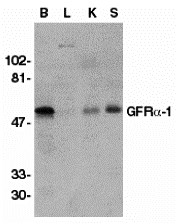 |
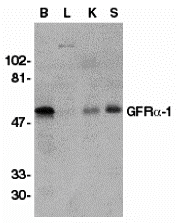
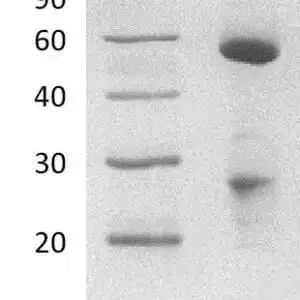
| Western blot analysis of GFR alpha 1 in crude membrane fractions of human brain (B), liver (L), kidney (K), and spleen (S), respectively, with GFR alpha 1 antibody at 1 µg/mL. |
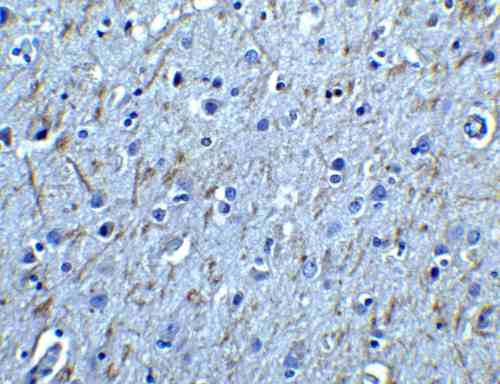 |
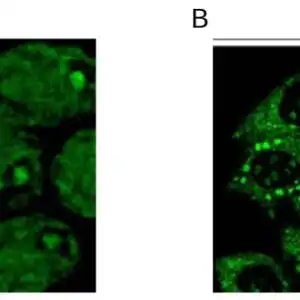
| Immunohistochemistry of GFR alpha 1 in human brain tissue with GFR alpha 1 antibody at 2.5 µg/mL. |
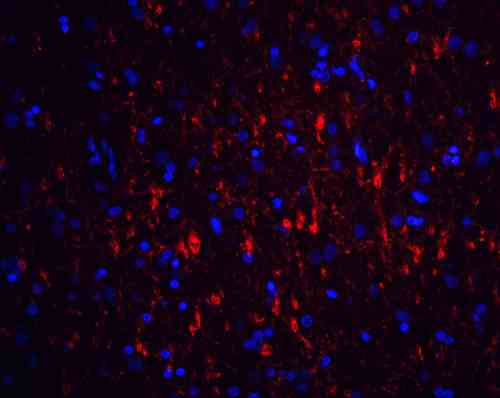 |
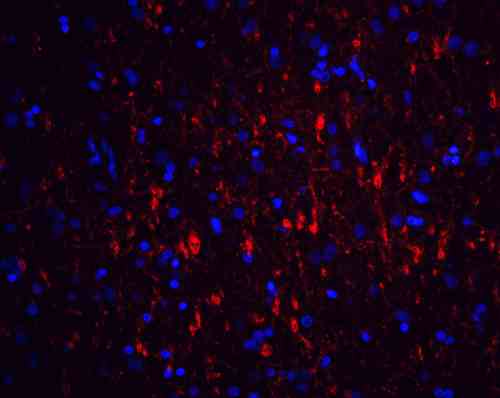
| Immunofluorescence of GFR alpha 1 in human brain tissue with GFR alpha 1 antibody at 20 µg/mL.
Red: GFR alpha 1 Antibody (8851) Blue: DAPI staining |
 |
| Immunohistochemistry of GFR alpha 1 in human brain tissue with GFR alpha 1 antibody at 1 µg/mL. |
FAQ & Publications
Frequently Asked Questions
What species does the rabbit anti-GFR-1 (IN) polyclonal antibody 8851 react with?
The antibody is reactive to GFRα-1, with the immunogen peptide sequence corresponding to amino acids 369-382 of human GFRα-1, which is identical to the mouse and rat sequences, indicating cross-reactivity with these species.
What are the recommended storage conditions and stability for the rabbit anti-GFR-1 (IN) polyclonal antibody 8851?
This antibody should be stored at -20°C and is stable for at least one year under these conditions. It is advised to avoid multiple freeze-thaw cycles to maintain antibody integrity.
Publications
| pmid | title | authors | citation |
|---|---|---|---|
| We haven't added any publications to our database yet. | |||
Published literature highly relevant to the biological target of this product and referencing this antibody or clone are retrieved from the PubMed database provided by the United States National Library of Medicine at the National Institutes of Health.
Protocols
| relevant to this product |
|---|
| Western blot IHC ICC |
Documents
| Batch Number | QC File | SDS |
|---|---|---|
| To view batch-specific Safety Datasheets and Quality Certificates associated with your account, please Log In. | ||
Only logged in customers who have purchased this product may leave a review.


Reviews
There are no reviews yet.