| Weight | 1 lbs |
|---|---|
| Dimensions | 9 × 5 × 2 in |
| host | rabbit |
| isotype | IgG |
| clonality | polyclonal |
| concentration | 1 mg/mL |
| applications | ICC/IF, WB |
| reactivity | FLIP (CT) |
| available sizes | 100 µg |


rabbit anti-FLIP (CT) polyclonal antibody 5982
$445.00
Antibody summary
- Rabbit polyclonal to FLIP (CT)
- Suitable for: ELISA,WB,ICC,IF
- Isotype: IgG
- 100 µg
rabbit anti-FLIP (CT) polyclonal antibody 5982
| antibody |
|---|
| Tested applications WB,ICC/IF,ELISA |
| Recommended dilutions Immunoblotting: use at 1ug/mL. Immunocytochemistry: use at 10ug/mL. Positive control: Whole cell lysate from HeLa cells. These are recommended concentrations. Enduser should determine optimal concentrations for their applications. |
| Immunogen Peptide corresponding to aa 447- 464 at the C-terminus of human FLIPa/FLIPL (accession no. AAC51622) |
| Size and concentration 100µg and lot specific |
| Form liquid |
| Storage Instructions This antibody is stable for at least one (1) year at -20°C. Avoid multiple freeze-thaw cycles. |
| Storage buffer PBS, pH 7.4. |
| Purity peptide affinity purification |
| Clonality polyclonal |
| Isotype IgG |
| Compatible secondaries goat anti-rabbit IgG, H&L chain specific, peroxidase conjugated, conjugated polyclonal antibody 9512 goat anti-rabbit IgG, H&L chain specific, biotin conjugated polyclonal antibody 2079 goat anti-rabbit IgG, H&L chain specific, FITC conjugated polyclonal antibody 7863 goat anti-rabbit IgG, H&L chain specific, Cross Absorbed polyclonal antibody 2371 goat anti-rabbit IgG, H&L chain specific, biotin conjugated polyclonal antibody, crossabsorbed 1715 goat anti-rabbit IgG, H&L chain specific, FITC conjugated polyclonal antibody, crossabsorbed 1720 |
| Isotype control Rabbit polyclonal - Isotype Control |
| target relevance |
|---|
| Protein names CASP8 and FADD-like apoptosis regulator (Caspase homolog) (CASH) (Caspase-eight-related protein) (Casper) (Caspase-like apoptosis regulatory protein) (CLARP) (Cellular FLICE-like inhibitory protein) (c-FLIP) (FADD-like antiapoptotic molecule 1) (FLAME-1) (Inhibitor of FLICE) (I-FLICE) (MACH-related inducer of toxicity) (MRIT) (Usurpin) [Cleaved into: CASP8 and FADD-like apoptosis regulator subunit p43; CASP8 and FADD-like apoptosis regulator subunit p12] |
| Gene names CFLAR,CFLAR CASH CASP8AP1 CLARP MRIT |
| Protein family Peptidase C14A family |
| Mass 55344Da |
| Function FUNCTION: Apoptosis regulator protein which may function as a crucial link between cell survival and cell death pathways in mammalian cells. Acts as an inhibitor of TNFRSF6 mediated apoptosis. A proteolytic fragment (p43) is likely retained in the death-inducing signaling complex (DISC) thereby blocking further recruitment and processing of caspase-8 at the complex. Full length and shorter isoforms have been shown either to induce apoptosis or to reduce TNFRSF-triggered apoptosis. Lacks enzymatic (caspase) activity. {ECO:0000269|PubMed:9880531}. |
| Tissues TISSUE SPECIFICITY: Widely expressed. Higher expression in skeletal muscle, pancreas, heart, kidney, placenta, and peripheral blood leukocytes. Also detected in diverse cell lines. Isoform 8 is predominantly expressed in testis and skeletal muscle. |
| Structure SUBUNIT: TNFRSF6 stimulation triggers recruitment to the death-inducing signaling complex (DISC) formed by TNFRSF6, FADD and CASP8 (PubMed:9880531). A proteolytic fragment (p43) stays associated with the DISC (PubMed:9880531). Also interacts with FADD, CASP8, CASP3, TRAF1, TRAF2 and Bcl-X(L) (in vitro) (PubMed:9208847, PubMed:9326610). Interacts with RIPK1 (By similarity) (PubMed:9208847, PubMed:9326610, PubMed:9880531). {ECO:0000250|UniProtKB:O35732, ECO:0000269|PubMed:9208847, ECO:0000269|PubMed:9326610, ECO:0000269|PubMed:9880531}.; SUBUNIT: (Microbial infection) Interacts with HBV protein X. {ECO:0000269|PubMed:12727877}. |
| Post-translational modification PTM: Proteolytically processed by CASP8 generating subunit p43 and p12. {ECO:0000269|PubMed:9228018}. |
| Domain DOMAIN: The caspase domain lacks the active site residues involved in catalysis. |
| Target Relevance information above includes information from UniProt accession: O15519 |
| The UniProt Consortium |
Data
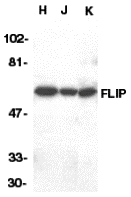 |
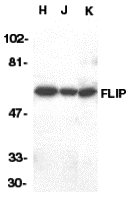
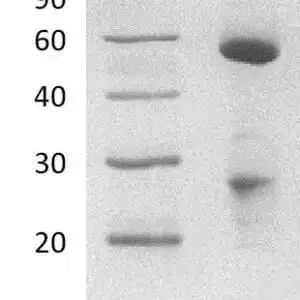
| Western blot analysis of FLIP in HeLa (H), Jurkat (J), and K562 (K) whole cell lysate with FLIP antibody at 1:1000 dilution. |
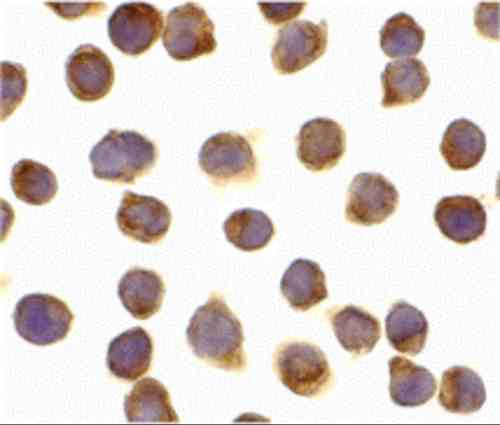 |
| Immunocytochemistry of FLIP in Jurkat cells with FLIP antibody at 10 µg/mL. |
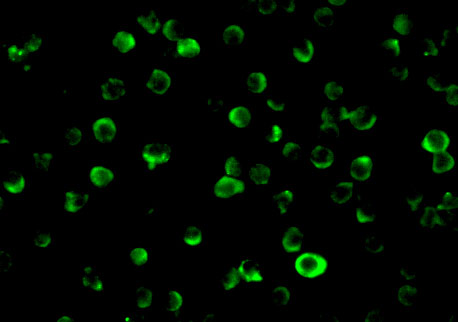 |
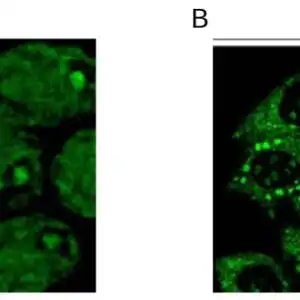
| Immunofluorescence of FLIP in Jurkat cells with FLIP antibody at 10 µg/mL. |
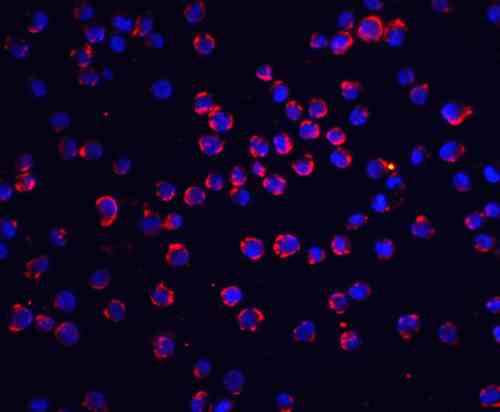 |
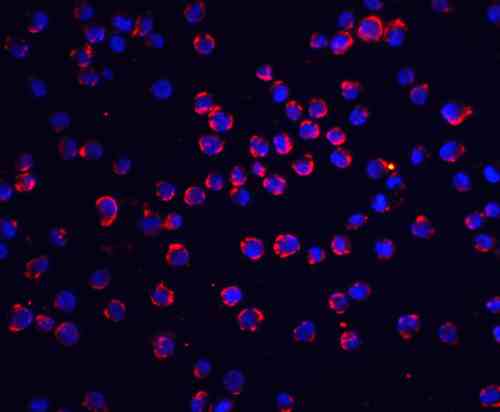
| Immunofluorescence of FLIP in K562 cells with FLIP antibody at 5 µg/mL.
Red: FLIP Antibody (5982) Blue: DAPI staining |
FAQ & Publications
Frequently Asked Questions
What applications has the rabbit anti-FLIP (CT) polyclonal antibody 5982 been validated for?
This antibody has been tested and validated for use in Western blotting (WB), immunocytochemistry/immunofluorescence (ICC/IF), and ELISA applications.
How should the rabbit anti-FLIP (CT) polyclonal antibody 5982 be stored to maintain stability?
The antibody should be stored at -20°C and is stable for at least one year under these conditions. It is important to avoid multiple freeze-thaw cycles to preserve antibody integrity.
What is the immunogen used to generate the rabbit anti-FLIP (CT) polyclonal antibody 5982?
The immunogen is a peptide corresponding to amino acids 447 to 464 at the C-terminus of human FLIPa/FLIPL (accession no. AAC51622).
Which secondary antibodies are compatible with the rabbit anti-FLIP (CT) polyclonal antibody 5982?
Compatible secondaries include goat anti-rabbit IgG antibodies that are H&L chain specific and conjugated with peroxidase, biotin, or FITC, including cross-absorbed variants.
Publications
| pmid | title | authors | citation |
|---|---|---|---|
| We haven't added any publications to our database yet. | |||
Published literature highly relevant to the biological target of this product and referencing this antibody or clone are retrieved from the PubMed database provided by the United States National Library of Medicine at the National Institutes of Health.
Protocols
| relevant to this product |
|---|
| Western blot IHC ICC |
Documents
| Batch Number | QC File | SDS |
|---|---|---|
| To view batch-specific Safety Datasheets and Quality Certificates associated with your account, please Log In. | ||
Only logged in customers who have purchased this product may leave a review.


Reviews
There are no reviews yet.