| Weight | 1 lbs |
|---|---|
| Dimensions | 9 × 5 × 2 in |
| host | rabbit |
| isotype | IgG |
| clonality | polyclonal |
| concentration | 1 mg/mL |
| applications | ICC/IF, WB |
| reactivity | CIKS/Act1 (NT) |
| available sizes | 100 µg |


rabbit anti-CIKS/Act1 (NT) polyclonal antibody 9655
$445.00
Antibody summary
- Rabbit polyclonal to CIKS/Act1 (NT)
- Suitable for: ELISA,WB,IHC-P,IF
- Isotype: Whole IgG
- 100 µg
rabbit anti-CIKS/Act1 (NT) polyclonal antibody 9655
| antibody |
|---|
| Tested applications WB,IHC,IHC,ICC/IF,ELISA |
| Recommended dilutions Immunoblotting: use at 0.5-1 ug/mL. In immunoblots, a band of 63 kD is detected. Positive control: Human placenta tissue lysate. |
| Immunogen Peptide corresponding to aa 2-15 of human CIKS. |
| Size and concentration 100µg and lot specific |
| Form liquid |
| Storage Instructions This antibody is stable for at least one (1) year at -20°C. Avoid multiple freeze- thaw cycles. |
| Storage buffer PBS, pH 7.4. |
| Purity peptide affinity purification |
| Clonality polyclonal |
| Isotype IgG |
| Compatible secondaries goat anti-rabbit IgG, H&L chain specific, peroxidase conjugated, conjugated polyclonal antibody 9512 goat anti-rabbit IgG, H&L chain specific, biotin conjugated polyclonal antibody 2079 goat anti-rabbit IgG, H&L chain specific, FITC conjugated polyclonal antibody 7863 goat anti-rabbit IgG, H&L chain specific, Cross Absorbed polyclonal antibody 2371 goat anti-rabbit IgG, H&L chain specific, biotin conjugated polyclonal antibody, crossabsorbed 1715 goat anti-rabbit IgG, H&L chain specific, FITC conjugated polyclonal antibody, crossabsorbed 1720 |
| Isotype control Rabbit polyclonal - Isotype Control |
| target relevance |
|---|
| Homo sapiens TRAF3IP2 E3 ubiquitin ligase TRAF3IP2 |
| Protein names E3 ubiquitin ligase TRAF3IP2 |
| Alternative names Adapter protein CIKS, Connection to IKK and SAPK/JNK, E3 ubiquitin-protein ligase CIKS, Nuclear factor NF-kappa-B activator 1, TRAF3-interacting protein 2 |
| Gene names TRAF3IP2 |
| Function E3 ubiquitin ligase that catalyzes 'Lys-63'-linked polyubiquitination of target protein, enhancing protein-protein interaction and cell signaling (PubMed:19825828). Transfers ubiquitin from E2 ubiquitin-conjugating enzyme UBE2V1-UBE2N to substrate protein (PubMed:19825828). Essential adapter molecule in IL17A-mediated signaling (PubMed:19825828, PubMed:24120361). Upon IL17A stimulation, interacts with IL17RA and IL17RC receptor chains through SEFIR domains and catalyzes 'Lys-63'-linked polyubiquitination of TRAF6, leading to TRAF6-mediated activation of NF-kappa-B and MAPkinase pathways (PubMed:19825828) |
| Catalytic activity S-ubiquitinyl-[E2 ubiquitin-conjugating enzyme]-L-cysteine + [acceptor protein]-L-lysine = [E2 ubiquitin-conjugating enzyme]-L-cysteine + N(6)-ubiquitinyl-[acceptor protein]-L-lysine. |
| Structure Interacts with IKBKG/NF-kappa B essential modulator, with CHUK/IKK-alpha and with IKBKB/IKK-beta (PubMed:12459498). Interacts with TRAF6; this interaction is direct (PubMed:12459498, PubMed:19825828). Interacts with IL17RA and IL17RC (PubMed:19825828, PubMed:24120361, PubMed:33723527). Interacts with IL17RB (PubMed:24120361) |
| Involvement in disease Psoriasis 13 A common, chronic inflammatory disease of the skin with multifactorial etiology. It is characterized by red, scaly plaques usually found on the scalp, elbows and knees. These lesions are caused by abnormal keratinocyte proliferation and infiltration of inflammatory cells into the dermis and epidermis. Candidiasis, familial, 8 A primary immunodeficiency disorder with altered immune responses and impaired clearance of fungal infections, selective against Candida. It is characterized by persistent and/or recurrent infections of the skin, nails and mucous membranes caused by organisms of the genus Candida, mainly Candida albicans. |
| Keywords Alternative splicing, Disease variant, Inflammatory response, Proteomics identification, Reference proteome, Transferase, Ubl conjugation pathway |
| Sequence MPPQLQETRMNRSIPVEVDESEPYPSQLLKPIPEYSPEEESEPPAPNIRNMAPNSLSAPT MLHNSSGDFSQAHSTLKLANHQRPVSRQVTCLRTQVLEDSEDSFCRRHPGLGKAFPSGCS AVSEPASESVVGALPAEHQFSFMEKRNQWLVSQLSAASPDTGHDSDKSDQSLPNASADSL GGSQEMVQRPQPHRNRAGLDLPTIDTGYDSQPQDVLGIRQLERPLPLTSVCYPQDLPRPL RSREFPQFEPQRYPACAQMLPPNLSPHAPWNYHYHCPGSPDHQVPYGHDYPRAAYQQVIQ PALPGQPLPGASVRGLHPVQKVILNYPSPWDHEERPAQRDCSFPGLPRHQDQPHHQPPNR AGAPGESLECPAELRPQVPQPPSPAAVPRPPSNPPARGTLKTSNLPEELRKVFITYSMDT AMEVVKFVNFLLVNGFQTAIDIFEDRIRGIDIIKWMERYLRDKTVMIIVAISPKYKQDVE GAESQLDEDEHGLHTKYIHRMMQIEFIKQGSMNFRFIPVLFPNAKKEHVPTWLQNTHVYS WPKNKKNILLRLLREEEYVAPPRGPLPTLQVVPL |
| UniProt accession: O43734 |
Data
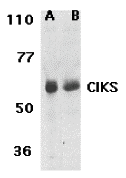 |
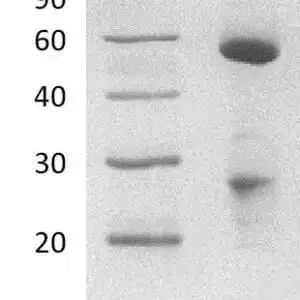
| Western blot analysis of CIKS expression in human lung (lane A) and placenta (lane B) tissue lysates with CIKS antibody at 1 µg/mL. |
 |
| Immunohistochemistry of CIKS in human lung tissue with CIKS antibody at 5 µg/mL. |
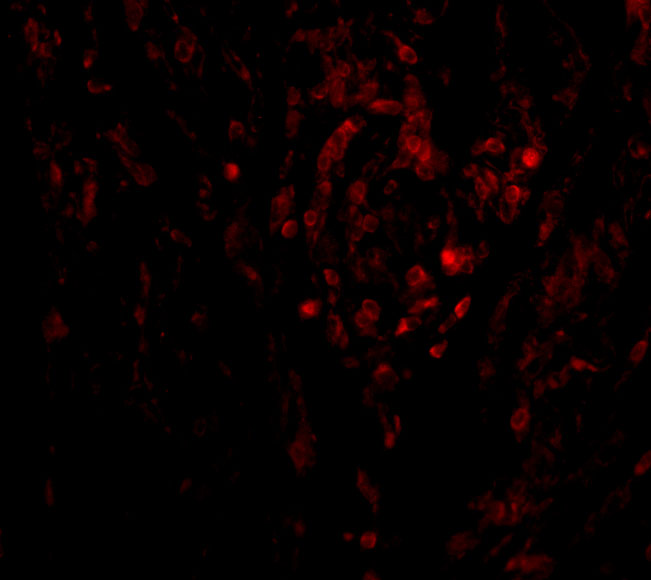 |
| Immunofluorescence of CIKS in human lung tissue with CIKS antibody at 20 µg/mL. |
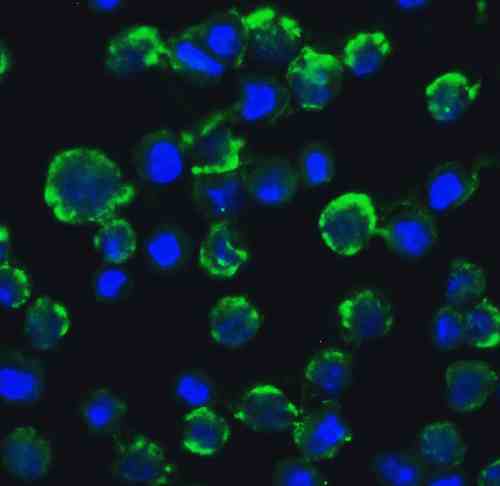 |
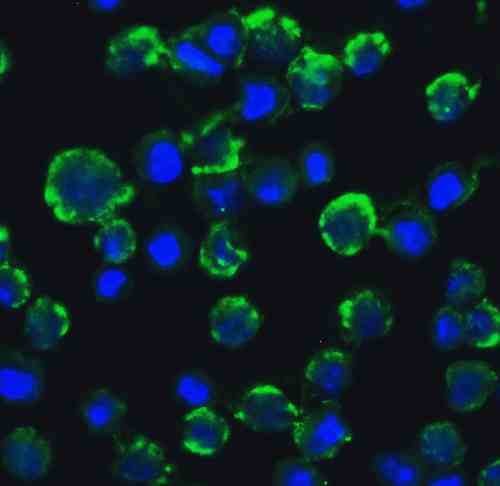
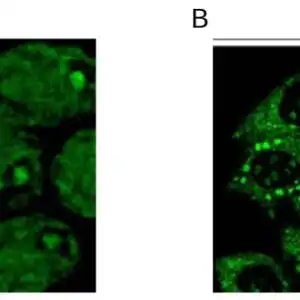
| Immunofluorescence of CIKS in A549 cells with CIKS antibody at 20 µg/mL.
Green: CIKS Antibody (9655) Blue: DAPI staining |
FAQ & Publications
Frequently Asked Questions
What applications has the rabbit anti-CIKS/Act1 (NT) polyclonal antibody been validated for?
This antibody has been tested and validated for use in Western blotting (WB), Immunohistochemistry (IHC), Immunocytochemistry/Immunofluorescence (ICC/IF), and ELISA applications.
How should the rabbit anti-CIKS/Act1 (NT) antibody be stored to maintain stability?
The antibody should be stored at -20°C and is stable for at least one year under these conditions. It is important to avoid multiple freeze-thaw cycles to preserve antibody integrity.
What is the recommended dilution for using this antibody in immunoblotting experiments?
For Western blotting, it is recommended to use the antibody at a concentration of 0.5 to 1 µg/mL to detect the CIKS protein, which appears as a band of approximately 63 kDa.
What is the immunogen used to generate the rabbit anti-CIKS/Act1 (NT) polyclonal antibody?
The antibody was raised against a peptide corresponding to amino acids 2 to 15 of the human CIKS protein.
Publications
| pmid | title | authors | citation |
|---|---|---|---|
| We haven't added any publications to our database yet. | |||
Published literature highly relevant to the biological target of this product and referencing this antibody or clone are retrieved from the PubMed database provided by the United States National Library of Medicine at the National Institutes of Health.
Protocols
| relevant to this product |
|---|
| Western blot IHC ICC |
Documents
| Batch Number | QC File | SDS |
|---|---|---|
| To view batch-specific Safety Datasheets and Quality Certificates associated with your account, please Log In. | ||
Only logged in customers who have purchased this product may leave a review.


Reviews
There are no reviews yet.