| Weight | 1 lbs |
|---|---|
| Dimensions | 9 × 5 × 2 in |
| host | rabbit |
| isotype | IgG |
| clonality | polyclonal |
| concentration | 1 mg/mL |
| applications | ICC/IF, WB |
| reactivity | CIDE-B (CT) |
| available sizes | 100 µg |
rabbit anti-CIDE-B (CT) polyclonal antibody 2048
$445.00
Antibody summary
- Rabbit polyclonal to CIDE-B (CT)
- Suitable for: ELISA,WB
- Isotype: IgG
- 100 µg
rabbit anti-CIDE-B (CT) polyclonal antibody 2048
| antibody |
|---|
| Tested applications WB,ELISA |
| Recommended dilutions Immunoblotting: use at 2ug/mL. These are recommended concentrations. Enduser should determine optimal concentration for their application. Positive control: Tissue lysate of mouse liver. |
| Immunogen Peptide corresponding to aa 204- 219 of mouse CIDE-B (accession no. AF041377). |
| Size and concentration 100µg and lot specific |
| Form liquid |
| Storage Instructions This antibody is stable for at least one (1) year at -20°C. Avoid multiple freeze-thaw cycles. |
| Storage buffer PBS, pH 7.4. |
| Purity peptide affinity purification |
| Clonality polyclonal |
| Isotype IgG |
| Compatible secondaries goat anti-rabbit IgG, H&L chain specific, peroxidase conjugated, conjugated polyclonal antibody 9512 goat anti-rabbit IgG, H&L chain specific, biotin conjugated polyclonal antibody 2079 goat anti-rabbit IgG, H&L chain specific, FITC conjugated polyclonal antibody 7863 goat anti-rabbit IgG, H&L chain specific, Cross Absorbed polyclonal antibody 2371 goat anti-rabbit IgG, H&L chain specific, biotin conjugated polyclonal antibody, crossabsorbed 1715 goat anti-rabbit IgG, H&L chain specific, FITC conjugated polyclonal antibody, crossabsorbed 1720 |
| Isotype control Rabbit polyclonal - Isotype Control |
| target relevance |
|---|
| Mus musculus CIDEB Lipid transferase CIDEB |
| Protein names Lipid transferase CIDEB |
| Alternative names Cell death activator CIDE-B, Cell death-inducing DFFA-like effector B |
| Gene names Cideb |
| Protein family Belongs to the CIDE family |
| Function Lipid transferase specifically expressed in hepatocytes, which promotes unilocular lipid droplet formation by mediating lipid droplet fusion (PubMed:26733203). Lipid droplet fusion promotes their enlargement, restricting lipolysis and favoring lipid storage (PubMed:26733203). Localizes on the lipid droplet surface, at focal contact sites between lipid droplets, and mediates atypical lipid droplet fusion by promoting directional net neutral lipid transfer from the smaller to larger lipid droplets (By similarity). The transfer direction may be driven by the internal pressure difference between the contacting lipid droplet pair (By similarity). Promotes lipid exchange and lipid droplet fusion in both small and large lipid droplet-containing hepatocytes (PubMed:26733203). In addition to its role in lipid droplet fusion, also involved in cytoplasmic vesicle biogenesis and transport (PubMed:19187774, PubMed:23297397, PubMed:30858281). Required for very-low-density lipoprotein (VLDL) lipidation and maturation (PubMed:19187774, PubMed:23297397). Probably involved in the biogenesis of VLDL transport vesicles by forming a COPII vesicle coat and facilitating the formation of endoplasmic reticulum-derived large vesicles (PubMed:23297397). Also involved in sterol-regulated export of the SCAP-SREBP complex, composed of SCAP, SREBF1/SREBP1 and SREBF2/SREBP2, by promoting loading of SCAP-SREBP into COPII vesicles (PubMed:30858281). May also activate apoptosis (PubMed:9564035) |
| Subcellular location Lipid droplet, Endoplasmic reticulum membrane, Golgi apparatus, Cytoplasmic vesicle, COPI-coated vesicle |
| Structure Interacts with DFFA (By similarity). Interacts with DFFB; inhibited by DFFB (By similarity). Interacts with APOB (PubMed:19187774, PubMed:23297397). Interacts with PREB/SEC12; facilitating loading of SCAP-SREBP into COPII vesicles (PubMed:30858281) |
| Keywords Apoptosis, Cytoplasmic vesicle, Endoplasmic reticulum, Golgi apparatus, Lipid droplet, Membrane, Phosphoprotein, Reference proteome |
| Sequence MEYLSAFNPNGLLRSVSTVSSELSRRVWNSAPPPQRPFRVCDHKRTVRKGLTAASLQELL DKVLETLLLRGVLTLVLEEDGTAVDSEDFFQLLEDDTCLMVLEQGQSWSPKSGMLSYGLG REKPKHSKDIARITFDVYKQNPRDLFGSLNVKATFYGLYSMSCDFQGVGPKRVLRELLRW TSSLLQGLGHMLLGISSTLRHVVEGADRWQWHGQRHLHS |
| UniProt accession: O70303 |
Data
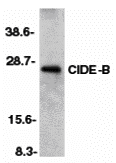 |
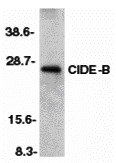
| Western blot analysis of CIDE-B in mouse liver tissue lysate with CIDE-B antibody at 1:500 dilution. |
FAQ & Publications
Frequently Asked Questions
What applications has the rabbit anti-CIDE-B (CT) polyclonal antibody 2048 been validated for?
This antibody has been tested and is suitable for use in Western blot (WB) and ELISA applications. Recommended use concentration for immunoblotting is 2 µg/mL, though optimal concentration should be determined by the end user.
How should the rabbit anti-CIDE-B (CT) polyclonal antibody 2048 be stored to maintain stability?
The antibody should be stored at -20°C and is stable for at least one year under these conditions. It is important to avoid multiple freeze-thaw cycles to preserve antibody integrity.
What is the immunogen used to generate the rabbit anti-CIDE-B (CT) polyclonal antibody 2048, and what is its host species and clonality?
The immunogen is a peptide corresponding to amino acids 204-219 of mouse CIDE-B. The antibody is a rabbit host-derived polyclonal IgG antibody.
Publications
| pmid | title | authors | citation |
|---|---|---|---|
| We haven't added any publications to our database yet. | |||
Published literature highly relevant to the biological target of this product and referencing this antibody or clone are retrieved from the PubMed database provided by the United States National Library of Medicine at the National Institutes of Health.
Protocols
| relevant to this product |
|---|
| Western blot IHC ICC |
Documents
| Batch Number | QC File | SDS |
|---|---|---|
| To view batch-specific Safety Datasheets and Quality Certificates associated with your account, please Log In. | ||
Only logged in customers who have purchased this product may leave a review.


Reviews
There are no reviews yet.