| Weight | 1 lbs |
|---|---|
| Dimensions | 9 × 5 × 2 in |
| host | rabbit |
| isotype | IgG |
| clonality | polyclonal |
| concentration | 1 mg/mL |
| applications | ICC/IF, WB |
| reactivity | Caspase-4 |
| available sizes | 100 µg |


rabbit anti-Caspase-4 antibody polyclonal antibody 7722
$445.00
Antibody summary
- Rabbit polyclonal to Caspase-4 Antibody
- Suitable for: ELISA,WB,IHC-P,IF
- Isotype: IgG
- 100 µg
rabbit anti-Caspase-4 antibody polyclonal antibody 7722
| antibody |
|---|
| Tested applications WB,IHC,IHC,ICC/IF,ELISA |
| Recommended dilutions Immunoblotting: use at 1ug/mL. Positive control: Ramos cell lysate. Immunohistochemistry: use at 2ug/mL. These are recommended concentrations. Enduser should determine optimal concentrations for their applications. |
| Immunogen Synthetic peptide corresponding to 16 amino acids at the amino-terminus of human Caspase-4 (accession no. |
| Size and concentration 100µg and lot specific |
| Form liquid |
| Storage Instructions This antibody is stable for at least one (1) year at -20°C. Avoid multiple freeze-thaw cycles. |
| Storage buffer PBS, pH 7.4. |
| Purity peptide affinity purification |
| Clonality polyclonal |
| Isotype IgG |
| Compatible secondaries goat anti-rabbit IgG, H&L chain specific, peroxidase conjugated, conjugated polyclonal antibody 9512 goat anti-rabbit IgG, H&L chain specific, biotin conjugated polyclonal antibody 2079 goat anti-rabbit IgG, H&L chain specific, FITC conjugated polyclonal antibody 7863 goat anti-rabbit IgG, H&L chain specific, Cross Absorbed polyclonal antibody 2371 goat anti-rabbit IgG, H&L chain specific, biotin conjugated polyclonal antibody, crossabsorbed 1715 goat anti-rabbit IgG, H&L chain specific, FITC conjugated polyclonal antibody, crossabsorbed 1720 |
| Isotype control Rabbit polyclonal - Isotype Control |
| target relevance |
|---|
| Homo sapiens CASP4 Caspase-4 |
| Protein names Caspase-4 |
| Alternative names ICE and Ced-3 homolog 2, ICE(rel)-II, Mih1, Protease TX |
| Gene names CASP4 |
| Protein family Belongs to the peptidase C14A family |
| Function Inflammatory caspase that acts as the effector of the non-canonical inflammasome by mediating lipopolysaccharide (LPS)-induced pyroptosis (PubMed:25119034, PubMed:26375003, PubMed:32109412, PubMed:34671164, PubMed:37001519, PubMed:37993712, PubMed:37993714). Also indirectly activates the NLRP3 and NLRP6 inflammasomes (PubMed:23516580, PubMed:26375003, PubMed:32109412, PubMed:7797510). Acts as a thiol protease that cleaves a tetrapeptide after an Asp residue at position P1: catalyzes cleavage of CGAS, GSDMD and IL18 (PubMed:15326478, PubMed:23516580, PubMed:26375003, PubMed:28314590, PubMed:32109412, PubMed:37993712, PubMed:37993714, PubMed:7797510). Effector of the non-canonical inflammasome independently of NLRP3 inflammasome and CASP1: the non-canonical inflammasome promotes pyroptosis through GSDMD cleavage without involving secretion of cytokine IL1B (PubMed:25119034, PubMed:25121752, PubMed:26375003, PubMed:31268602, PubMed:32109412, PubMed:37993712, PubMed:37993714). In the non-canonical inflammasome, CASP4 is activated by direct binding to the lipid A moiety of LPS without the need of an upstream sensor (PubMed:25119034, PubMed:25121752, PubMed:29520027, PubMed:32510692, PubMed:32581219, PubMed:37993712). LPS-binding promotes CASP4 activation and CASP4-mediated cleavage of GSDMD and IL18, followed by IL18 secretion through the GSDMD pore, pyroptosis of infected cells and their extrusion into the gut lumen (PubMed:25119034, PubMed:25121752, PubMed:37993712, PubMed:37993714). Also indirectly promotes secretion of mature cytokines (IL1A and HMGB1) downstream of GSDMD-mediated pyroptosis via activation of the NLRP3 and NLRP6 inflammasomes (PubMed:26375003, PubMed:32109412). Involved in NLRP3-dependent CASP1 activation and IL1B secretion in response to non-canonical activators, such as UVB radiation or cholera enterotoxin (PubMed:22246630, PubMed:23516580, PubMed:24879791, PubMed:25964352, PubMed:26173988, PubMed:26174085, PubMed:26508369). Involved in NLRP6 inflammasome-dependent activation in response to lipoteichoic acid (LTA), a cell-wall component of Gram-positive bacteria, which leads to CASP1 activation and IL1B secretion (PubMed:33377178). Involved in LPS-induced IL6 secretion; this activity may not require caspase enzymatic activity (PubMed:26508369). The non-canonical inflammasome is required for innate immunity to cytosolic, but not vacuolar, bacteria (By similarity). Plays a crucial role in the restriction of S.typhimurium replication in colonic epithelial cells during infection (PubMed:25121752, PubMed:25964352). Activation of the non-canonical inflammasome in brain endothelial cells can lead to excessive pyroptosis, leading to blood-brain barrier breakdown (By similarity). Pyroptosis limits bacterial replication, while cytokine secretion promotes the recruitment and activation of immune cells and triggers mucosal inflammation (PubMed:25121752, PubMed:25964352, PubMed:26375003). May also act as an activator of adaptive immunity in dendritic cells, following activation by oxidized phospholipid 1-palmitoyl-2-arachidonoyl- sn-glycero-3-phosphorylcholine, an oxidized phospholipid (oxPAPC) (By similarity). Involved in cell death induced by endoplasmic reticulum stress and by treatment with cytotoxic APP peptides found in Alzheimer's patient brains (PubMed:15123740, PubMed:22246630, PubMed:23661706). Cleavage of GSDMD is not strictly dependent on the consensus cleavage site but depends on an exosite interface on CASP4 that recognizes and binds the Gasdermin-D, C-terminal (GSDMD-CT) part (PubMed:32109412). Catalyzes cleavage and maturation of IL18; IL18 processing also depends of the exosite interface on CASP4 (PubMed:15326478, PubMed:37993712, PubMed:37993714). In contrast, it does not directly process IL1B (PubMed:7743998, PubMed:7797510, PubMed:7797592). During non-canonical inflammasome activation, cuts CGAS and may play a role in the regulation of antiviral innate immune activation (PubMed:28314590) |
| Catalytic activity Strict requirement for Asp at the P1 position. It has a preferred cleavage sequence of Tyr-Val-Ala-Asp-|- but also cleaves at Asp-Glu-Val-Asp-|-. |
| Subcellular location Cytoplasm, cytosol, Endoplasmic reticulum membrane, Mitochondrion, Inflammasome, Secreted |
| Structure (Microbial infection) Interacts with cathepsin CTSG; the interaction is promoted by the Td92 surface protein of the periodontal pathogen T.denticola and leads to CASP4 activation |
| Post-translational modification In response to activation signals, undergoes autoproteolytic cleavage and activation (Microbial infection) ADP-riboxanation by S.flexneri OspC3 blocks CASP4 autoprocessing, preventing CASP4 activation and ability to recognize and cleave GSDMD, thereby thwarting the inflammasome/pyroptosis-mediated defense |
| Keywords 3D-structure, Acetylation, Alternative splicing, Cytoplasm, Endoplasmic reticulum, Hydrolase, Immunity, Inflammasome, Inflammatory response, Innate immunity, Membrane, Mitochondrion, Necrosis, Phosphoprotein, Protease, Proteomics identification, Reference proteome, Secreted, Thiol protease, Zymogen |
| Sequence MAEGNHRKKPLKVLESLGKDFLTGVLDNLVEQNVLNWKEEEKKKYYDAKTEDKVRVMADS MQEKQRMAGQMLLQTFFNIDQISPNKKAHPNMEAGPPESGESTDALKLCPHEEFLRLCKE RAEEIYPIKERNNRTRLALIICNTEFDHLPPRNGADFDITGMKELLEGLDYSVDVEENLT ARDMESALRAFATRPEHKSSDSTFLVLMSHGILEGICGTVHDEKKPDVLLYDTIFQIFNN RNCLSLKDKPKVIIVQACRGANRGELWVRDSPASLEVASSQSSENLEEDAVYKTHVEKDF IAFCSSTPHNVSWRDSTMGSIFITQLITCFQKYSWCCHLEEVFRKVQQSFETPRAKAQMP TIERLSMTRYFYLFPGN |
| UniProt accession: P49662 |
Data
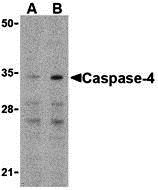 |
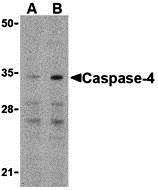
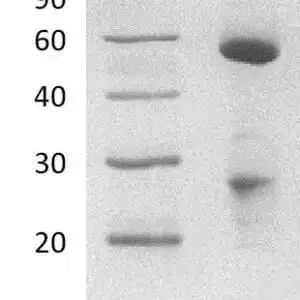
| Western blot analysis of caspase-4 in Ramos cells with caspase-4 antibody at (A) 0.5 and (B) 1 µg/mL. |
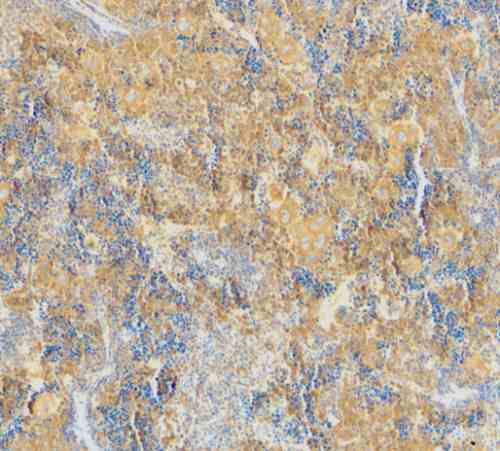 |
| Immunohistochemical staining of mouse spleen using caspase-4 antibody at 2 µg/mL. |
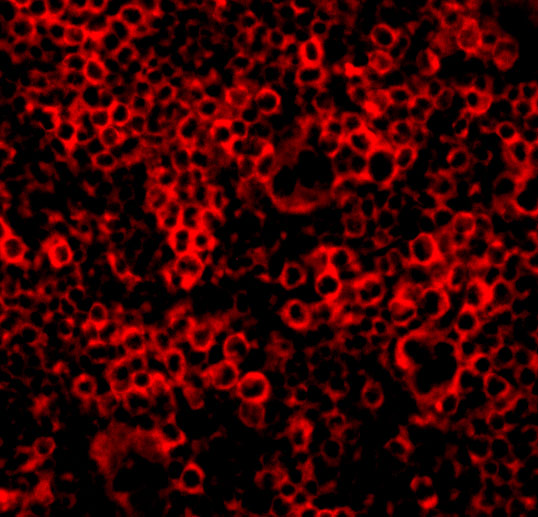 |
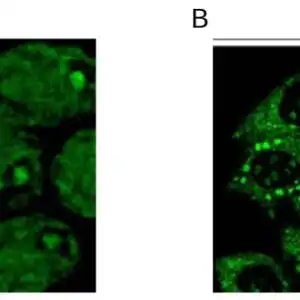
| Immunofluorescence of Caspase-4 in Mouse Spleen 100 cells with Caspase-4 antibody at µg/mL. |
FAQ & Publications
Frequently Asked Questions
What applications is the rabbit anti-Caspase-4 polyclonal antibody suitable for, and what are the recommended dilutions?
This rabbit anti-Caspase-4 polyclonal antibody is suitable for ELISA, Western blotting (WB), Immunohistochemistry (IHC), and Immunofluorescence (IF). Recommended dilutions are 1 µg/mL for immunoblotting and 2 µg/mL for immunohistochemistry. Users should optimize concentrations based on their specific experimental conditions.
How should the rabbit anti-Caspase-4 antibody be stored to maintain stability, and what is its concentration and form?
The antibody is supplied as a liquid at a concentration of 1 mg/mL. It should be stored at -20°C and is stable for at least one year under these conditions. To preserve antibody integrity, avoid multiple freeze-thaw cycles. The storage buffer is PBS at pH 7.4.
Publications
| pmid | title | authors | citation |
|---|---|---|---|
| We haven't added any publications to our database yet. | |||
Published literature highly relevant to the biological target of this product and referencing this antibody or clone are retrieved from the PubMed database provided by the United States National Library of Medicine at the National Institutes of Health.
Protocols
| relevant to this product |
|---|
| Western blot IHC ICC |
Documents
| Batch Number | QC File | SDS |
|---|---|---|
| To view batch-specific Safety Datasheets and Quality Certificates associated with your account, please Log In. | ||
Only logged in customers who have purchased this product may leave a review.


Reviews
There are no reviews yet.