| Weight | 1 lbs |
|---|---|
| Dimensions | 9 × 5 × 2 in |
| host | rabbit |
| isotype | IgG |
| clonality | polyclonal |
| concentration | 1 mg/mL |
| applications | ICC/IF, WB |
| reactivity | Bnip3L (IN) |
| available sizes | 100 µg |


rabbit anti-Bnip3L (IN) polyclonal antibody 5958
$445.00
Antibody summary
- Rabbit polyclonal to Bnip3L (IN)
- Suitable for: ELISA,WB,IHC-P,IF
- Isotype: IgG
- 100 µg
rabbit anti-Bnip3L (IN) polyclonal antibody 5958
| antibody |
|---|
| Tested applications WB,IHC,IHC,ICC/IF,ELISA |
| Recommended dilutions Immunoblotting: use at 1ug/mL. Immunohistochemistry: use at 2ug/mL. These are recommended concentrations. Enduser should determine optimal concentrations for their applications. Positive control: Whole cell lysate of human K562 cells. |
| Immunogen Peptide corresponding to aa 77- 92 of human Bnip3L (accession no. AF067396) This amino acid sequence is identical to that of mouse. |
| Size and concentration 100µg and lot specific |
| Form liquid |
| Storage Instructions This antibody is stable for at least one (1) year at -20°C. Avoid multiple freeze-thaw cycles. |
| Storage buffer PBS, pH 7.4. |
| Purity peptide affinity purification |
| Clonality polyclonal |
| Isotype IgG |
| Compatible secondaries goat anti-rabbit IgG, H&L chain specific, peroxidase conjugated, conjugated polyclonal antibody 9512 goat anti-rabbit IgG, H&L chain specific, biotin conjugated polyclonal antibody 2079 goat anti-rabbit IgG, H&L chain specific, FITC conjugated polyclonal antibody 7863 goat anti-rabbit IgG, H&L chain specific, Cross Absorbed polyclonal antibody 2371 goat anti-rabbit IgG, H&L chain specific, biotin conjugated polyclonal antibody, crossabsorbed 1715 goat anti-rabbit IgG, H&L chain specific, FITC conjugated polyclonal antibody, crossabsorbed 1720 |
| Isotype control Rabbit polyclonal - Isotype Control |
| target relevance |
|---|
| Homo sapiens BNIP3L BCL2/adenovirus E1B 19 kDa protein-interacting protein 3-like |
| Protein names BCL2/adenovirus E1B 19 kDa protein-interacting protein 3-like |
| Alternative names Adenovirus E1B19K-binding protein B5, BCL2/adenovirus E1B 19 kDa protein-interacting protein 3A, NIP3-like protein X |
| Gene names BNIP3L |
| Protein family Belongs to the NIP3 family |
| Function Induces apoptosis. Interacts with viral and cellular anti-apoptosis proteins. Can overcome the suppressors BCL-2 and BCL-XL, although high levels of BCL-XL expression will inhibit apoptosis. Inhibits apoptosis induced by BNIP3. Involved in mitochondrial quality control via its interaction with SPATA18/MIEAP: in response to mitochondrial damage, participates in mitochondrial protein catabolic process (also named MALM) leading to the degradation of damaged proteins inside mitochondria. The physical interaction of SPATA18/MIEAP, BNIP3 and BNIP3L/NIX at the mitochondrial outer membrane regulates the opening of a pore in the mitochondrial double membrane in order to mediate the translocation of lysosomal proteins from the cytoplasm to the mitochondrial matrix. May function as a tumor suppressor |
| Subcellular location Nucleus envelope, Endoplasmic reticulum, Mitochondrion outer membrane, Membrane |
| Structure (Microbial infection) Interacts with Kaposi's sarcoma-associated herpesvirus protein VIRF-1 |
| Post-translational modification Undergoes progressive proteolysis to an 11 kDa C-terminal fragment, which is blocked by the proteasome inhibitor lactacystin |
| Keywords Alternative splicing, Apoptosis, Endoplasmic reticulum, Host-virus interaction, Membrane, Mitochondrion, Mitochondrion outer membrane, Nucleus, Phosphoprotein, Proteomics identification, Reference proteome, Transmembrane, Transmembrane helix |
| Sequence MSSHLVEPPPPLHNNNNNCEENEQSLPPPAGLNSSWVELPMNSSNGNDNGNGKNGGLEHV PSSSSIHNGDMEKILLDAQHESGQSSSRGSSHCDSPSPQEDGQIMFDVEMHTSRDHSSQS EEEVVEGEKEVEALKKSADWVSDWSSRPENIPPKEFHFRHPKRSVSLSMRKSGAMKKGGI FSAEFLKVFIPSLFLSHVLALGLGIYIGKRLSTPSASTY |
| UniProt accession: O60238 |
Data
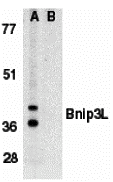 |
| Western blot analysis of Bnip3L in K562 whole cell lysate in (A) the absence, or (B) presence of immunogenic peptide with Bnip3L antibody at 1 µg/mL. |
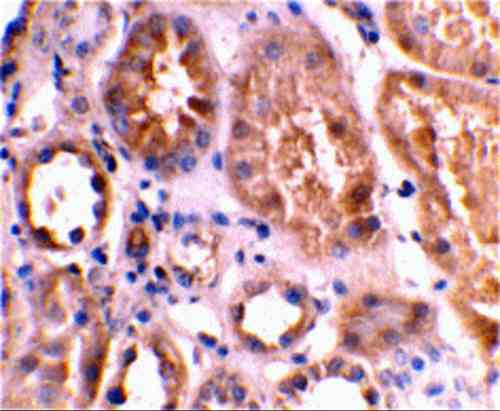 |
| Immunohistochemical staining of human kidney tissue using Bnip3L antibody at 2 µg/mL. |
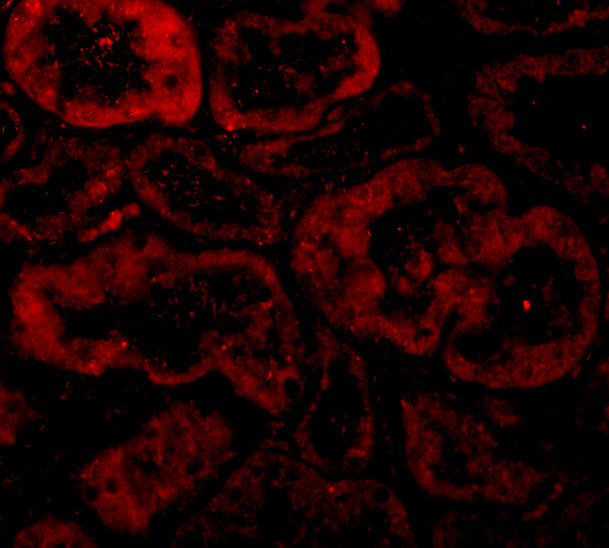 |
| Immunofluorescence of Bnip3L in Human Kidney tissue with Bnip3L antibody at 10 µg/mL. |
FAQ & Publications
Frequently Asked Questions
What are the recommended applications and dilutions for the rabbit anti-Bnip3L (IN) polyclonal antibody 5958?
This antibody is suitable for ELISA, Western blot (WB), immunohistochemistry (IHC-P), and immunofluorescence (IF). Recommended dilutions are 1 µg/mL for immunoblotting and 2 µg/mL for immunohistochemistry, though end users should optimize concentrations for their specific applications.
How should the rabbit anti-Bnip3L (IN) polyclonal antibody 5958 be stored to maintain stability?
The antibody should be stored at -20°C and is stable for at least one year under these conditions. Multiple freeze-thaw cycles should be avoided to preserve antibody integrity. It is supplied in PBS buffer at pH 7.4.
What is the immunogen used to generate the rabbit anti-Bnip3L (IN) polyclonal antibody 5958, and does it cross-react with mouse Bnip3L?
The immunogen is a peptide corresponding to amino acids 77-92 of human Bnip3L (accession no. AF067396). This amino acid sequence is identical to that of mouse Bnip3L, indicating cross-reactivity with mouse protein.
Publications
| pmid | title | authors | citation |
|---|---|---|---|
| We haven't added any publications to our database yet. | |||
Published literature highly relevant to the biological target of this product and referencing this antibody or clone are retrieved from the PubMed database provided by the United States National Library of Medicine at the National Institutes of Health.
Protocols
| relevant to this product |
|---|
| Western blot IHC ICC |
Documents
| Batch Number | QC File | SDS |
|---|---|---|
| To view batch-specific Safety Datasheets and Quality Certificates associated with your account, please Log In. | ||
Only logged in customers who have purchased this product may leave a review.


Reviews
There are no reviews yet.