| Weight | 1 lbs |
|---|---|
| Dimensions | 9 × 5 × 2 in |
| host | rabbit |
| isotype | IgG |
| clonality | polyclonal |
| concentration | 1 mg/mL |
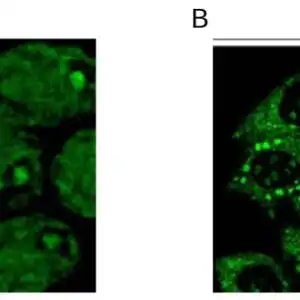
| applications | ICC/IF, WB |
| reactivity | BACH1 |
| available sizes | 100 µg |

rabbit anti-BACH1 polyclonal antibody 6739
$376.00
Antibody summary
- Rabbit polyclonal to BACH1
- Suitable for: WB
- Isotype: Whole IgG
- 100 µg
rabbit anti-BACH1 polyclonal antibody 6739
| antibody |
|---|
| Tested applications WB |
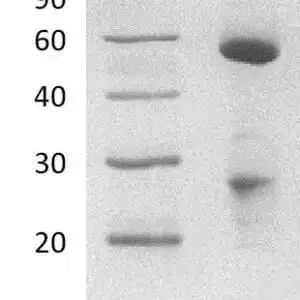
| Recommended dilutions Immunoblotting: use at 1:500-1:1,000 dilution. A band of approximately 81 kD is detected. |
| Immunogen Peptide corresponding to aa 1233-1249 of the human BACH1 protein. |
| Size and concentration 100µg and lot specific |
| Form liquid |
| Storage Instructions This antibody is stable for at least one (1) year at -70°C. Avoid multiple freeze- thaw cycles. |
| Storage buffer PBS, pH 7.4. |
| Purity immunogen affinity purification |
| Clonality polyclonal |
| Isotype IgG |
| Compatible secondaries goat anti-rabbit IgG, H&L chain specific, peroxidase conjugated, conjugated polyclonal antibody 9512 goat anti-rabbit IgG, H&L chain specific, biotin conjugated polyclonal antibody 2079 goat anti-rabbit IgG, H&L chain specific, FITC conjugated polyclonal antibody 7863 goat anti-rabbit IgG, H&L chain specific, Cross Absorbed polyclonal antibody 2371 goat anti-rabbit IgG, H&L chain specific, biotin conjugated polyclonal antibody, crossabsorbed 1715 goat anti-rabbit IgG, H&L chain specific, FITC conjugated polyclonal antibody, crossabsorbed 1720 |
| Isotype control Rabbit polyclonal - Isotype Control |
| target relevance |
|---|
| Homo sapiens BACH1 Transcription regulator protein BACH1 |
| Protein names Transcription regulator protein BACH1 |
| Alternative names BTB and CNC homolog 1, HA2303 |
| Gene names BACH1 |
| Protein family Belongs to the bZIP family. CNC subfamily |
| Function Transcriptional regulator that acts as a repressor or activator, depending on the context. Binds to NF-E2 DNA binding sites. Plays important roles in coordinating transcription activation and repression by MAFK (By similarity). Together with MAF, represses the transcription of genes under the control of the NFE2L2 oxidative stress pathway (PubMed:24035498) |
| Subcellular location Nucleus |
| Structure Heterodimer of BACH1 and MAFK |
| Post-translational modification Ubiquitinated by the SCF(FBXL17) complex or by the by the SCF(FBXO22) complex, leading to its degradation by the proteasome. Under oxidative stress, reactive oxygen species covalently modify cysteine residues on the bZIP domain of BACH1 and release it from chromatin. If the BTB domain of BACH1 remains intact, its beta1-alpha6 degron is recognized by FBXO22, promoting its ubiquitination and degradation. If the structural integrity of the beta1-alpha6 degron is compromised, FBXL17 will transiently associate with the BACH1 BTB dimer and remodel it into stably bound monomer for ubiquitination and degradation (PubMed:39504958) |
| Keywords 3D-structure, Activator, DNA-binding, Nucleus, Phosphoprotein, Proteomics identification, Reference proteome, Repressor, Transcription, Transcription regulation, Ubl conjugation |
| Sequence MSLSENSVFAYESSVHSTNVLLSLNDQRKKDVLCDVTIFVEGQRFRAHRSVLAACSSYFH SRIVGQADGELNITLPEEVTVKGFEPLIQFAYTAKLILSKENVDEVCKCVEFLSVHNIEE SCFQFLKFKFLDSTADQQECPRKKCFSSHCQKTDLKLSLLDQRDLETDEVEEFLENKNVQ TPQCKLRRYQGNAKASPPLQDSASQTYESMCLEKDAALALPSLCPKYRKFQKAFGTDRVR TGESSVKDIHASVQPNERSENECLGGVPECRDLQVMLKCDESKLAMEPEETKKDPASQCP TEKSEVTPFPHNSSIDPHGLYSLSLLHTYDQYGDLNFAGMQNTTVLTEKPLSGTDVQEKT FGESQDLPLKSDLGTREDSSVASSDRSSVEREVAEHLAKGFWSDICSTDTPCQMQLSPAV AKDGSEQISQKRSECPWLGIRISESPEPGQRTFTTLSSVNCPFISTLSTEGCSSNLEIGN DDYVSEPQQEPCPYACVISLGDDSETDTEGDSESCSAREQECEVKLPFNAQRIISLSRND FQSLLKMHKLTPEQLDCIHDIRRRSKNRIAAQRCRKRKLDCIQNLESEIEKLQSEKESLL KERDHILSTLGETKQNLTGLCQKVCKEAALSQEQIQILAKYSAADCPLSFLISEKDKSTP DGELALPSIFSLSDRPPAVLPPCARGNSEPGYARGQESQQMSTATSEQAGPAEQCRQSGG ISDFCQQMTDKCTTDE |
| UniProt accession: O14867 |
Data
| No results found |
FAQ & Publications
Frequently Asked Questions
What applications is the rabbit anti-BACH1 polyclonal antibody 6739 validated for?
This antibody is validated for Western blot (WB) and immunocytochemistry/immunofluorescence (ICC/IF) applications.
How should the rabbit anti-BACH1 antibody 6739 be stored to maintain stability?
The antibody should be stored at -70°C and is stable for at least one year under these conditions. It is important to avoid multiple freeze-thaw cycles to preserve antibody integrity.
What is the recommended dilution range for using this antibody in Western blot analysis?
For immunoblotting, it is recommended to use the antibody at a dilution between 1:500 and 1:1,000. A band of approximately 81 kDa corresponding to BACH1 can be detected under these conditions.
What is the immunogen used to generate the rabbit anti-BACH1 polyclonal antibody 6739?
The immunogen is a peptide corresponding to amino acids 1233 to 1249 of the human BACH1 protein.
Which secondary antibodies are compatible with this rabbit anti-BACH1 polyclonal antibody?
Compatible secondary antibodies include goat anti-rabbit IgG antibodies that are H&L chain specific and conjugated to peroxidase, biotin, or FITC. Cross-absorbed versions are also compatible.
Publications
| pmid | title | authors | citation |
|---|---|---|---|
| We haven't added any publications to our database yet. | |||
Published literature highly relevant to the biological target of this product and referencing this antibody or clone are retrieved from the PubMed database provided by the United States National Library of Medicine at the National Institutes of Health.
Protocols
| relevant to this product |
|---|
| Western blot IHC ICC |
Documents
| Batch Number | QC File | SDS |
|---|---|---|
| To view batch-specific Safety Datasheets and Quality Certificates associated with your account, please Log In. | ||
Only logged in customers who have purchased this product may leave a review.


Reviews
There are no reviews yet.