| Weight | 1 lbs |
|---|---|
| Dimensions | 9 × 5 × 2 in |
| host | rabbit |
| isotype | IgG |
| clonality | polyclonal |
| concentration | 1 mg/mL |
| applications | ICC/IF, WB |
| reactivity | ATR |
| available sizes | 100 µg |


rabbit anti-ATR polyclonal antibody 6893
$518.00
Antibody summary
- Rabbit polyclonal to ATR
- Suitable for: WB,IP
- Isotype: Whole IgG
- 100 µg
rabbit anti-ATR polyclonal antibody 6893
| target relevance |
|---|
| Homo sapiens ATR Serine/threonine-protein kinase ATR |
| Protein names Serine/threonine-protein kinase ATR |
| Alternative names Ataxia telangiectasia and Rad3-related protein, FRAP-related protein 1 |
| Gene names ATR |
| Protein family Belongs to the PI3/PI4-kinase family. ATM subfamily |
| Function Serine/threonine protein kinase which activates checkpoint signaling upon genotoxic stresses such as ionizing radiation (IR), ultraviolet light (UV), or DNA replication stalling, thereby acting as a DNA damage sensor (PubMed:10597277, PubMed:10608806, PubMed:10859164, PubMed:11721054, PubMed:12791985, PubMed:12814551, PubMed:14657349, PubMed:14729973, PubMed:14742437, PubMed:15210935, PubMed:15496423, PubMed:16260606, PubMed:21144835, PubMed:21777809, PubMed:23273981, PubMed:25083873, PubMed:27723717, PubMed:27723720, PubMed:30139873, PubMed:33848395, PubMed:37788673, PubMed:37832547, PubMed:9427750, PubMed:9636169). Recognizes the substrate consensus sequence [ST]-Q (PubMed:10597277, PubMed:10608806, PubMed:10859164, PubMed:11721054, PubMed:12791985, PubMed:12814551, PubMed:14657349, PubMed:14729973, PubMed:14742437, PubMed:15210935, PubMed:15496423, PubMed:16260606, PubMed:21144835, PubMed:23273981, PubMed:27723717, PubMed:27723720, PubMed:33848395, PubMed:9427750, PubMed:9636169). Phosphorylates BRCA1, CHEK1, MCM2, RAD17, RBBP8, RPA2, SMC1 and p53/TP53, which collectively inhibit DNA replication and mitosis and promote DNA repair, recombination and apoptosis (PubMed:11114888, PubMed:11418864, PubMed:11865061, PubMed:21777809, PubMed:23273981, PubMed:25083873, PubMed:9925639). Phosphorylates 'Ser-139' of histone variant H2AX at sites of DNA damage, thereby regulating DNA damage response mechanism (PubMed:11673449). Required for FANCD2 ubiquitination (PubMed:15314022). Critical for maintenance of fragile site stability and efficient regulation of centrosome duplication (PubMed:12526805). Acts as a regulator of the S-G2 transition by restricting the activity of CDK1 during S-phase to prevent premature entry into G2 (PubMed:30139873). Acts as a regulator of the nuclear envelope integrity in response to DNA damage and stress (PubMed:25083873, PubMed:37788673, PubMed:37832547). Acts as a mechanical stress sensor at the nuclear envelope: relocalizes to the nuclear envelope in response to mechanical stress and mediates a checkpoint via phosphorylation of CHEK1 (PubMed:25083873). Also promotes nuclear envelope rupture in response to DNA damage by mediating phosphorylation of LMNA at 'Ser-282', leading to lamin disassembly (PubMed:37832547). Involved in the inflammatory response to genome instability and double-stranded DNA breaks: acts by localizing to micronuclei arising from genome instability and catalyzing phosphorylation of LMNA at 'Ser-395', priming LMNA for subsequent phosphorylation by CDK1 and micronuclei envelope rupture (PubMed:37788673). The rupture of micronuclear envelope triggers the cGAS-STING pathway thereby activating the type I interferon response and innate immunity (PubMed:37788673). Positively regulates the restart of stalled replication forks following activation by the KHDC3L-OOEP scaffold complex (By similarity) |
| Catalytic activity L-seryl-[protein] + ATP = O-phospho-L-seryl-[protein] + ADP + H(+) L-threonyl-[protein] + ATP = O-phospho-L-threonyl-[protein] + ADP + H(+) |
| Subcellular location Nucleus, Chromosome, Nucleus envelope |
| Structure Forms a heterodimer with ATRIP, forming the ATR-ATRIP complex (PubMed:11721054, PubMed:12791985, PubMed:14729973, PubMed:15758953, PubMed:21777809). Present in a complex containing ATRIP and RPA-coated single-stranded DNA (PubMed:12791985, PubMed:14729973). Binds to DNA, and to UV-damaged DNA with higher affinity (PubMed:12791985). Interacts with MSH2 and HDAC2 (PubMed:14657349). Present in a complex containing CHD4 and HDAC2 (PubMed:10545197). Interacts with EEF1E1, the interaction is enhanced by UV irradiation (PubMed:15680327). Interacts with CLSPN and CEP164 (PubMed:12766152, PubMed:18283122). Interacts with TELO2 and TTI1 (PubMed:20427287, PubMed:20801936, PubMed:20810650). Interacts with BCR-ABL after genotoxic stress (PubMed:15050919). Interacts with UHRF2; this interaction promotes ATR activation (PubMed:33848395). Interacts (when phosphorylated) with TOPBP1; interaction takes place when ATR is autophosphorylated at Thr-1989, leading to ATR activation by TOPBP1 (PubMed:21705319, PubMed:21777809) |
| Post-translational modification Phosphorylated (PubMed:21144835). Autophosphorylation at Thr-1989 in response to DNA damage promotes interaction with TOPBP1 and activation of ATR (PubMed:21705319, PubMed:21777809) |
| Involvement in disease Seckel syndrome 1 A rare autosomal recessive disorder characterized by proportionate dwarfism of prenatal onset associated with low birth weight, growth retardation, severe microcephaly with a bird-headed like appearance, and intellectual disability. Cutaneous telangiectasia and cancer syndrome, familial A disease characterized by cutaneous telangiectases in infancy with patchy alopecia over areas of affected skin, thinning of the lateral eyebrows, and mild dental and nail anomalies. Affected individuals are at increased risk of developing oropharyngeal cancer, and other malignancies have been reported as well. |
| Keywords 3D-structure, Alternative splicing, ATP-binding, Chromosome, Disease variant, DNA damage, DNA repair, DNA-binding, Dwarfism, Intellectual disability, Kinase, Manganese, Nucleotide-binding, Nucleus, Phosphoprotein, Proteomics identification, Reference proteome, Repeat, Serine/threonine-protein kinase, Transferase |
| Sequence MGEHGLELASMIPALRELGSATPEEYNTVVQKPRQILCQFIDRILTDVNVVAVELVKKTD SQPTSVMLLDFIQHIMKSSPLMFVNVSGSHEAKGSCIEFSNWIITRLLRIAATPSCHLLH KKICEVICSLLFLFKSKSPAIFGVLTKELLQLFEDLVYLHRRNVMGHAVEWPVVMSRFLS QLDEHMGYLQSAPLQLMSMQNLEFIEVTLLMVLTRIIAIVFFRRQELLLWQIGCVLLEYG SPKIKSLAISFLTELFQLGGLPAQPASTFFSSFLELLKHLVEMDTDQLKLYEEPLSKLIK TLFPFEAEAYRNIEPVYLNMLLEKLCVMFEDGVLMRLKSDLLKAALCHLLQYFLKFVPAG YESALQVRKVYVRNICKALLDVLGIEVDAEYLLGPLYAALKMESMEIIEEIQCQTQQENL SSNSDGISPKRRRLSSSLNPSKRAPKQTEEIKHVDMNQKSILWSALKQKAESLQISLEYS GLKNPVIEMLEGIAVVLQLTALCTVHCSHQNMNCRTFKDCQHKSKKKPSVVITWMSLDFY TKVLKSCRSLLESVQKLDLEATIDKVVKIYDALIYMQVNSSFEDHILEDLCGMLSLPWIY SHSDDGCLKLTTFAANLLTLSCRISDSYSPQAQSRCVFLLTLFPRRIFLEWRTAVYNWAL QSSHEVIRASCVSGFFILLQQQNSCNRVPKILIDKVKDDSDIVKKEFASILGQLVCTLHG MFYLTSSLTEPFSEHGHVDLFCRNLKATSQHECSSSQLKASVCKPFLFLLKKKIPSPVKL AFIDNLHHLCKHLDFREDETDVKAVLGTLLNLMEDPDKDVRVAFSGNIKHILESLDSEDG FIKELFVLRMKEAYTHAQISRNNELKDTLILTTGDIGRAAKGDLVPFALLHLLHCLLSKS ASVSGAAYTEIRALVAAKSVKLQSFFSQYKKPICQFLVESLHSSQMTALPNTPCQNADVR KQDVAHQREMALNTLSEIANVFDFPDLNRFLTRTLQVLLPDLAAKASPAASALIRTLGKQ LNVNRREILINNFKYIFSHLVCSCSKDELERALHYLKNETEIELGSLLRQDFQGLHNELL LRIGEHYQQVFNGLSILASFASSDDPYQGPRDIISPELMADYLQPKLLGILAFFNMQLLS SSVGIEDKKMALNSLMSLMKLMGPKHVSSVRVKMMTTLRTGLRFKDDFPELCCRAWDCFV RCLDHACLGSLLSHVIVALLPLIHIQPKETAAIFHYLIIENRDAVQDFLHEIYFLPDHPE LKKIKAVLQEYRKETSESTDLQTTLQLSMKAIQHENVDVRIHALTSLKETLYKNQEKLIK YATDSETVEPIISQLVTVLLKGCQDANSQARLLCGECLGELGAIDPGRLDFSTTETQGKD FTFVTGVEDSSFAYGLLMELTRAYLAYADNSRAQDSAAYAIQELLSIYDCREMETNGPGH QLWRRFPEHVREILEPHLNTRYKSSQKSTDWSGVKKPIYLSKLGSNFAEWSASWAGYLIT KVRHDLASKIFTCCSIMMKHDFKVTIYLLPHILVYVLLGCNQEDQQEVYAEIMAVLKHDD QHTINTQDIASDLCQLSTQTVFSMLDHLTQWARHKFQALKAEKCPHSKSNRNKVDSMVST VDYEDYQSVTRFLDLIPQDTLAVASFRSKAYTRAVMHFESFITEKKQNIQEHLGFLQKLY AAMHEPDGVAGVSAIRKAEPSLKEQILEHESLGLLRDATACYDRAIQLEPDQIIHYHGVV KSMLGLGQLSTVITQVNGVHANRSEWTDELNTYRVEAAWKLSQWDLVENYLAADGKSTTW SVRLGQLLLSAKKRDITAFYDSLKLVRAEQIVPLSAASFERGSYQRGYEYIVRLHMLCEL EHSIKPLFQHSPGDSSQEDSLNWVARLEMTQNSYRAKEPILALRRALLSLNKRPDYNEMV GECWLQSARVARKAGHHQTAYNALLNAGESRLAELYVERAKWLWSKGDVHQALIVLQKGV ELCFPENETPPEGKNMLIHGRAMLLVGRFMEETANFESNAIMKKYKDVTACLPEWEDGHF YLAKYYDKLMPMVTDNKMEKQGDLIRYIVLHFGRSLQYGNQFIYQSMPRMLTLWLDYGTK AYEWEKAGRSDRVQMRNDLGKINKVITEHTNYLAPYQFLTAFSQLISRICHSHDEVFVVL MEIIAKVFLAYPQQAMWMMTAVSKSSYPMRVNRCKEILNKAIHMKKSLEKFVGDATRLTD KLLELCNKPVDGSSSTLSMSTHFKMLKKLVEEATFSEILIPLQSVMIPTLPSILGTHANH ASHEPFPGHWAYIAGFDDMVEILASLQKPKKISLKGSDGKFYIMMCKPKDDLRKDCRLME FNSLINKCLRKDAESRRRELHIRTYAVIPLNDECGIIEWVNNTAGLRPILTKLYKEKGVY MTGKELRQCMLPKSAALSEKLKVFREFLLPRHPPIFHEWFLRTFPDPTSWYSSRSAYCRS TAVMSMVGYILGLGDRHGENILFDSLTGECVHVDFNCLFNKGETFEVPEIVPFRLTHNMV NGMGPMGTEGLFRRACEVTMRLMRDQREPLMSVLKTFLHDPLVEWSKPVKGHSKAPLNET GEVVNEKAKTHVLDIEQRLQGVIKTRNRVTGLPLSIEGHVHYLIQEATDENLLCQMYLGW TPYM |
| UniProt accession: Q13535 |
Data
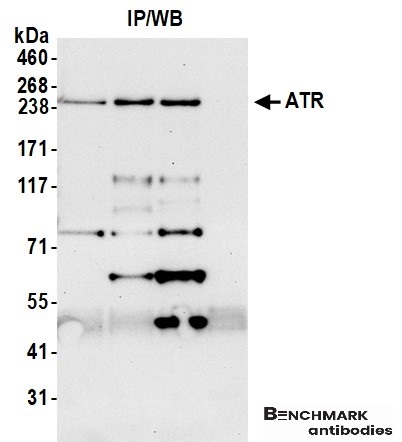 |
| Detection of human ATR by western blot of immunoprecipitates. Samples: Whole cell lysate (1.0 mg per IP reaction; 20% of IP loaded) from HeLa cells prepared using NETN lysis buffer. Antibodies: Affinity purified rabbit anti-ATR antibody (6893 lot 3) used for IP at 6 µg per reaction. ATR was also immunoprecipitated by a previous lot of this antibody (6893 lot 2) and a second antibody against a different epitope of rabbit ATR (13018). For blotting immunoprecipitated ATR, 6893 was used at 0.1 µg /ml. Detection: Chemiluminescence with an exposure time of 10 seconds. |
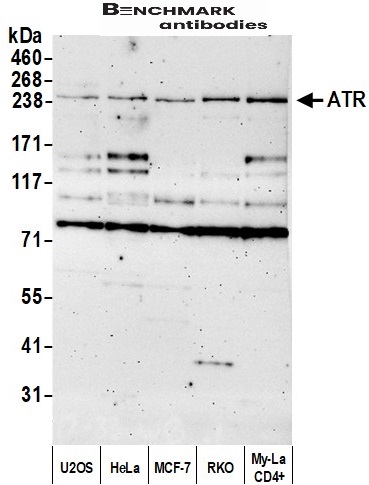 |
| Detection of human ATR by western blot. Samples: Whole cell lysate (10 µg ) from U2OS, HeLa, MCF-7, RKO, and My-La CD4+ cells prepared using NETN lysis buffer. Antibody: Affinity purified rabbit anti-ATR antibody (6893 lot 3) used for WB at 0.1 µg /ml. Detection: Chemiluminescence with an exposure time of 3 minutes. |
FAQ & Publications
Frequently Asked Questions
What applications is the rabbit anti-ATR polyclonal antibody 6893 validated for?
This antibody is suitable and tested for Western Blot (WB) and Immunoprecipitation (IP) applications.
How should the rabbit anti-ATR polyclonal antibody 6893 be stored to maintain stability?
The antibody should be stored at 2 to 8°C, where it remains stable for up to one year.
What is the concentration and format of the rabbit anti-ATR polyclonal antibody 6893 supplied?
The antibody is supplied as a liquid at a concentration of 1 mg/mL, with a size of 100 µg per vial.
Publications
| pmid | title | authors | citation |
|---|---|---|---|
| We haven't added any publications to our database yet. | |||
Published literature highly relevant to the biological target of this product and referencing this antibody or clone are retrieved from the PubMed database provided by the United States National Library of Medicine at the National Institutes of Health.
Protocols
| relevant to this product |
|---|
| Western blot |
Documents
| Batch Number | QC File | SDS |
|---|---|---|
| To view batch-specific Safety Datasheets and Quality Certificates associated with your account, please Log In. | ||
Only logged in customers who have purchased this product may leave a review.


Reviews
There are no reviews yet.