| Weight | 1 lbs |
|---|---|
| Dimensions | 9 × 5 × 2 in |
| host | rabbit |
| isotype | IgG |
| clonality | polyclonal |
| concentration | 1 mg/mL |
| applications | ICC/IF, WB |
| reactivity | ASK1 |
| available sizes | 100 µg |


rabbit anti-ASK1 (CT) polyclonal antibody 9588
$445.00
Antibody summary
- Rabbit polyclonal to ASK1 (CT)
- Suitable for: ELISA,WB,ICC,IF
- Isotype: IgG
- 100 µg
rabbit anti-ASK1 (CT) polyclonal antibody 9588
| antibody |
|---|
| Tested applications WB,ICC/IF,ELISA |
| Recommended dilutions Immunoblotting: use at 0.5-1ug/mL Immunocytochemistry: use at 10ug/mL. These are recommended concentrations. Enduser should determine optimal concentration for their application. Positive control: Whole cell lysate from SW1353 cells. |
| Immunogen Peptide corresponding to aa 1356-1375 of human ASK1. This peptide sequence is different from that of mouse in the last two amino acids. |
| Size and concentration 100µg and lot specific |
| Form liquid |
| Storage Instructions This antibody is stable for at least one (1) year at -20°C. Avoid multiple freeze-thaw cycles. |
| Storage buffer PBS, pH 7.4. |
| Purity peptide affinity purification |
| Clonality polyclonal |
| Isotype IgG |
| Compatible secondaries goat anti-rabbit IgG, H&L chain specific, peroxidase conjugated, conjugated polyclonal antibody 9512 goat anti-rabbit IgG, H&L chain specific, biotin conjugated polyclonal antibody 2079 goat anti-rabbit IgG, H&L chain specific, FITC conjugated polyclonal antibody 7863 goat anti-rabbit IgG, H&L chain specific, Cross Absorbed polyclonal antibody 2371 goat anti-rabbit IgG, H&L chain specific, biotin conjugated polyclonal antibody, crossabsorbed 1715 goat anti-rabbit IgG, H&L chain specific, FITC conjugated polyclonal antibody, crossabsorbed 1720 |
| Isotype control Rabbit polyclonal - Isotype Control |
| target relevance |
|---|
| Homo sapiens MAP3K5 Mitogen-activated protein kinase kinase kinase 5 |
| Protein names Mitogen-activated protein kinase kinase kinase 5 |
| Alternative names Apoptosis signal-regulating kinase 1, MAPK/ERK kinase kinase 5 |
| Gene names MAP3K5 |
| Protein family Belongs to the protein kinase superfamily. STE Ser/Thr protein kinase family. MAP kinase kinase kinase subfamily |
| Function Serine/threonine kinase which acts as an essential component of the MAP kinase signal transduction pathway. Plays an important role in the cascades of cellular responses evoked by changes in the environment. Mediates signaling for determination of cell fate such as differentiation and survival. Plays a crucial role in the apoptosis signal transduction pathway through mitochondria-dependent caspase activation. MAP3K5/ASK1 is required for the innate immune response, which is essential for host defense against a wide range of pathogens. Mediates signal transduction of various stressors like oxidative stress as well as by receptor-mediated inflammatory signals, such as the tumor necrosis factor (TNF) or lipopolysaccharide (LPS). Once activated, acts as an upstream activator of the MKK/JNK signal transduction cascade and the p38 MAPK signal transduction cascade through the phosphorylation and activation of several MAP kinase kinases like MAP2K4/SEK1, MAP2K3/MKK3, MAP2K6/MKK6 and MAP2K7/MKK7. These MAP2Ks in turn activate p38 MAPKs and c-jun N-terminal kinases (JNKs). Both p38 MAPK and JNKs control the transcription factors activator protein-1 (AP-1) |
| Catalytic activity L-seryl-[protein] + ATP = O-phospho-L-seryl-[protein] + ADP + H(+) L-threonyl-[protein] + ATP = O-phospho-L-threonyl-[protein] + ADP + H(+) |
| Subcellular location Cytoplasm, Endoplasmic reticulum |
| Structure (Microbial infection) Interacts with HIV-1 Nef; this interaction inhibits MAP3K5 signaling |
| Post-translational modification Phosphorylated at Thr-838 through autophosphorylation and by MAP3K6/ASK2 which leads to activation. Thr-838 is dephosphorylated by PPP5C. Ser-83 and Ser-1033 are inactivating phosphorylation sites, the former of which is phosphorylated by AKT1. Phosphorylated at Ser-966 which induces association of MAP3K5/ASK1 with the 14-3-3 family proteins and suppresses MAP3K5/ASK1 activity. Calcineurin (CN) dephosphorylates this site. Also dephosphorylated and activated by PGAM5. Phosphorylation at Ser-966 in response to oxidative stress is negatively regulated by PPIA/CYPA (PubMed:26095851) Ubiquitinated (PubMed:16038411, PubMed:17220297, PubMed:29186683). Tumor necrosis factor (TNF) induces TNFR2-dependent ubiquitination, leading to proteasomal degradation (PubMed:17220297). Ubiquitinated by RC3H2 in a TRIM48-dependent manner (PubMed:29186683) Methylation at Arg-78 and Arg-80 by PRMT1 promotes association of MAP3K5 with thioredoxin and negatively regulates MAP3K5 association with TRAF2, inhibiting MAP3K5 activation (PubMed:22095282). Methylation is blocked by ubiquitination of PRMT1 by TRIM48 (PubMed:29186683) |
| Keywords 3D-structure, Alternative splicing, Apoptosis, ATP-binding, Coiled coil, Cytoplasm, Endoplasmic reticulum, Host-virus interaction, Immunity, Innate immunity, Kinase, Magnesium, Metal-binding, Methylation, Nucleotide-binding, Phosphoprotein, Proteomics identification, Reference proteome, Serine/threonine-protein kinase, Stress response, Transferase, Ubl conjugation |
| Sequence MSTEADEGITFSVPPFAPSGFCTIPEGGICRRGGAAAVGEGEEHQLPPPPPGSFWNVESA AAPGIGCPAATSSSSATRGRGSSVGGGSRRTTVAYVINEASQGQLVVAESEALQSLREAC ETVGATLETLHFGKLDFGETTVLDRFYNADIAVVEMSDAFRQPSLFYHLGVRESFSMANN IILYCDTNSDSLQSLKEIICQKNTMCTGNYTFVPYMITPHNKVYCCDSSFMKGLTELMQP NFELLLGPICLPLVDRFIQLLKVAQASSSQYFRESILNDIRKARNLYTGKELAAELARIR QRVDNIEVLTADIVINLLLSYRDIQDYDSIVKLVETLEKLPTFDLASHHHVKFHYAFALN RRNLPGDRAKALDIMIPMVQSEGQVASDMYCLVGRIYKDMFLDSNFTDTESRDHGASWFK KAFESEPTLQSGINYAVLLLAAGHQFESSFELRKVGVKLSSLLGKKGNLEKLQSYWEVGF FLGASVLANDHMRVIQASEKLFKLKTPAWYLKSIVETILIYKHFVKLTTEQPVAKQELVD FWMDFLVEATKTDVTVVRFPVLILEPTKIYQPSYLSINNEVEEKTISIWHVLPDDKKGIH EWNFSASSVRGVSISKFEERCCFLYVLHNSDDFQIYFCTELHCKKFFEMVNTITEEKGRS TEEGDCESDLLEYDYEYDENGDRVVLGKGTYGIVYAGRDLSNQVRIAIKEIPERDSRYSQ PLHEEIALHKHLKHKNIVQYLGSFSENGFIKIFMEQVPGGSLSALLRSKWGPLKDNEQTI GFYTKQILEGLKYLHDNQIVHRDIKGDNVLINTYSGVLKISDFGTSKRLAGINPCTETFT GTLQYMAPEIIDKGPRGYGKAADIWSLGCTIIEMATGKPPFYELGEPQAAMFKVGMFKVH PEIPESMSAEAKAFILKCFEPDPDKRACANDLLVDEFLKVSSKKKKTQPKLSALSAGSNE YLRSISLPVPVLVEDTSSSSEYGSVSPDTELKVDPFSFKTRAKSCGERDVKGIRTLFLGI PDENFEDHSAPPSPEEKDSGFFMLRKDSERRATLHRILTEDQDKIVRNLMESLAQGAEEP KLKWEHITTLIASLREFVRSTDRKIIATTLSKLKLELDFDSHGISQVQVVLFGFQDAVNK VLRNHNIKPHWMFALDSIIRKAVQTAITILVPELRPHFSLASESDTADQEDLDVEDDHEE QPSNQTVRRPQAVIEDAVATSGVSTLSSTVSHDSQSAHRSLNVQLGRMKIETNRLLEELV RKEKELQALLHRAIEEKDQEIKHLKLKSQPIEIPELPVFHLNSSGTNTEDSELTDWLRVN GADEDTISRFLAEDYTLLDVLYYVTRDDLKCLRLRGGMLCTLWKAIIDFRNKQT |
| UniProt accession: Q99683 |
Data
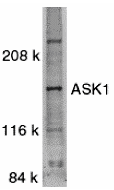 |
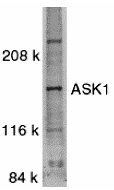
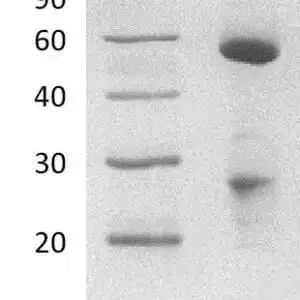
| Western blot analysis of ASK1 in SW1353 whole cell lysate with ASK1 antibody at 1:500 dilution. |
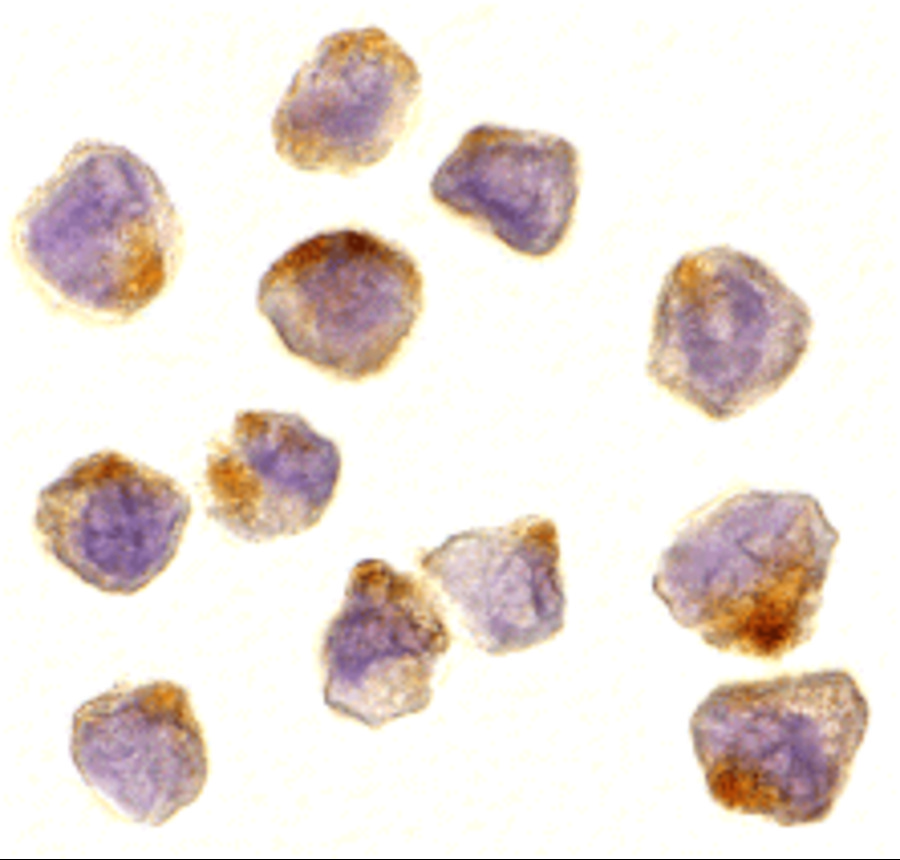 |
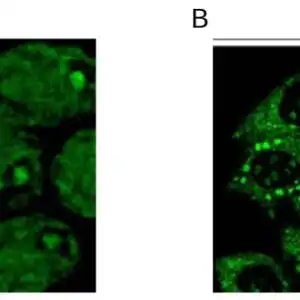
| Immunocytochemistry of ASK1 in A431 cells with ASK1 antibody at 10 µg/mL. |
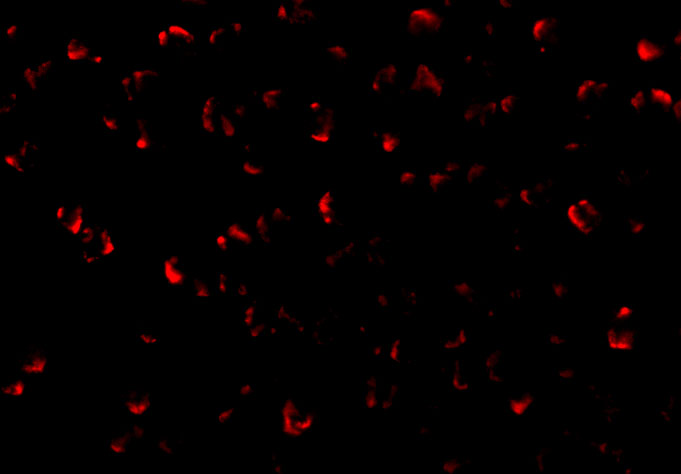 |
| Immunofluorescence of ASK1 in A431 cells with ASK1 antibody at 20 µg/mL. |
FAQ & Publications
Frequently Asked Questions
What applications is the rabbit anti-ASK1 (CT) polyclonal antibody suitable for?
This antibody is suitable for ELISA, Western blot (WB), immunocytochemistry (ICC), and immunofluorescence (IF) applications.
How should the rabbit anti-ASK1 (CT) polyclonal antibody be stored to maintain stability?
The antibody should be stored at -20°C and is stable for at least one year under these conditions. It is recommended to avoid multiple freeze-thaw cycles to preserve antibody integrity.
What is the recommended concentration for using this antibody in immunoblotting and immunocytochemistry?
For immunoblotting, the recommended concentration is 0.5-1 µg/mL, while for immunocytochemistry, a concentration of 10 µg/mL is suggested. However, users should optimize the concentration for their specific applications.
Publications
| pmid | title | authors | citation |
|---|---|---|---|
| We haven't added any publications to our database yet. | |||
Published literature highly relevant to the biological target of this product and referencing this antibody or clone are retrieved from the PubMed database provided by the United States National Library of Medicine at the National Institutes of Health.
Protocols
| relevant to this product |
|---|
| Western blot IHC ICC |
Documents
| Batch Number | QC File | SDS |
|---|---|---|
| To view batch-specific Safety Datasheets and Quality Certificates associated with your account, please Log In. | ||
Only logged in customers who have purchased this product may leave a review.


Reviews
There are no reviews yet.