| Weight | 1 lbs |
|---|---|
| Dimensions | 9 × 5 × 2 in |
| host | rabbit |
| isotype | IgG |
| clonality | polyclonal |
| concentration | 1 mg/mL |
| applications | ICC/IF, WB |
| reactivity | ARTS |
| available sizes | 100 µg |


rabbit anti-ARTS polyclonal antibody 1245
$445.00
Antibody summary
- Rabbit polyclonal to ARTS
- Suitable for: ELISA,WB,IHC-P,IF
- Isotype: IgG
- 100 µg
rabbit anti-ARTS polyclonal antibody 1245
| antibody |
|---|
| Tested applications WB,IHC,IHC,ICC/IF,ELISA |
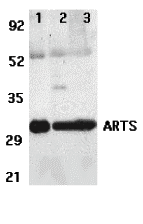
| Recommended dilutions Immunoblotting: use at 2ug/mL. A band of 32 kDa is detected. Immunohistochemistry: use at 2ug/mL. These are recommended concentrations. Enduser should determine optimal concentrations for their applications. Positive control: Human lung, kidney, or spleen lysates. |
| Immunogen Peptide corresponding to aa 3-14 of human ARTS. |
| Size and concentration 100µg and lot specific |
| Form liquid |
| Storage Instructions This antibody is stable for at least one (1) year at -20°C. Avoid multiple freeze-thaw cycles. |
| Storage buffer PBS, pH 7.4. |
| Purity peptide affinity purification |
| Clonality polyclonal |
| Isotype IgG |
| Compatible secondaries goat anti-rabbit IgG, H&L chain specific, peroxidase conjugated, conjugated polyclonal antibody 9512 goat anti-rabbit IgG, H&L chain specific, biotin conjugated polyclonal antibody 2079 goat anti-rabbit IgG, H&L chain specific, FITC conjugated polyclonal antibody 7863 goat anti-rabbit IgG, H&L chain specific, Cross Absorbed polyclonal antibody 2371 goat anti-rabbit IgG, H&L chain specific, biotin conjugated polyclonal antibody, crossabsorbed 1715 goat anti-rabbit IgG, H&L chain specific, FITC conjugated polyclonal antibody, crossabsorbed 1720 |
| Isotype control Rabbit polyclonal - Isotype Control |
| target relevance |
|---|
| Homo sapiens SEPTIN4 Septin-4 |
| Protein names Septin-4 |
| Alternative names Bradeion beta, Brain protein H5, CE5B3 beta, Cell division control-related protein 2, Peanut-like protein 2 |
| Gene names SEPTIN4 |
| Protein family Belongs to the TRAFAC class TrmE-Era-EngA-EngB-Septin-like GTPase superfamily. Septin GTPase family |
| Function Filament-forming cytoskeletal GTPase (Probable). Pro-apoptotic protein involved in LGR5-positive intestinal stem cell and Paneth cell expansion in the intestines, via its interaction with XIAP (By similarity). May also play a role in the regulation of cell fate in the intestine (By similarity). Positive regulator of apoptosis involved in hematopoietic stem cell homeostasis; via its interaction with XIAP (By similarity). Negative regulator of repair and hair follicle regeneration in response to injury, due to inhibition of hair follicle stem cell proliferation, potentially via its interaction with XIAP (By similarity). Plays an important role in male fertility and sperm motility (PubMed:36135717). During spermiogenesis, essential for the establishment of the annulus (a fibrous ring structure connecting the midpiece and the principal piece of the sperm flagellum) which is a requisite for the structural and mechanical integrity of the sperm (PubMed:36135717). Involved in the migration of cortical neurons and the formation of neuron leading processes during embryonic development (By similarity). Required for dopaminergic metabolism in presynaptic autoreceptors; potentially via activity as a presynaptic scaffold protein (By similarity) |
| Subcellular location Mitochondrion, Nucleus |
| Structure Part of a complex composed of SEPTIN4 isoform ARTS, XIAP and BCL2, within the complex interacts with both BCL2 (via BH3 domain) and XIAP, ARTS acts as a scaffold protein and stabilizes the complex (PubMed:29020630). Interacts with XIAP (via BIR3 domain) following the induction of apoptosis (PubMed:15029247, PubMed:21695558) |
| Post-translational modification Phosphorylated by DYRK1A Ubiquitinated by AREL1 |
| Involvement in disease Spermatogenic failure 99 An autosomal recessive, male infertility disorder characterized by asthenoteratozoospermia with markedly reduced sperm progressive motility, and abnormal sperm morphology. Patient sperm exhibit a thin midpiece, absence of the annulus, and disorganization of the mitochondrial sheath. |
| Keywords 3D-structure, Alternative splicing, Cell cycle, Cell division, Cell projection, Cilium, Coiled coil, Cytoplasm, Cytoplasmic vesicle, Differentiation, Direct protein sequencing, Disease variant, Flagellum, GTP-binding, Mitochondrion, Nucleotide-binding, Nucleus, Phosphoprotein, Proteomics identification, Reference proteome, Spermatogenesis, Synapse, Ubl conjugation |
| Sequence MVKTNKPGAKVAVSAQRGSEVTTNTSPQQGHGYVLASSHRSAAVSLNPSHRRSEAAHPTT PHSASDYPRSVSLQSGPGHYAVPTPRGPETGPRTESSRHSSPHLKSQKTQTLASHASSRQ WKVSPPREEAARRGSESKSGREVGHHASSIPDAKSTHQLSFQDQKNNLQSQILEDDPPSK VQNPQGVRVPRRILSYPKDEAVQTEPIQRITTTSEIRSPRSPSLLEHGSSCVSADYQTAQ RRVPVEESETGPYGPIPSKPKALYRNMNLDSLLKLSVLKDSDGVHRVSARVDPESLHKYS AYPETKPSAKVLVSSQVESNVRTPIRGNSEVGRRVTISPGVQSVEPTHHVTVPSVSEGSH KSSMFVTPEPIYKQQTQKPPEITYMSQGPTPRYPELSQKPSIHAELELTPRPLPPRSLPR YGPDSSWWPLLNPEVETPQSQLTTPDFEPKCSPSLDLLLSGFKIDSSPFCEDLKFQREKA SLSPPSPPKEFPSWAPLSEVPQTPKHTCKQPIQRFTAFFLDVSEEMYNRVIWWLKDEEIK RFLEDTTDDGELSKFVKDFSGNASCHPPEAKTWASRPQVPEPRPQAPDLYDDDLEFRPPS RPQSSDNQQYFCAPAPLSPSARPRSPWGKLDPYDSSEDDKEYVGFATLPNQVHRKSVKKG FDFTLMVAGESGLGKSTLVNSLFLTDLYRDRKLLGAEERIMQTVEITKHAVDIEEKGVRL RLTIVDTPGFGDAVNNTECWKPVAEYIDQQFEQYFRDESGLNRKNIQDNRVHCCLYFISP FGHGLRPLDVEFMKALHQRVNIVPILAKADTLTPPEVDHKKRKIREEIEHFGIKIYQFPD CDSDEDEDFKLQDQALKESIPFAVIGSNTVVEARGRRVRGRLYPWGIVEVENPGHCDFVK LRTMLVRTHMQDLKDVTRETHYENYRAQCIQSMTRLVVKERNRNKLTRESGTDFPIPAVP PGTDPETEKLIREKDEELRRMQEMLHKIQKQMKENY |
| UniProt accession: O43236 |
Data
 |
| Western blot analysis of ARTS expression in human lung (lane 1), spleen (lane 2), and kidney (lane 3) tissue lysates with ARTS antibody at 2 µg/mL. |
 |
| Immunohistochemistry of ARTS in human lung tissue with ARTS antibody at 2 µg/mL. |
 |
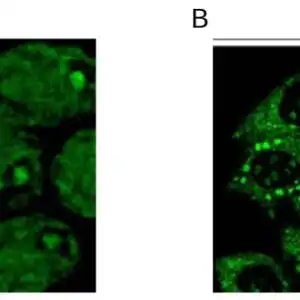
| Immunofluorescence of ARTS in Human Lung cells with ARTS antibody at 20 µg/mL. |
FAQ & Publications
Frequently Asked Questions
What applications is the rabbit anti-ARTS polyclonal antibody 1245 validated for?
This antibody has been tested and is suitable for use in Western blotting (WB), immunohistochemistry (IHC), immunocytochemistry/immunofluorescence (ICC/IF), and ELISA assays.
How should the rabbit anti-ARTS polyclonal antibody 1245 be stored to ensure stability?
The antibody should be stored at -20°C and is stable for at least one year under these conditions. It is important to avoid multiple freeze-thaw cycles to maintain antibody integrity.
Publications
| pmid | title | authors | citation |
|---|---|---|---|
| We haven't added any publications to our database yet. | |||
Published literature highly relevant to the biological target of this product and referencing this antibody or clone are retrieved from the PubMed database provided by the United States National Library of Medicine at the National Institutes of Health.
Protocols
| relevant to this product |
|---|
| Western blot IHC ICC |
Documents
| Batch Number | QC File | SDS |
|---|---|---|
| To view batch-specific Safety Datasheets and Quality Certificates associated with your account, please Log In. | ||
Only logged in customers who have purchased this product may leave a review.


Reviews
There are no reviews yet.