| Weight | 1 lbs |
|---|---|
| Dimensions | 9 × 5 × 2 in |
| host | rabbit |
| isotype | IgG |
| clonality | polyclonal |
| concentration | 1 mg/mL |
| applications | ICC/IF, WB |
| reactivity | ARC (NT) |
| available sizes | 100 µg |
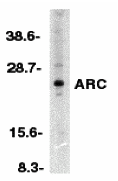
rabbit anti-ARC (NT) polyclonal antibody 8209
$445.00
Antibody summary
- Rabbit polyclonal to ARC (NT)
- Suitable for: ELISA,WB
- Isotype: IgG
- 100 µg
rabbit anti-ARC (NT) polyclonal antibody 8209
| antibody |
|---|
| Tested applications WB,ELISA |
| Recommended dilutions Immunoblotting: use at 2ug/mL These are recommended concentrations. Enduser should determine optimal concentrations for their application. Positive control: Whole cell lysate of HeLa cells. |
| Immunogen Peptide corresponding to aa 2-18 of human ARC. |
| Size and concentration 100µg and lot specific |
| Form liquid |
| Storage Instructions This antibody is stable for at least one (1) year at -20°C. Avoid multiple freeze-thaw cycles. |
| Storage buffer PBS, pH 7.4. |
| Purity peptide affinity purification |
| Clonality polyclonal |
| Isotype IgG |
| Compatible secondaries goat anti-rabbit IgG, H&L chain specific, peroxidase conjugated, conjugated polyclonal antibody 9512 goat anti-rabbit IgG, H&L chain specific, biotin conjugated polyclonal antibody 2079 goat anti-rabbit IgG, H&L chain specific, FITC conjugated polyclonal antibody 7863 goat anti-rabbit IgG, H&L chain specific, Cross Absorbed polyclonal antibody 2371 goat anti-rabbit IgG, H&L chain specific, biotin conjugated polyclonal antibody, crossabsorbed 1715 goat anti-rabbit IgG, H&L chain specific, FITC conjugated polyclonal antibody, crossabsorbed 1720 |
| Isotype control Rabbit polyclonal - Isotype Control |
| target relevance |
|---|
| Homo sapiens NOL3 Nucleolar protein 3 |
| Protein names Nucleolar protein 3 |
| Alternative names Apoptosis repressor with CARD, Muscle-enriched cytoplasmic protein, Nucleolar protein of 30 kDa |
| Gene names NOL3 |
| Function May be involved in RNA splicing |
| Subcellular location Cytoplasm, Mitochondrion, Sarcoplasmic reticulum, Membrane |
| Structure Oligomerizes (via CARD doamin). Interacts (via CARD domain) with CASP2; inhibits CASP2 activity in a phosphorylation-dependent manner. Interacts with CASP8; decreases CASP8 activity in a mitochondria localization- and phosphorylation-dependent manner and this interaction is dissociated by calcium. Interacts with TFPT; translocates NOL3 into the nucleus and negatively regulated TFPT-induced cell death (By similarity). Interacts directly (via CARD domain) with FAS and FADD (via DED domain); inhibits death-inducing signaling complex death-inducing signaling complex (DISC) assembly by inhibiting the increase in FAS-FADD binding induced by FAS activation (By similarity). Interacts (via CARD domain) with BAX (via a C-terminal 33 residues); inhibits BAX activation and translocation and consequently cytochrome c release from mitochondria. Interacts with PPM1G; may dephosphorylate NOL3 (By similarity). Interacts (via CARD domain) with BBC3 (via BH3 domain); preventing the association of BBC3 with BCL2 and resulting in activation of CASP8 (By similarity). Interacts (via CARD domain) with BAD(via BH3 domain); preventing the association of BAD with BCL2 (By similarity). Interacts directly (via CARD domain) with TNFRSF1A; inhibits TNF-signaling pathway (By similarity). Isoform 1 binds to SFRS9/SRp30C |
| Post-translational modification Phosphorylation at Thr-149 is required for its antiapoptotic effect by blocking death-inducing signaling complex death-inducing signaling complex (DISC) activity through the control of interaction with CASP8. Phosphorylation at Thr-149 results in translocation to mitochondria and this translocation enables the binding to CASP8. Dephosphorylated at Thr-149 by calcineurin; doesn't inhibit the association between FADD and CASP8 and the consequent apoptosis Polyubiquitinated by MDM2; promoting proteasomal-dependent degradation in response to apoptotic stimuli |
| Involvement in disease Myoclonus, familial, 1 An autosomal dominant neurologic condition characterized by adult onset of cortical myoclonus manifest as involuntary jerks or movements affecting the face and limbs. Affected individuals can also experience falls without seizure activity or loss of consciousness. |
| Keywords 3D-structure, Alternative splicing, Apoptosis, Calcium, Cytoplasm, Disease variant, Lipoprotein, Membrane, Metal-binding, Mitochondrion, mRNA processing, mRNA splicing, Myristate, Nucleus, Phosphoprotein, Proteomics identification, Reference proteome, Sarcoplasmic reticulum, Ubl conjugation |
| Sequence MGNAQERPSETIDRERKRLVETLQADSGLLLDALLARGVLTGPEYEALDALPDAERRVRR LLLLVQGKGEAACQELLRCAQRTAGAPDPAWDWQHVGPGYRDRSYDPPCPGHWTPEAPGS GTTCPGLPRASDPDEAGGPEGSEAVQSGTPEEPEPELEAEASKEAEPEPEPEPELEPEAE AEPEPELEPEPDPEPEPDFEERDESEDS |
| UniProt accession: O60936 |
Data
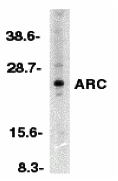 |
| Western blot analysis of ARC in HeLa whole cell lysates with ARC antibody at 1:500 dilution. |
FAQ & Publications
Frequently Asked Questions
What applications has the rabbit anti-ARC (NT) polyclonal antibody 8209 been tested for?
This antibody has been tested and is suitable for use in Western blotting (WB) and ELISA applications.
How should I store the rabbit anti-ARC (NT) polyclonal antibody to ensure its stability?
The antibody should be stored at -20°C and is stable for at least one year under these conditions. It is important to avoid multiple freeze-thaw cycles to maintain antibody integrity.
What is the immunogen used for generating the rabbit anti-ARC (NT) polyclonal antibody 8209?
The immunogen is a peptide corresponding to amino acids 2-18 of the human ARC protein.
Can you provide information on the antibody host, clonality, and concentration for this product?
This product is a rabbit polyclonal antibody of the IgG isotype, supplied at a concentration of 1 mg/mL in liquid form.
Publications
| pmid | title | authors | citation |
|---|---|---|---|
| We haven't added any publications to our database yet. | |||
Published literature highly relevant to the biological target of this product and referencing this antibody or clone are retrieved from the PubMed database provided by the United States National Library of Medicine at the National Institutes of Health.
Protocols
| relevant to this product |
|---|
| Western blot IHC ICC |
Documents
| Batch Number | QC File | SDS |
|---|---|---|
| To view batch-specific Safety Datasheets and Quality Certificates associated with your account, please Log In. | ||
Only logged in customers who have purchased this product may leave a review.


Reviews
There are no reviews yet.