| Weight | 1 lbs |
|---|---|
| Dimensions | 9 × 5 × 2 in |
| host | rabbit |
| isotype | IgG |
| clonality | polyclonal |
| concentration | 1 mg/mL |
| applications | ICC/IF, WB |
| reactivity | Apaf1 (NT) |
| available sizes | 100 µg |


rabbit anti-Apaf1 (NT) polyclonal antibody 4088
$445.00
Antibody summary
- Rabbit polyclonal to Apaf1 (NT)
- Suitable for: ELISA,WB,IHC-P,IF
- Isotype: IgG
- 100 µg
rabbit anti-Apaf1 (NT) polyclonal antibody 4088
| antibody |
|---|
| Tested applications WB,IHC,IHC,ICC/IF,ELISA |
| Recommended dilutions Immunoblotting: use at 1-2ug/mL Immunohistochemistry: use at 1-2ug/mL These are recommended concentrations. Endusers should determine optimal concentrations for their applications. Positive control: Whole cell lysate of HeLa or K562 cells. |
| Immunogen Peptide corresponding to aa 12-28 of human Apaf1. This sequence is identical in human and mouse. |
| Size and concentration 100µg and lot specific |
| Form liquid |
| Storage Instructions This antibody is stable for at least one (1) year at -20°C. Avoid multiple freeze-thaw cycles. |
| Storage buffer PBS, pH 7.4. |
| Purity peptide affinity purification |
| Clonality polyclonal |
| Isotype IgG |
| Compatible secondaries goat anti-rabbit IgG, H&L chain specific, peroxidase conjugated, conjugated polyclonal antibody 9512 goat anti-rabbit IgG, H&L chain specific, biotin conjugated polyclonal antibody 2079 goat anti-rabbit IgG, H&L chain specific, FITC conjugated polyclonal antibody 7863 goat anti-rabbit IgG, H&L chain specific, Cross Absorbed polyclonal antibody 2371 goat anti-rabbit IgG, H&L chain specific, biotin conjugated polyclonal antibody, crossabsorbed 1715 goat anti-rabbit IgG, H&L chain specific, FITC conjugated polyclonal antibody, crossabsorbed 1720 |
| Isotype control Rabbit polyclonal - Isotype Control |
| target relevance |
|---|
| Homo sapiens APAF1 Apoptotic protease-activating factor 1 |
| Protein names Apoptotic protease-activating factor 1 |
| Gene names APAF1 |
| Function Oligomeric Apaf-1 mediates the cytochrome c-dependent autocatalytic activation of pro-caspase-9 (Apaf-3), leading to the activation of caspase-3 and apoptosis. This activation requires ATP. Isoform 6 is less effective in inducing apoptosis |
| Subcellular location Cytoplasm |
| Structure Monomer. Oligomerizes to a heptameric ring, known as the apoptosome, upon binding of cytochrome c and dATP. Oligomeric Apaf-1 and pro-caspase-9 bind to each other via their respective NH2-terminal CARD domains and consecutively mature caspase-9 is released from the complex. Pro-caspase-3 is recruited into the Apaf-1-pro-caspase-9 complex via interaction with pro-caspase-9. Interacts with APIP. Interacts (via CARD and NACHT domains) with NAIP/BIRC1 (via NACHT domain). Interacts with CIAO2A (PubMed:25716227) |
| Keywords 3D-structure, Alternative splicing, Apoptosis, ATP-binding, Calcium, Cytoplasm, Direct protein sequencing, Nucleotide-binding, Proteomics identification, Reference proteome, Repeat, WD repeat |
| Sequence MDAKARNCLLQHREALEKDIKTSYIMDHMISDGFLTISEEEKVRNEPTQQQRAAMLIKMI LKKDNDSYVSFYNALLHEGYKDLAALLHDGIPVVSSSSGKDSVSGITSYVRTVLCEGGVP QRPVVFVTRKKLVNAIQQKLSKLKGEPGWVTIHGMAGCGKSVLAAEAVRDHSLLEGCFPG GVHWVSVGKQDKSGLLMKLQNLCTRLDQDESFSQRLPLNIEEAKDRLRILMLRKHPRSLL ILDDVWDSWVLKAFDSQCQILLTTRDKSVTDSVMGPKYVVPVESSLGKEKGLEILSLFVN MKKADLPEQAHSIIKECKGSPLVVSLIGALLRDFPNRWEYYLKQLQNKQFKRIRKSSSYD YEALDEAMSISVEMLREDIKDYYTDLSILQKDVKVPTKVLCILWDMETEEVEDILQEFVN KSLLFCDRNGKSFRYYLHDLQVDFLTEKNCSQLQDLHKKIITQFQRYHQPHTLSPDQEDC MYWYNFLAYHMASAKMHKELCALMFSLDWIKAKTELVGPAHLIHEFVEYRHILDEKDCAV SENFQEFLSLNGHLLGRQPFPNIVQLGLCEPETSEVYQQAKLQAKQEVDNGMLYLEWINK KNITNLSRLVVRPHTDAVYHACFSEDGQRIASCGADKTLQVFKAETGEKLLEIKAHEDEV LCCAFSTDDRFIATCSVDKKVKIWNSMTGELVHTYDEHSEQVNCCHFTNSSHHLLLATGS SDCFLKLWDLNQKECRNTMFGHTNSVNHCRFSPDDKLLASCSADGTLKLWDATSANERKS INVKQFFLNLEDPQEDMEVIVKCCSWSADGARIMVAAKNKIFLFDIHTSGLLGEIHTGHH STIQYCDFSPQNHLAVVALSQYCVELWNTDSRSKVADCRGHLSWVHGVMFSPDGSSFLTS SDDQTIRLWETKKVCKNSAVMLKQEVDVVFQENEVMVLAVDHIRRLQLINGRTGQIDYLT EAQVSCCCLSPHLQYIAFGDENGAIEILELVNNRIFQSRFQHKKTVWHIQFTADEKTLIS SSDDAEIQVWNWQLDKCIFLRGHQETVKDFRLLKNSRLLSWSFDGTVKVWNIITGNKEKD FVCHQGTVLSCDISHDATKFSSTSADKTAKIWSFDLLLPLHELRGHNGCVRCSAFSVDST LLATGDDNGEIRIWNVSNGELLHLCAPLSEEGAATHGGWVTDLCFSPDGKMLISAGGYIK WWNVVTGESSQTFYTNGTNLKKIHVSPDFKTYVTVDNLGILYILQTLE |
| UniProt accession: O14727 |
Data
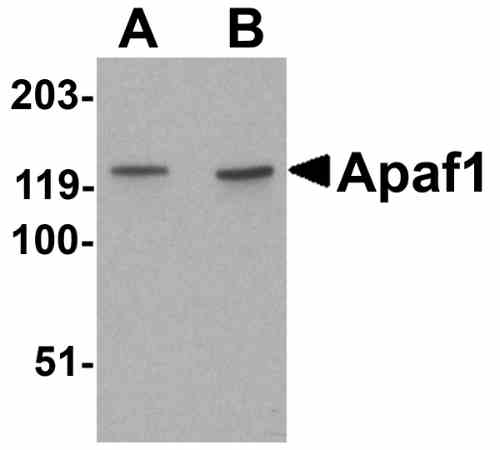 |
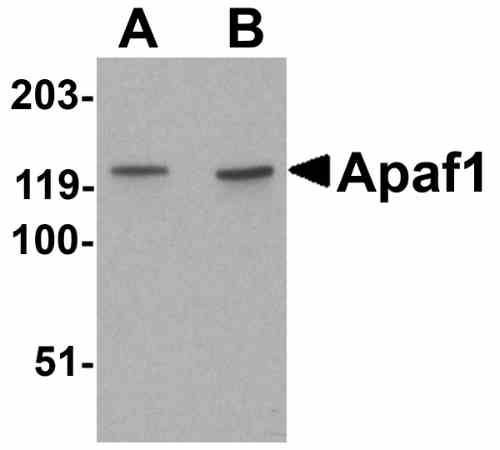
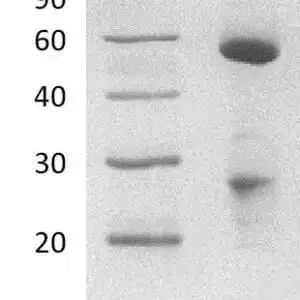
| Western blot analysis of Apaf1 in K562 cell lysate with Apaf1 antibody at (A) 1 and (B) 2 µg/mL. |
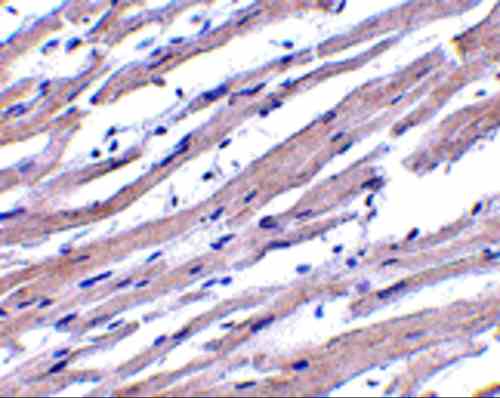 |
| Immunohistochemistry of Apaf1 in human heart tissue with Apaf1 antibody at 1 µg/mL. |
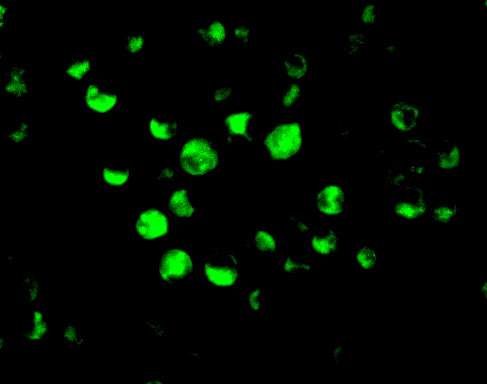 |
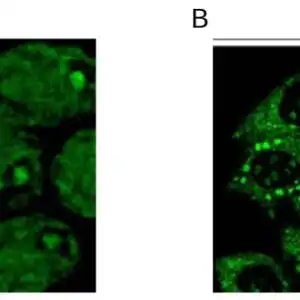
| Immunofluorescence of Apaf1 in K562 cells with Apaf1 antibody at 10 µg/mL. |
FAQ & Publications
Frequently Asked Questions
What applications has the rabbit anti-Apaf1 (NT) polyclonal antibody 4088 been validated for?
This antibody has been tested and is suitable for ELISA, Western Blot (WB), Immunohistochemistry (IHC-P), and Immunofluorescence (IF) applications.
How should the rabbit anti-Apaf1 (NT) polyclonal antibody 4088 be stored to maintain stability?
The antibody should be stored at -20°C and is stable for at least one year under these conditions. It is recommended to avoid multiple freeze-thaw cycles to preserve antibody integrity.
What is the host species and clonality of the anti-Apaf1 (NT) antibody 4088?
The antibody is a rabbit polyclonal antibody, of the IgG isotype, purified by peptide affinity chromatography.
What immunogen was used to generate the rabbit anti-Apaf1 (NT) polyclonal antibody 4088?
The immunogen is a peptide corresponding to amino acids 12-28 of human Apaf1, which is identical in both human and mouse species.
Can you recommend optimal antibody concentrations for immunoblotting and immunohistochemistry using this anti-Apaf1 antibody?
Recommended concentrations are 1-2 μg/mL for both immunoblotting and immunohistochemistry; however, end users should determine optimal dilutions for their specific experimental conditions.
Publications
| pmid | title | authors | citation |
|---|---|---|---|
| We haven't added any publications to our database yet. | |||
Published literature highly relevant to the biological target of this product and referencing this antibody or clone are retrieved from the PubMed database provided by the United States National Library of Medicine at the National Institutes of Health.
Protocols
| relevant to this product |
|---|
| Western blot IHC ICC |
Documents
| Batch Number | QC File | SDS |
|---|---|---|
| To view batch-specific Safety Datasheets and Quality Certificates associated with your account, please Log In. | ||
Only logged in customers who have purchased this product may leave a review.


Reviews
There are no reviews yet.