| Weight | 1 lbs |
|---|---|
| Dimensions | 9 × 5 × 2 in |
| host | rabbit |
| isotype | IgG |
| clonality | polyclonal |
| concentration | 1 mg/mL |
| applications | ICC/IF, WB |
| reactivity | Angiotensin Converting Enzyme 2 (ACE2) |
| available sizes | 100 µL |


rabbit anti-Angiotensin Converting Enzyme 2 (ACE2) polyclonal antibody 7437
$551.00
Antibody summary
- Rabbit polyclonal to Angiotensin Converting Enzyme 2 (ACE2)
- Suitable for: WB,IHC
- Isotype: Whole IgG
- 100 µl
rabbit anti-Angiotensin Converting Enzyme 2 (ACE2) polyclonal antibody 7437
| antibody |
|---|
| Tested applications WB,IHC,IHC |
| Recommended dilutions Immunoblotting: use at 1ug/mL. A band of ~92kDa is detected. Detection of ACE2 in human kidney lysate with #19504 at 1ug/mL. |
| Immunogen Synthetic peptide corresponding to amino acids near the N-terminus of human ACE2 protein. |
| Size and concentration 100µL and 1 mg/mL |
| Form liquid |
| Storage Instructions This antibody is stable for at least one (1) year at -20°C. |
| Storage buffer PBS, 0.02% NaN3. |
| Purity immunogen affinity purification |
| Clonality polyclonal |
| Isotype IgG |
| Compatible secondaries goat anti-rabbit IgG, H&L chain specific, peroxidase conjugated, conjugated polyclonal antibody 9512 goat anti-rabbit IgG, H&L chain specific, biotin conjugated polyclonal antibody 2079 goat anti-rabbit IgG, H&L chain specific, FITC conjugated polyclonal antibody 7863 goat anti-rabbit IgG, H&L chain specific, Cross Absorbed polyclonal antibody 2371 goat anti-rabbit IgG, H&L chain specific, biotin conjugated polyclonal antibody, crossabsorbed 1715 goat anti-rabbit IgG, H&L chain specific, FITC conjugated polyclonal antibody, crossabsorbed 1720 |
| Isotype control Rabbit polyclonal - Isotype Control |
| target relevance |
|---|
| Homo sapiens ACE2 Angiotensin-converting enzyme 2 |
| Protein names Angiotensin-converting enzyme 2 |
| Alternative names Angiotensin-converting enzyme homolog, Angiotensin-converting enzyme-related carboxypeptidase, Metalloprotease MPROT15 |
| Gene names ACE2 |
| Protein family Belongs to the peptidase M2 family |
| Function Essential counter-regulatory carboxypeptidase of the renin-angiotensin hormone system that is a critical regulator of blood volume, systemic vascular resistance, and thus cardiovascular homeostasis (PubMed:27217402). Converts angiotensin I to angiotensin 1-9, a nine-amino acid peptide with anti-hypertrophic effects in cardiomyocytes, and angiotensin II to angiotensin 1-7, which then acts as a beneficial vasodilator and anti-proliferation agent, counterbalancing the actions of the vasoconstrictor angiotensin II (PubMed:10924499, PubMed:10969042, PubMed:11815627, PubMed:14504186, PubMed:19021774). Also removes the C-terminal residue from three other vasoactive peptides, neurotensin, kinetensin, and des-Arg bradykinin, but is not active on bradykinin (PubMed:10969042, PubMed:11815627). Also cleaves other biological peptides, such as apelins (apelin-13, [Pyr1]apelin-13, apelin-17, apelin-36), casomorphins (beta-casomorphin-7, neocasomorphin) and dynorphin A with high efficiency (PubMed:11815627, PubMed:27217402, PubMed:28293165). In addition, ACE2 C-terminus is homologous to collectrin and is responsible for the trafficking of the neutral amino acid transporter SL6A19 to the plasma membrane of gut epithelial cells via direct interaction, regulating its expression on the cell surface and its catalytic activity (PubMed:18424768, PubMed:19185582) |
| Catalytic activity angiotensin II + H2O = angiotensin-(1-7) + L-phenylalanine angiotensin I + H2O = angiotensin-(1-9) + L-leucine bradykinin(1-8) + H2O = bradykinin(1-7) + L-phenylalanine neurotensin + H2O = neurotensin-(1-12) + L-leucine neurotensin-(1-8) + H2O = neurotensin-(1-7) + L-arginine kinetensin + H2O = kinetensin-(1-8) + L-leucine dynorphin A-(1-13) + H2O = dynorphin A-(1-12) + L-lysine apelin-13 + H2O = apelin-12 + L-phenylalanine [Pyr1]apelin-13 + H2O = [Pyr1]apelin-12 + L-phenylalanine apelin-17 + H2O = apelin-16 + L-phenylalanine beta-casomorphin-7 + H2O = beta-casomorphin-6 + L-isoleucine neocasomorphin + H2O = neocasomorphin-(1-5) + L-isoleucine |
| Subcellular location Apical cell membrane |
| Structure (Microbial infection) Interacts with SARS coronavirus-2/SARS-CoV-2 spike protein; the interaction is increased by AVP/Arg-vasopressin with which they may form a complex |
| Post-translational modification N-glycosylation on Asn-90 may limit SARS infectivity Proteolytic cleavage by ADAM17 generates a secreted form (PubMed:15983030, PubMed:33713620). Also cleaved by serine proteases: TMPRSS2, TMPRSS11D and HPN/TMPRSS1 Phosphorylated. Phosphorylation at Tyr-781 probably inhibits interaction with AP2M1 and enables interactions with proteins containing SH2 domains Ubiquitinated. Ubiquitinated on Lys-788 via 'Lys-48'-linked ubiquitin (PubMed:36876523). 'Lys-48'-linked deubiquitinated by USP50 on the Lys-788; leading to its stabilization (PubMed:36876523) |
| Keywords 3D-structure, Alternative splicing, Carboxypeptidase, Cell membrane, Cell projection, Chloride, Cytoplasm, Direct protein sequencing, Disulfide bond, Glycoprotein, Host cell receptor for virus entry, Host-virus interaction, Hydrolase, Isopeptide bond, Membrane, Metal-binding, Metalloprotease, Phosphoprotein, Protease, Proteomics identification, Receptor, Reference proteome, Secreted, Signal, Transmembrane, Transmembrane helix, Ubl conjugation, Zinc |
| Sequence MSSSSWLLLSLVAVTAAQSTIEEQAKTFLDKFNHEAEDLFYQSSLASWNYNTNITEENVQ NMNNAGDKWSAFLKEQSTLAQMYPLQEIQNLTVKLQLQALQQNGSSVLSEDKSKRLNTIL NTMSTIYSTGKVCNPDNPQECLLLEPGLNEIMANSLDYNERLWAWESWRSEVGKQLRPLY EEYVVLKNEMARANHYEDYGDYWRGDYEVNGVDGYDYSRGQLIEDVEHTFEEIKPLYEHL HAYVRAKLMNAYPSYISPIGCLPAHLLGDMWGRFWTNLYSLTVPFGQKPNIDVTDAMVDQ AWDAQRIFKEAEKFFVSVGLPNMTQGFWENSMLTDPGNVQKAVCHPTAWDLGKGDFRILM CTKVTMDDFLTAHHEMGHIQYDMAYAAQPFLLRNGANEGFHEAVGEIMSLSAATPKHLKS IGLLSPDFQEDNETEINFLLKQALTIVGTLPFTYMLEKWRWMVFKGEIPKDQWMKKWWEM KREIVGVVEPVPHDETYCDPASLFHVSNDYSFIRYYTRTLYQFQFQEALCQAAKHEGPLH KCDISNSTEAGQKLFNMLRLGKSEPWTLALENVVGAKNMNVRPLLNYFEPLFTWLKDQNK NSFVGWSTDWSPYADQSIKVRISLKSALGDKAYEWNDNEMYLFRSSVAYAMRQYFLKVKN QMILFGEEDVRVANLKPRISFNFFVTAPKNVSDIIPRTEVEKAIRMSRSRINDAFRLNDN SLEFLGIQPTLGPPNQPPVSIWLIVFGVVMGVIVVGIVILIFTGIRDRKKKNKARSGENP YASIDISKGENNPGFQNTDDVQTSF |
| UniProt accession: Q9BYF1 |
Data
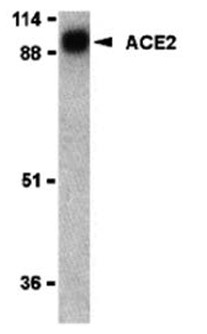 |
| Immunoblotting: use at 1ug/ml. A band of ~92kDa is detected. Detection of ACE2 in human kidney lysate with #7437 at 1ug/ml. |
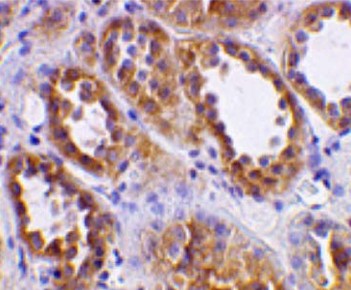 |
| IHC: use at 2ug/ml. Detection of ACE2 in paraffin-embedded human kidney with #7437 at 2ug/ml. |
FAQ & Publications
Frequently Asked Questions
What applications has the rabbit anti-ACE2 polyclonal antibody 7437 been validated for?
This antibody has been tested and validated for use in Western Blot (WB), Immunohistochemistry (IHC), and Immunocytochemistry/Immunofluorescence (ICC/IF) applications.
How should the rabbit anti-ACE2 antibody 7437 be stored to maintain its stability?
The antibody is supplied in liquid form at a concentration of 1 mg/mL and should be stored at -20°C. Under these conditions, it remains stable for at least one year.
What is the immunogen used to generate the rabbit anti-ACE2 polyclonal antibody 7437?
The antibody was raised against a synthetic peptide corresponding to amino acids near the N-terminus of the human ACE2 protein.
Publications
| pmid | title | authors | citation |
|---|---|---|---|
| We haven't added any publications to our database yet. | |||
Published literature highly relevant to the biological target of this product and referencing this antibody or clone are retrieved from the PubMed database provided by the United States National Library of Medicine at the National Institutes of Health.
Protocols
| relevant to this product |
|---|
| Western blot IHC |
Documents
| Batch Number | QC File | SDS |
|---|---|---|
| To view batch-specific Safety Datasheets and Quality Certificates associated with your account, please Log In. | ||
Only logged in customers who have purchased this product may leave a review.


Reviews
There are no reviews yet.