| Weight | 1 lbs |
|---|---|
| Dimensions | 9 × 5 × 2 in |
| host | rabbit |
| isotype | IgG |
| clonality | polyclonal |
| concentration | 1 mg/mL |
| applications | ICC/IF, WB |
| reactivity | ADAM10 /KUZ /MADM |
| available sizes | 100 µg |

rabbit anti-ADAM 10 (CT) polyclonal antibody 2327
$445.00
Antibody summary
- Rabbit polyclonal to ADAM 10 (CT)
- Suitable for: ELISA,WB,ICC,IF
- Isotype: IgG
- 100 µg
rabbit anti-ADAM 10 (CT) polyclonal antibody 2327
| antibody |
|---|
| Tested applications WB,ICC/IF,ELISA |
| Recommended dilutions Immunoblotting: use at 1- 10ug/mL. Immunofluorescence: use at 10ug/mL. Immunocytochemistry: use at 2ug/mL. Endusers should determine optimal concentrations for their applications. |
| Immunogen Peptide corresponding to aa 732-748 of human ADAM10. This sequence is identical to those of bovine and rat and differs from mouse by one amino acid. |
| Size and concentration 100µg and lot specific |
| Form liquid |
| Storage Instructions This antibody can be stored at 4°C for three months and for one year at -20°C. Store product in appropriate aliquots to avoid multiple freeze-thaw cycles. |
| Storage buffer PBS, pH 7.4, 0.02% NaN3. |
| Purity peptide affinity purification |
| Clonality polyclonal |
| Isotype IgG |
| Compatible secondaries goat anti-rabbit IgG, H&L chain specific, peroxidase conjugated, conjugated polyclonal antibody 9512 goat anti-rabbit IgG, H&L chain specific, biotin conjugated polyclonal antibody 2079 goat anti-rabbit IgG, H&L chain specific, FITC conjugated polyclonal antibody 7863 goat anti-rabbit IgG, H&L chain specific, Cross Absorbed polyclonal antibody 2371 goat anti-rabbit IgG, H&L chain specific, biotin conjugated polyclonal antibody, crossabsorbed 1715 goat anti-rabbit IgG, H&L chain specific, FITC conjugated polyclonal antibody, crossabsorbed 1720 |
| Isotype control Rabbit polyclonal - Isotype Control |
| target relevance |
|---|
| Homo sapiens ADAM10 Disintegrin and metalloproteinase domain-containing protein 10 |
| Protein names Disintegrin and metalloproteinase domain-containing protein 10 |
| Alternative names CDw156, Kuzbanian protein homolog, Mammalian disintegrin-metalloprotease |
| Gene names ADAM10 |
| Function Transmembrane metalloprotease which mediates the ectodomain shedding of a myriad of transmembrane proteins, including adhesion proteins, growth factor precursors and cytokines being essential for development and tissue homeostasis (PubMed:11786905, PubMed:12475894, PubMed:20592283, PubMed:24990881, PubMed:26686862, PubMed:28600292, PubMed:31792032). Associates with six members of the tetraspanin superfamily TspanC8 which regulate its exit from the endoplasmic reticulum and its substrate selectivity (PubMed:26686862, PubMed:28600292, PubMed:31792032, PubMed:34739841, PubMed:37516108). Cleaves the membrane-bound precursor of TNF at '76-Ala-|-Val-77' to its mature soluble form. Responsible for the proteolytical release of soluble JAM3 from endothelial cells surface (PubMed:20592283). Responsible for the proteolytic release of several other cell-surface proteins, including heparin-binding epidermal growth-like factor, ephrin-A2, CD44, CDH2 and for constitutive and regulated alpha-secretase cleavage of amyloid precursor protein (APP) (PubMed:11786905, PubMed:26686862, PubMed:29224781, PubMed:34739841). Contributes to the normal cleavage of the cellular prion protein (PubMed:11477090). Involved in the cleavage of the adhesion molecule L1 at the cell surface and in released membrane vesicles, suggesting a vesicle-based protease activity (PubMed:12475894). Also controls the proteolytic processing of Notch and mediates lateral inhibition during neurogenesis (By similarity). Required for the development of type 1 transitional B cells into marginal zone B cells, probably by cleaving Notch (By similarity). Responsible for the FasL ectodomain shedding and for the generation of the remnant ADAM10-processed FasL (FasL APL) transmembrane form (PubMed:17557115). Also cleaves the ectodomain of the integral membrane proteins CORIN and ITM2B (PubMed:19114711, PubMed:21288900). Mediates the proteolytic cleavage of LAG3, leading to release the secreted form of LAG3 (By similarity). Mediates the proteolytic cleavage of IL6R and IL11RA, leading to the release of secreted forms of IL6R and IL11RA (PubMed:26876177). Enhances the cleavage of CHL1 by BACE1 (By similarity). Cleaves NRCAM (By similarity). Cleaves TREM2, resulting in shedding of the TREM2 ectodomain (PubMed:24990881). Involved in the development and maturation of glomerular and coronary vasculature (By similarity). During development of the cochlear organ of Corti, promotes pillar cell separation by forming a ternary complex with CADH1 and EPHA4 and cleaving CADH1 at adherens junctions (By similarity). May regulate the EFNA5-EPHA3 signaling (PubMed:16239146). Regulates leukocyte transmigration as a sheddase for the adherens junction protein VE-cadherin/CDH5 in endothelial cells (PubMed:28600292) |
| Catalytic activity Endopeptidase of broad specificity. |
| Subcellular location Cell membrane, Golgi apparatus membrane, Cytoplasmic vesicle, clathrin-coated vesicle, Cell projection, axon, Cell projection, dendrite, Cell junction, adherens junction, Cytoplasm |
| Structure (Microbial infection) Interacts with S.aureus hly; this interaction is necessary for toxin pore formation, disruption of focal adhesions and S.aureus hly-mediated cytotoxicity |
| Post-translational modification The precursor is cleaved by furin and PCSK7 |
| Involvement in disease Reticulate acropigmentation of Kitamura A rare cutaneous pigmentation disorder characterized by reticulate, slightly depressed, sharply demarcated brown macules without hypopigmentation, affecting the dorsa of the hands and feet and appearing in the first or second decade of life. The macules gradually darken and extend to the proximal regions of the extremities. The manifestations tend to progress until middle age, after which progression of the eruptions stops. The pigmentary augmentation is found on the flexor aspects of the wrists, neck, patella and olecranon. Other features include breaks in the epidermal ridges on the palms and fingers, palmoplantar pits, occasionally plantar keratoderma, and partial alopecia. Alzheimer disease 18 A late-onset form of Alzheimer disease. Alzheimer disease is a neurodegenerative disorder characterized by progressive dementia, loss of cognitive abilities, and deposition of fibrillar amyloid proteins as intraneuronal neurofibrillary tangles, extracellular amyloid plaques and vascular amyloid deposits. The major constituents of these plaques are neurotoxic amyloid-beta protein 40 and amyloid-beta protein 42, that are produced by the proteolysis of the transmembrane APP protein. The cytotoxic C-terminal fragments (CTFs) and the caspase-cleaved products, such as C31, are also implicated in neuronal death. |
| Keywords 3D-structure, Alternative splicing, Alzheimer disease, Amyloidosis, Cell junction, Cell membrane, Cell projection, Cleavage on pair of basic residues, Cytoplasm, Cytoplasmic vesicle, Direct protein sequencing, Disease variant, Disulfide bond, Glycoprotein, Golgi apparatus, Hydrolase, Membrane, Metal-binding, Metalloprotease, Neurodegeneration, Notch signaling pathway, Phosphoprotein, Protease, Proteomics identification, Reference proteome, SH3-binding, Signal, Transmembrane, Transmembrane helix, Zinc, Zymogen |
| Sequence MVLLRVLILLLSWAAGMGGQYGNPLNKYIRHYEGLSYNVDSLHQKHQRAKRAVSHEDQFL RLDFHAHGRHFNLRMKRDTSLFSDEFKVETSNKVLDYDTSHIYTGHIYGEEGSFSHGSVI DGRFEGFIQTRGGTFYVEPAERYIKDRTLPFHSVIYHEDDINYPHKYGPQGGCADHSVFE RMRKYQMTGVEEVTQIPQEEHAANGPELLRKKRTTSAEKNTCQLYIQTDHLFFKYYGTRE AVIAQISSHVKAIDTIYQTTDFSGIRNISFMVKRIRINTTADEKDPTNPFRFPNIGVEKF LELNSEQNHDDYCLAYVFTDRDFDDGVLGLAWVGAPSGSSGGICEKSKLYSDGKKKSLNT GIITVQNYGSHVPPKVSHITFAHEVGHNFGSPHDSGTECTPGESKNLGQKENGNYIMYAR ATSGDKLNNNKFSLCSIRNISQVLEKKRNNCFVESGQPICGNGMVEQGEECDCGYSDQCK DECCFDANQPEGRKCKLKPGKQCSPSQGPCCTAQCAFKSKSEKCRDDSDCAREGICNGFT ALCPASDPKPNFTDCNRHTQVCINGQCAGSICEKYGLEECTCASSDGKDDKELCHVCCMK KMDPSTCASTGSVQWSRHFSGRTITLQPGSPCNDFRGYCDVFMRCRLVDADGPLARLKKA IFSPELYENIAEWIVAHWWAVLLMGIALIMLMAGFIKICSVHTPSSNPKLPPPKPLPGTL KRRRPPQPIQQPQRQRPRESYQMGHMRR |
| UniProt accession: O14672 |
Data
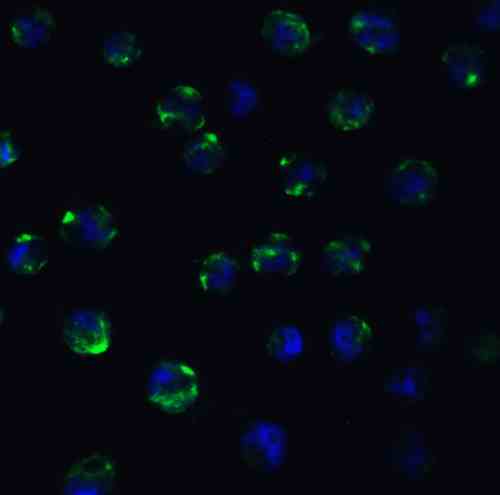 |
| Immunofluorescence of ADAM10 in K562 cells with ADAM10 antibody at 10 µg/mL. |
FAQ & Publications
Frequently Asked Questions
What applications is the rabbit anti-ADAM 10 (CT) polyclonal antibody 2327 validated for?
This antibody is suitable for ELISA, Western Blot (WB), Immunocytochemistry (ICC), and Immunofluorescence (IF) applications.
How should the rabbit anti-ADAM 10 (CT) antibody be stored to maintain stability?
The antibody can be stored at 4°C for up to three months and for one year at -20°C. It is recommended to aliquot the product to avoid multiple freeze-thaw cycles.
What is the immunogen used to generate the rabbit anti-ADAM 10 (CT) polyclonal antibody 2327?
The immunogen is a peptide corresponding to amino acids 732-748 of human ADAM10, which is identical in bovine and rat and differs by one amino acid in mouse.
Which secondary antibodies are compatible with the rabbit anti-ADAM 10 (CT) polyclonal antibody 2327?
Compatible secondaries include goat anti-rabbit IgG H&L chain specific antibodies conjugated to peroxidase, biotin, FITC, and cross-absorbed polyclonal antibodies.
Publications
| pmid | title | authors | citation |
|---|---|---|---|
| We haven't added any publications to our database yet. | |||
Published literature highly relevant to the biological target of this product and referencing this antibody or clone are retrieved from the PubMed database provided by the United States National Library of Medicine at the National Institutes of Health.
Protocols
| relevant to this product |
|---|
| Western blot IHC ICC |
Documents
| Batch Number | QC File | SDS |
|---|---|---|
| To view batch-specific Safety Datasheets and Quality Certificates associated with your account, please Log In. | ||
Only logged in customers who have purchased this product may leave a review.


Reviews
There are no reviews yet.