| Weight | 1 lbs |
|---|---|
| Dimensions | 9 × 5 × 2 in |
| host | mouse |
| isotype | IgG1 |
| clonality | monoclonal |
| concentration | concentrate, predilute |
| applications | IHC |
| reactivity | human |
| available size | 0.1 mL, 0.5 mL, 1 mL concentrated, 7 mL prediluted |

mouse anti-Thymidylate Synthase (TS) monoclonal antibody (TS106) 6382
Price range: $160.00 through $528.00
Antibody summary
- Mouse monoclonal to Thymidylate Synthase (TS)
- Suitable for: Immunohistochemistry (formalin-fixed, paraffin-embedded tissues)
- Reacts with: Human
- Isotype:IgG1
- Control: 5-FU resistant cancer
- Visualization: Cytoplasmic
- 0.1, 0.5, 1.0 mL concentrated, 7 mL prediluted
mouse anti-Thymidylate Synthase (TS) monoclonal antibody TS106 6382
| target relevance |
|---|
| Homo sapiens TYMS Thymidylate synthase |
| Protein names Thymidylate synthase |
| Gene names TYMS |
| Protein family Belongs to the thymidylate synthase family |
| Function Catalyzes the reductive methylation of 2'-deoxyuridine 5'-monophosphate (dUMP) to thymidine 5'-monophosphate (dTMP), using the cosubstrate, 5,10- methylenetetrahydrofolate (CH2H4folate) as a 1-carbon donor and reductant and contributes to the mitochondrial and nuclear de novo thymidylate biosynthesis pathway |
| Catalytic activity dUMP + (6R)-5,10-methylene-5,6,7,8-tetrahydrofolate = 7,8-dihydrofolate + dTMP |
| Subcellular location Nucleus, Cytoplasm, Mitochondrion, Mitochondrion matrix, Mitochondrion inner membrane |
| Structure Homodimer. Part of the de novo thymidylate synthesis complex composed at least by SHMT1, DHFR and TYMS (PubMed:22235121). Interacts with SHMT1; this interaction is DNA-dependent and mediates TYMS co-localization with LMNB1 (PubMed:22235121) |
| Post-translational modification Sumoylated by UBE2I/UBC9 |
| Involvement in disease Dyskeratosis congenita, digenic A form of dyskeratosis congenita, a rare multisystem disorder caused by defective telomere maintenance. It is characterized by progressive bone marrow failure, and the clinical triad of reticulated skin hyperpigmentation, nail dystrophy, and mucosal leukoplakia. Common but variable features include premature graying, aplastic anemia, low platelets, osteoporosis, pulmonary fibrosis, and liver fibrosis among others. Early mortality is often associated with bone marrow failure, infections, fatal pulmonary complications, or malignancy. DKCD transmission pattern is consistent with digenic inheritance. |
| Keywords 3D-structure, Alternative splicing, Cytoplasm, Direct protein sequencing, Disease variant, Dyskeratosis congenita, Isopeptide bond, Membrane, Methyltransferase, Mitochondrion, Mitochondrion inner membrane, Nucleotide biosynthesis, Nucleus, Phosphoprotein, Proteomics identification, Reference proteome, Transferase, Ubl conjugation |
| Sequence MPVAGSELPRRPLPPAAQERDAEPRPPHGELQYLGQIQHILRCGVRKDDRTGTGTLSVFG MQARYSLRDEFPLLTTKRVFWKGVLEELLWFIKGSTNAKELSSKGVKIWDANGSRDFLDS LGFSTREEGDLGPVYGFQWRHFGAEYRDMESDYSGQGVDQLQRVIDTIKTNPDDRRIIMC AWNPRDLPLMALPPCHALCQFYVVNSELSCQLYQRSGDMGLGVPFNIASYALLTYMIAHI TGLKPGDFIHTLGDAHIYLNHIEPLKIQLQREPRPFPKLRILRKVEKIDDFKAEDFQIEG YNPHPTIKMEMAV |
| UniProt accession: P04818 |
Data
 |
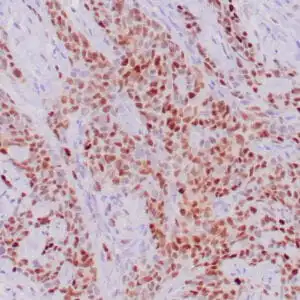
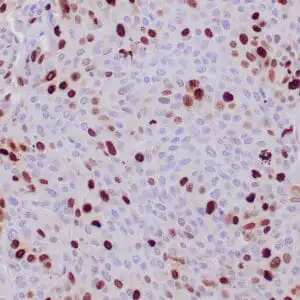
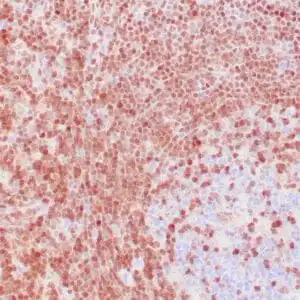
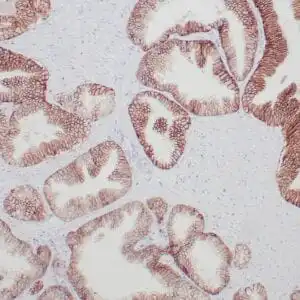
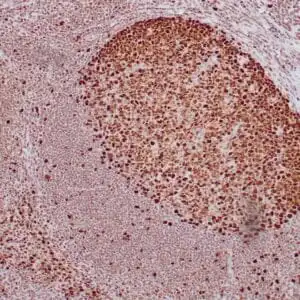
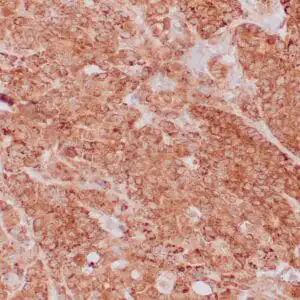
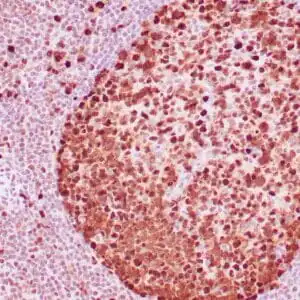
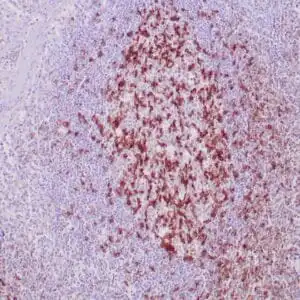
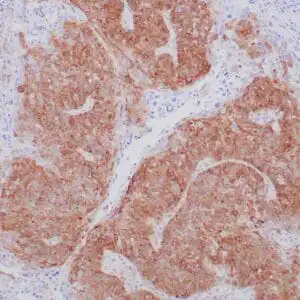
| Human colon carcinoma stained with anti-thymidylate synthase (TS) antibody using peroxidase-conjugate and DAB chromogen. Note the cytoplasmic staining of tumor cells. |
FAQ & Publications
Frequently Asked Questions
What applications is the mouse anti-Thymidylate Synthase (TS) monoclonal antibody (TS106) validated for?
This antibody is validated for use in immunohistochemistry (IHC) on formalin-fixed, paraffin-embedded human tissue samples.
How should the mouse anti-Thymidylate Synthase (TS) antibody be stored to maintain stability?
For short-term storage, keep the antibody at 2-8°C. For longer-term preservation, store it at -20°C and avoid repeated freeze/thaw cycles to maintain antibody integrity.
What species does the anti-Thymidylate Synthase (TS) monoclonal antibody (TS106) react with?
The antibody is reactive with human Thymidylate Synthase and is suitable for detecting human tissue samples.
What is the recommended dilution for using the concentrated form of the TS106 antibody in IHC?
The concentrated antibody should be diluted at a ratio of 1:50 for optimal immunohistochemical staining results.
Publications
| pmid | title | authors | citation |
|---|---|---|---|
| We haven't added any publications to our database yet. | |||
Published literature highly relevant to the biological target of this product and referencing this antibody or clone are retrieved from the PubMed database provided by the United States National Library of Medicine at the National Institutes of Health.
Protocols
| relevant to this product |
|---|
| IHC |
Documents
| Batch Number | QC File | SDS |
|---|---|---|
| To view batch-specific Safety Datasheets and Quality Certificates associated with your account, please Log In. | ||
Only logged in customers who have purchased this product may leave a review.
Reviews
There are no reviews yet.