| Weight | 1 lbs |
|---|---|
| Dimensions | 9 × 5 × 2 in |
| host | mouse |
| isotype | IgG1 |
| clonality | monoclonal |
| concentration | concentrate, predilute |
| applications | IHC |
| reactivity | human |
| available size | 0.1 mL, 0.5 mL, 1 mL concentrated, 7 mL prediluted |

mouse anti-MMP-2 monoclonal antibody (CA-4001) 6259
Price range: $160.00 through $528.00
Antibody summary
- Mouse monoclonal to MMP-2
- Suitable for: Immunohistochemistry (formalin-fixed, paraffin-embedded tissues)
- Reacts with: Human
- Isotype:IgG1
- Control: Placenta, bladder, breast, and ovarian carcinoma
- Visualization: Cytoplasmic
- 0.1, 0.5, 1.0 mL concentrated, 7 mL prediluted
mouse anti-MMP-2 monoclonal antibody CA-4001 6259
| antibody |
|---|
| Database link: human P08253 |
| Tested applications IHC |
| Recommended dilutions Concentrated 1:50 |
| Application Notes Positive control: Placenta, bladder, breast, and ovarian carcinoma |
| Immunogen A synthetic peptide derived from near N-terminal of human MMP-2 protein |
| Size and concentration 7 mL prediluted or 0.1, 0.5, 1.0 mL and concentrated |
| Form liquid |
| Storage Instructions 2-8°C for short term, for longer term at -20°C. Avoid freeze / thaw cycles. |
| Purity affinity purified |
| Clonality monoclonal |
| Isotype IgG1 |
| Compatible secondaries goat anti-mouse IgG, H&L chain specific, peroxidase conjugated polyclonal antibody 5486 goat anti-mouse IgG, H&L chain specific, biotin conjugated, Conjugate polyclonal antibody 2685 goat anti-mouse IgG, H&L chain specific, FITC conjugated polyclonal antibody 7854 goat anti-mouse IgG, H&L chain specific, peroxidase conjugated polyclonal antibody, crossabsorbed 1706 goat anti-mouse IgG, H&L chain specific, biotin conjugated polyclonal antibody, crossabsorbed 1716 goat anti-mouse IgG, H&L chain specific, FITC conjugated polyclonal antibody, crossabsorbed 1721 |
| Isotype control Mouse monoclonal IgG1 - Isotype Control |
| target relevance |
|---|
| Homo sapiens MMP2 72 kDa type IV collagenase |
| Protein names 72 kDa type IV collagenase |
| Alternative names 72 kDa gelatinase, Gelatinase A, Matrix metalloproteinase-2, TBE-1 |
| Gene names MMP2 |
| Protein family Belongs to the peptidase M10A family |
| Function Ubiquitinous metalloproteinase that is involved in diverse functions such as remodeling of the vasculature, angiogenesis, tissue repair, tumor invasion, inflammation, and atherosclerotic plaque rupture. As well as degrading extracellular matrix proteins, can also act on several nonmatrix proteins such as big endothelial 1 and beta-type CGRP promoting vasoconstriction. Also cleaves KISS at a Gly-|-Leu bond. Appears to have a role in myocardial cell death pathways. Contributes to myocardial oxidative stress by regulating the activity of GSK3beta. Cleaves GSK3beta in vitro. Involved in the formation of the fibrovascular tissues in association with MMP14 |
| Catalytic activity Cleavage of gelatin type I and collagen types IV, V, VII, X. Cleaves the collagen-like sequence Pro-Gln-Gly-|-Ile-Ala-Gly-Gln. |
| Subcellular location Cytoplasm, Mitochondrion |
| Structure Interacts (via the C-terminal hemopexin-like domains-containing region) with the integrin alpha-V/beta-3; the interaction promotes vascular invasion in angiogenic vessels and melamoma cells. Interacts (via the C-terminal PEX domain) with TIMP2 (via the C-terminal); the interaction inhibits the degradation activity. Interacts with GSK3B |
| Post-translational modification Phosphorylation on multiple sites modulates enzymatic activity. Phosphorylated by PKC in vitro The propeptide is processed by MMP14 (MT-MMP1) and MMP16 (MT-MMP3). Autocatalytic cleavage in the C-terminal produces the anti-angiogenic peptide, PEX. This processing appears to be facilitated by binding integrinv/beta3 |
| Involvement in disease Multicentric osteolysis, nodulosis, and arthropathy An autosomal recessive syndrome characterized by severe multicentric osteolysis with predominant involvement of the hands and feet. Additional features include coarse face, corneal opacities, patches of thickened, hyperpigmented skin, hypertrichosis and gum hypertrophy. |
| Keywords 3D-structure, Alternative splicing, Angiogenesis, Autocatalytic cleavage, Calcium, Collagen degradation, Cytoplasm, Direct protein sequencing, Disease variant, Disulfide bond, Extracellular matrix, Glycoprotein, Hydrolase, Membrane, Metal-binding, Metalloprotease, Mitochondrion, Nucleus, Phosphoprotein, Protease, Proteomics identification, Reference proteome, Repeat, Secreted, Signal, Zinc, Zymogen |
| Sequence MEALMARGALTGPLRALCLLGCLLSHAAAAPSPIIKFPGDVAPKTDKELAVQYLNTFYGC PKESCNLFVLKDTLKKMQKFFGLPQTGDLDQNTIETMRKPRCGNPDVANYNFFPRKPKWD KNQITYRIIGYTPDLDPETVDDAFARAFQVWSDVTPLRFSRIHDGEADIMINFGRWEHGD GYPFDGKDGLLAHAFAPGTGVGGDSHFDDDELWTLGEGQVVRVKYGNADGEYCKFPFLFN GKEYNSCTDTGRSDGFLWCSTTYNFEKDGKYGFCPHEALFTMGGNAEGQPCKFPFRFQGT SYDSCTTEGRTDGYRWCGTTEDYDRDKKYGFCPETAMSTVGGNSEGAPCVFPFTFLGNKY ESCTSAGRSDGKMWCATTANYDDDRKWGFCPDQGYSLFLVAAHEFGHAMGLEHSQDPGAL MAPIYTYTKNFRLSQDDIKGIQELYGASPDIDLGTGPTPTLGPVTPEICKQDIVFDGIAQ IRGEIFFFKDRFIWRTVTPRDKPMGPLLVATFWPELPEKIDAVYEAPQEEKAVFFAGNEY WIYSASTLERGYPKPLTSLGLPPDVQRVDAAFNWSKNKKTYIFAGDKFWRYNEVKKKMDP GFPKLIADAWNAIPDNLDAVVDLQGGGHSYFFKGAYYLKLENQSLKSVKFGSIKSDWLGC |
| UniProt accession: P08253 |
Data
 |
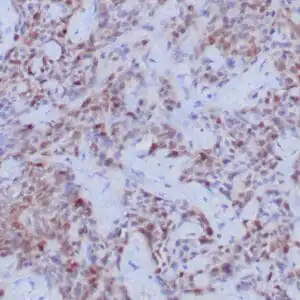
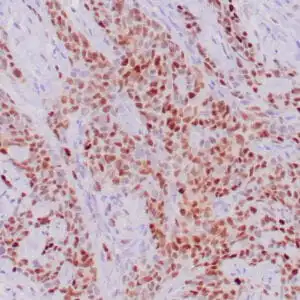
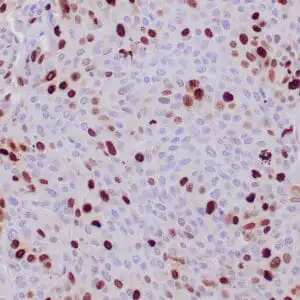
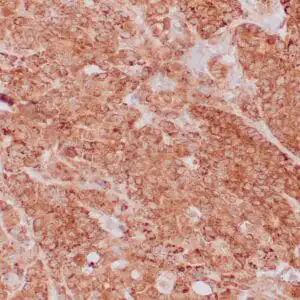
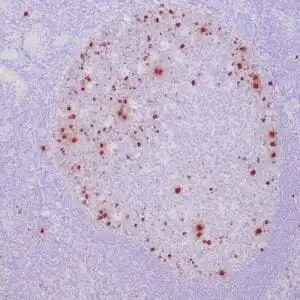
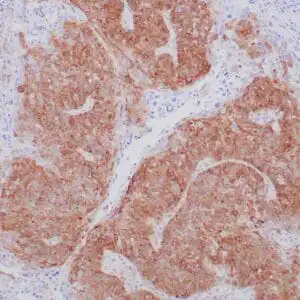
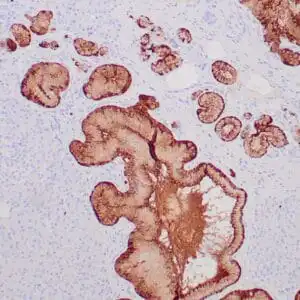
| Human sarcoma stained with anti-MMP-2 antibody using peroxidase-conjugate and DAB chromogen. Note the cytoplasmic staining of some tumor cells.. |
FAQ & Publications
Frequently Asked Questions
What species does the mouse anti-MMP-2 monoclonal antibody (CA-4001) specifically react with?
This antibody reacts specifically with human MMP-2 protein.
Which applications is the mouse anti-MMP-2 monoclonal antibody (CA-4001) validated for?
It is validated for immunohistochemistry (IHC) on formalin-fixed, paraffin-embedded tissues.
What are the recommended storage conditions for maintaining the antibody's stability?
For short-term storage, keep the antibody at 2-8°C. For longer term preservation, store at -20°C and avoid freeze/thaw cycles.
What immunogen was used to generate this monoclonal anti-MMP-2 antibody?
The antibody was raised against a synthetic peptide derived from near the N-terminal region of the human MMP-2 protein.
What is the clonality and isotype of the mouse anti-MMP-2 monoclonal antibody (CA-4001)?
This antibody is a mouse monoclonal of the IgG1 isotype.
Publications
| pmid | title | authors | citation |
|---|---|---|---|
| We haven't added any publications to our database yet. | |||
Published literature highly relevant to the biological target of this product and referencing this antibody or clone are retrieved from the PubMed database provided by the United States National Library of Medicine at the National Institutes of Health.
Protocols
| relevant to this product |
|---|
| IHC |
Documents
| Batch Number | QC File | SDS |
|---|---|---|
| To view batch-specific Safety Datasheets and Quality Certificates associated with your account, please Log In. | ||
Only logged in customers who have purchased this product may leave a review.
Reviews
There are no reviews yet.