| Weight | 1 lbs |
|---|---|
| Dimensions | 9 × 5 × 2 in |
| host | mouse |
| isotype | IgG1 |
| clonality | monoclonal |
| concentration | concentrate, predilute |
| applications | IHC |
| reactivity | human |
| available size | 0.1 mL, 0.5 mL, 1 mL concentrated, 7 mL prediluted |

mouse anti-Galectin-3 monoclonal antibody (ZM182) 6188
Price range: $160.00 through $528.00
Antibody summary
- Mouse monoclonal to Galectin-3
- Suitable for: Immunohistochemistry (formalin-fixed, paraffin-embedded tissues)
- Reacts with: Human
- Isotype:IgG1
- Control: Papillary or follicular thyroid carcinoma
- Visualization: Cytoplasmic
- 0.1, 0.5, 1.0 mL concentrated, 7 mL prediluted
mouse anti-Galectin-3 monoclonal antibody ZM182 6188
| antibody |
|---|
| Database link: human P17931 |
| Tested applications IHC |
| Recommended dilutions Concentrated 1:100-200 |
| Application Notes Positive control: Papillary or follicular thyroid carcinoma |
| Immunogen A synthetic peptide from the C-terminus of human LGALS3 protein (aa 150-200) |
| Size and concentration 7 mL prediluted or 0.1, 0.5, 1.0 mL and concentrated |
| Form liquid |
| Storage Instructions 2-8°C for short term, for longer term at -20°C. Avoid freeze / thaw cycles. |
| Purity affinity purified |
| Clonality monoclonal |
| Isotype IgG1 |
| Compatible secondaries goat anti-mouse IgG, H&L chain specific, peroxidase conjugated polyclonal antibody 5486 goat anti-mouse IgG, H&L chain specific, biotin conjugated, Conjugate polyclonal antibody 2685 goat anti-mouse IgG, H&L chain specific, FITC conjugated polyclonal antibody 7854 goat anti-mouse IgG, H&L chain specific, peroxidase conjugated polyclonal antibody, crossabsorbed 1706 goat anti-mouse IgG, H&L chain specific, biotin conjugated polyclonal antibody, crossabsorbed 1716 goat anti-mouse IgG, H&L chain specific, FITC conjugated polyclonal antibody, crossabsorbed 1721 |
| Isotype control Mouse monoclonal IgG1 - Isotype Control |
| target relevance |
|---|
| Homo sapiens LGALS3 Galectin-3 |
| Protein names Galectin-3 |
| Alternative names 35 kDa lectin, Carbohydrate-binding protein 35, Galactose-specific lectin 3, Galactoside-binding protein, IgE-binding protein, L-31, Laminin-binding protein, Lectin L-29, Mac-2 antigen |
| Gene names LGALS3 |
| Function Galactose-specific lectin which binds IgE. May mediate with the alpha-3, beta-1 integrin the stimulation by CSPG4 of endothelial cells migration. Together with DMBT1, required for terminal differentiation of columnar epithelial cells during early embryogenesis (By similarity). In the nucleus: acts as a pre-mRNA splicing factor. Involved in acute inflammatory responses including neutrophil activation and adhesion, chemoattraction of monocytes macrophages, opsonization of apoptotic neutrophils, and activation of mast cells. Together with TRIM16, coordinates the recognition of membrane damage with mobilization of the core autophagy regulators ATG16L1 and BECN1 in response to damaged endomembranes |
| Subcellular location Cytoplasm, Nucleus, Secreted |
| Structure Probably forms homo- or heterodimers. Interacts with DMBT1 (By similarity). Interacts with CD6 and ALCAM (PubMed:24945728). Forms a complex with the ITGA3, ITGB1 and CSPG4. Interacts with LGALS3BP, LYPD3, ZFTRAF1 and UACA. Interacts with TRIM16; this interaction mediates autophagy of damage endomembranes. Interacts with cargo receptor TMED10; the interaction mediates the translocation from the cytoplasm into the ERGIC (endoplasmic reticulum-Golgi intermediate compartment) and thereby secretion (PubMed:32272059) |
| Keywords 3D-structure, Acetylation, Cytoplasm, Differentiation, Disulfide bond, IgE-binding protein, Immunity, Innate immunity, Lectin, mRNA processing, mRNA splicing, Nucleus, Phosphoprotein, Proteomics identification, Reference proteome, Repeat, Secreted, Spliceosome |
| Sequence MADNFSLHDALSGSGNPNPQGWPGAWGNQPAGAGGYPGASYPGAYPGQAPPGAYPGQAPP GAYPGAPGAYPGAPAPGVYPGPPSGPGAYPSSGQPSATGAYPATGPYGAPAGPLIVPYNL PLPGGVVPRMLITILGTVKPNANRIALDFQRGNDVAFHFNPRFNENNRRVIVCNTKLDNN WGREERQSVFPFESGKPFKIQVLVEPDHFKVAVNDAHLLQYNHRVKKLNEISKLGISGDI DLTSASYTMI |
| UniProt accession: P17931 |
Data
 |
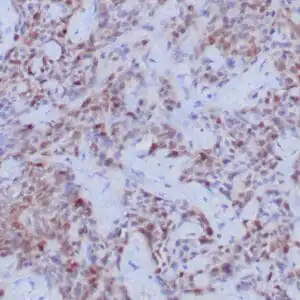
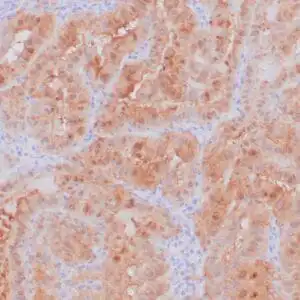
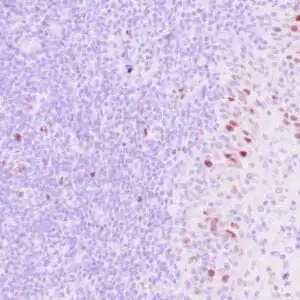
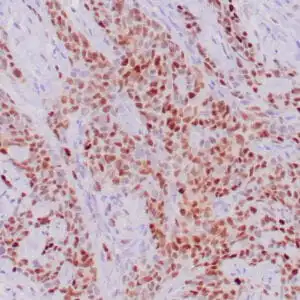
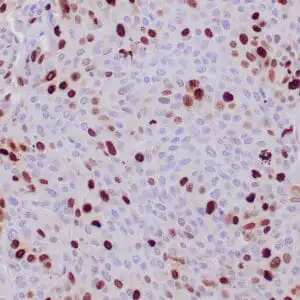
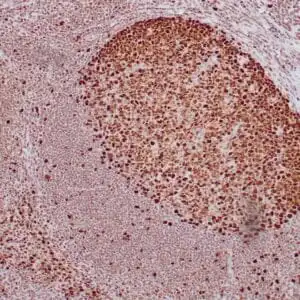
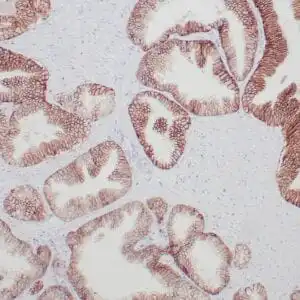
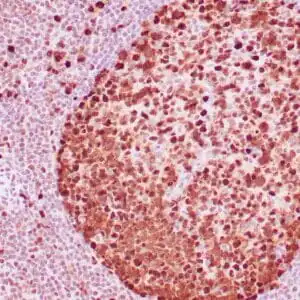
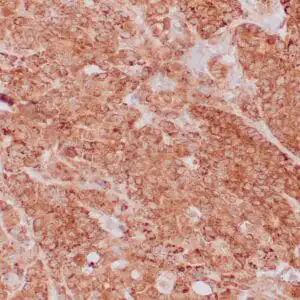
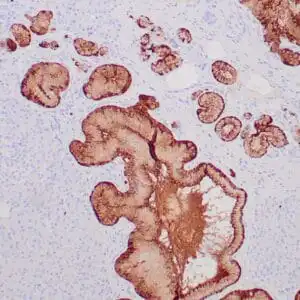
| Human kidney stained with anti-Galectin-3 antibody using peroxidase-conjugate and DAB chromogen. Note the cytoplasmic staining of tubular cells. |
FAQ & Publications
Frequently Asked Questions
What is the recommended dilution range for using the mouse anti-Galectin-3 monoclonal antibody (ZM182) in immunohistochemistry?
For immunohistochemistry applications, the concentrated mouse anti-Galectin-3 monoclonal antibody (ZM182) is recommended to be diluted between 1:100 and 1:200.
How should the mouse anti-Galectin-3 monoclonal antibody (ZM182) be stored to maintain its stability?
The antibody should be stored at 2-8°C for short-term use. For long-term storage, keep the antibody at -20°C and avoid repeated freeze-thaw cycles to preserve its stability.
Publications
| pmid | title | authors | citation |
|---|---|---|---|
| We haven't added any publications to our database yet. | |||
Published literature highly relevant to the biological target of this product and referencing this antibody or clone are retrieved from the PubMed database provided by the United States National Library of Medicine at the National Institutes of Health.
Protocols
| relevant to this product |
|---|
| IHC |
Documents
| Batch Number | QC File | SDS |
|---|---|---|
| To view batch-specific Safety Datasheets and Quality Certificates associated with your account, please Log In. | ||
Only logged in customers who have purchased this product may leave a review.
Reviews
There are no reviews yet.