| Weight | 1 lbs |
|---|---|
| Dimensions | 9 × 5 × 2 in |
| host | mouse |
| isotype | IgG1 |
| clonality | monoclonal |
| concentration | concentrate, predilute |
| applications | IHC |
| reactivity | human |
| available size | 0.1 mL, 0.5 mL, 1 mL concentrated, 7 mL prediluted |

mouse anti-Erythropoietin monoclonal antibody (ZM135) 6178
Price range: $160.00 through $528.00
Antibody summary
- Mouse monoclonal to Erythropoietin
- Suitable for: Immunohistochemistry (formalin-fixed, paraffin-embedded tissues)
- Reacts with: Human
- Isotype:IgG1
- Control: Kidney
- Visualization: Cytoplasmic
- 0.1, 0.5, 1.0 mL concentrated, 7 mL prediluted
mouse anti-Erythropoietin monoclonal antibody ZM135 6178
| target relevance |
|---|
| Homo sapiens EPO Erythropoietin |
| Protein names Erythropoietin |
| Gene names EPO |
| Protein family Belongs to the EPO/TPO family |
| Function Hormone involved in the regulation of erythrocyte proliferation and differentiation and the maintenance of a physiological level of circulating erythrocyte mass (PubMed:28283061). Binds to EPOR leading to EPOR dimerization and JAK2 activation thereby activating specific downstream effectors, including STAT1 and STAT3 (PubMed:9774108) |
| Subcellular location Secreted |
| Involvement in disease Microvascular complications of diabetes 2 Pathological conditions that develop in numerous tissues and organs as a consequence of diabetes mellitus. They include diabetic retinopathy, diabetic nephropathy leading to end-stage renal disease, and diabetic neuropathy. Diabetic retinopathy remains the major cause of new-onset blindness among diabetic adults. It is characterized by vascular permeability and increased tissue ischemia and angiogenesis. Erythrocytosis, familial, 5 An autosomal dominant disorder characterized by elevated serum hemoglobin and hematocrit. Some patients have increased serum erythropoietin levels. Diamond-Blackfan anemia-like An autosomal recessive hematologic disease characterized by severe red cell hypoplastic anemia, selective absence of red cell precursors and progenitors seen on bone marrow biopsy, and increased serum erythropoietin. |
| Keywords 3D-structure, Congenital erythrocytosis, Direct protein sequencing, Disease variant, Disulfide bond, Erythrocyte maturation, Glycoprotein, Hormone, Pharmaceutical, Proteomics identification, Reference proteome, Secreted, Signal |
| Sequence MGVHECPAWLWLLLSLLSLPLGLPVLGAPPRLICDSRVLERYLLEAKEAENITTGCAEHC SLNENITVPDTKVNFYAWKRMEVGQQAVEVWQGLALLSEAVLRGQALLVNSSQPWEPLQL HVDKAVSGLRSLTTLLRALGAQKEAISPPDAASAAPLRTITADTFRKLFRVYSNFLRGKL KLYTGEACRTGDR |
| UniProt accession: P01588 |
Data
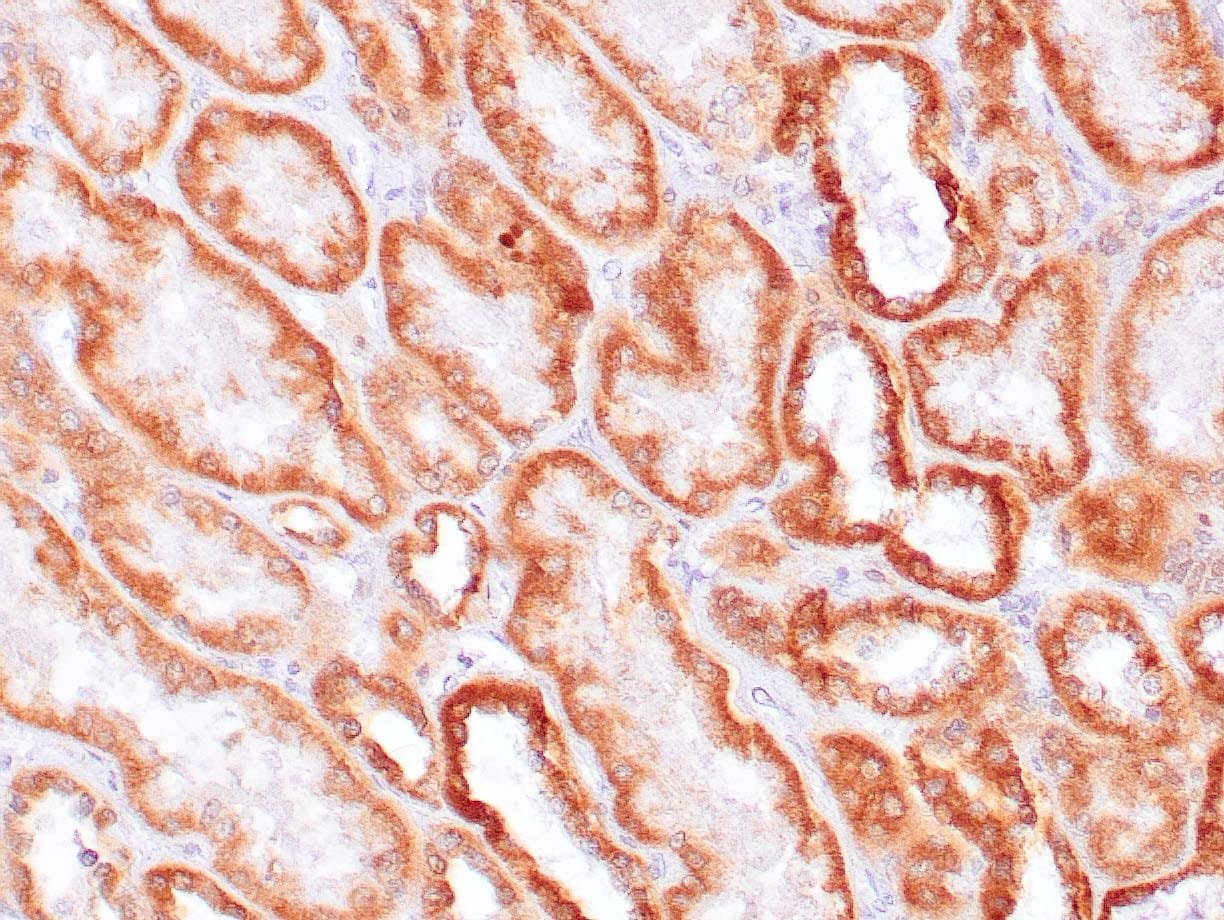 |
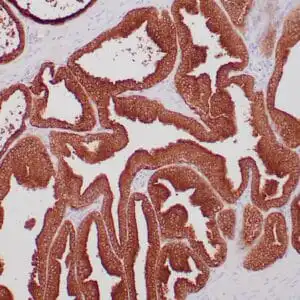
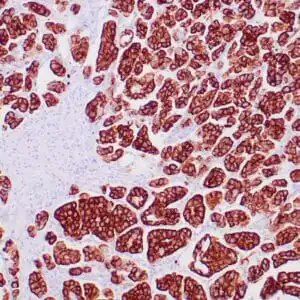
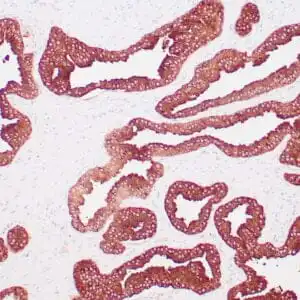
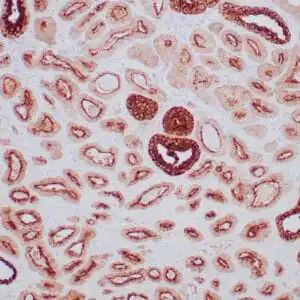
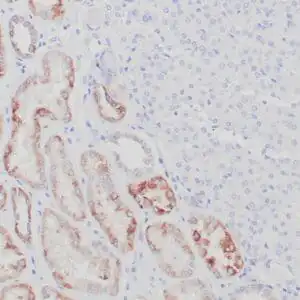
| Human kidney stained with anti-Erythropoietin antibody using peroxidase-conjugate and DAB chromogen. Note cytoplasmic staining of tubular cells. |
FAQ & Publications
Frequently Asked Questions
What is the recommended application for the mouse anti-Erythropoietin monoclonal antibody (ZM135) 6178?
This antibody is suitable for immunohistochemistry (IHC) applications, specifically on formalin-fixed, paraffin-embedded human tissue samples.
How should the mouse anti-Erythropoietin antibody be stored to maintain its stability?
For short-term storage, keep the antibody at 2-8°C. For longer-term preservation, store it at -20°C and avoid repeated freeze/thaw cycles to maintain antibody integrity.
Which species does the mouse anti-Erythropoietin monoclonal antibody (ZM135) specifically react with?
This monoclonal antibody reacts specifically with human erythropoietin.
What is the immunogen used to generate the mouse anti-Erythropoietin monoclonal antibody (ZM135)?
The immunogen is a recombinant fragment of the human erythropoietin protein, covering approximately amino acids 28 to 162.
Is this antibody monoclonal or polyclonal, and what is its isotype?
The antibody is a mouse monoclonal antibody of the IgG1 isotype.
Publications
| pmid | title | authors | citation |
|---|---|---|---|
| We haven't added any publications to our database yet. | |||
Published literature highly relevant to the biological target of this product and referencing this antibody or clone are retrieved from the PubMed database provided by the United States National Library of Medicine at the National Institutes of Health.
Protocols
| relevant to this product |
|---|
| IHC |
Documents
| Batch Number | QC File | SDS |
|---|---|---|
| To view batch-specific Safety Datasheets and Quality Certificates associated with your account, please Log In. | ||
Only logged in customers who have purchased this product may leave a review.
Reviews
There are no reviews yet.