| Weight | 1 lbs |
|---|---|
| Dimensions | 9 × 5 × 2 in |
| host | mouse |
| isotype | IgG1 |
| clonality | monoclonal |
| concentration | concentrate, predilute |
| applications | IHC |
| reactivity | human |
| available size | 0.1 mL, 0.5 mL, 1 mL concentrated, 7 mL prediluted |

mouse anti-Desmin monoclonal antibody (ZM34) 6157
Price range: $160.00 through $528.00
Antibody summary
- Mouse monoclonal to Desmin
- Suitable for: Immunohistochemistry (formalin-fixed, paraffin-embedded tissues)
- Reacts with: Human
- Isotype:IgG1
- Control: Skeletal muscle or rhabdomyosarcoma
- Visualization: Cytoplasmic and luminal membrane
- 0.1, 0.5, 1.0 mL concentrated, 7 mL prediluted
mouse anti-Desmin monoclonal antibody ZM34 6157
| target relevance |
|---|
| Homo sapiens DES Desmin |
| Protein names Desmin |
| Gene names DES |
| Protein family Belongs to the intermediate filament family |
| Function Muscle-specific type III intermediate filament essential for proper muscular structure and function. Plays a crucial role in maintaining the structure of sarcomeres, inter-connecting the Z-disks and forming the myofibrils, linking them not only to the sarcolemmal cytoskeleton, but also to the nucleus and mitochondria, thus providing strength for the muscle fiber during activity (PubMed:25358400). In adult striated muscle they form a fibrous network connecting myofibrils to each other and to the plasma membrane from the periphery of the Z-line structures (PubMed:24200904, PubMed:25394388, PubMed:26724190). May act as a sarcomeric microtubule-anchoring protein: specifically associates with detyrosinated tubulin-alpha chains, leading to buckled microtubules and mechanical resistance to contraction. Required for nuclear membrane integrity, via anchoring at the cell tip and nuclear envelope, resulting in maintenance of microtubule-derived intracellular mechanical forces (By similarity). Contributes to the transcriptional regulation of the NKX2-5 gene in cardiac progenitor cells during a short period of cardiomyogenesis and in cardiac side population stem cells in the adult. Plays a role in maintaining an optimal conformation of nebulette (NEB) on heart muscle sarcomeres to bind and recruit cardiac alpha-actin (By similarity) |
| Subcellular location Cytoplasm, myofibril, sarcomere, Z line, Cytoplasm, Cell membrane, sarcolemma, Nucleus, Cell tip, Nucleus envelope |
| Structure Homomer (PubMed:21135508). Interacts with DST (By similarity). Interacts with MTM1 (PubMed:21135508). Interacts with EPPK1; interaction is dependent of higher-order structure of intermediate filament (PubMed:16923132). Interacts with CRYAB (PubMed:28470624). Interacts with NEB (via nebulin repeats 160-164) (PubMed:23615443). Interacts (via rod region) with NEBL (via nebulin repeats 1-5) (PubMed:27733623). Interacts with ASB2 isoform 1; the interaction targets DES for proteasomal degradation (By similarity). Interacts with PLEC isoform 1C (PubMed:24940650). Interacts with PKP1 (PubMed:10852826). Interacts with FLII (By similarity) |
| Post-translational modification ADP-ribosylation prevents ability to form intermediate filaments Phosphorylation at Ser-7, Ser-28 and Ser-32 by CDK1, phosphorylation at Ser-60 by AURKB and phosphorylation at Thr-76 by ROCK1 contribute to efficient separation of desmin intermediate filaments during mitosis Ubiquitination by a SCF-like complex containing ASB2 isoform 1 leads to proteasomal degradation |
| Involvement in disease Myopathy, myofibrillar, 1 A form of myofibrillar myopathy, a group of chronic neuromuscular disorders characterized at ultrastructural level by disintegration of the sarcomeric Z disk and myofibrils, and replacement of the normal myofibrillar markings by small dense granules, or larger hyaline masses, or amorphous material. MFM1 is characterized by skeletal muscle weakness associated with cardiac conduction blocks, arrhythmias, restrictive heart failure, and accumulation of desmin-reactive deposits in cardiac and skeletal muscle cells. Cardiomyopathy, dilated, 1I A disorder characterized by ventricular dilation and impaired systolic function, resulting in congestive heart failure and arrhythmia. Patients are at risk of premature death. Neurogenic scapuloperoneal syndrome Kaeser type Autosomal dominant disorder with a peculiar scapuloperoneal distribution of weakness and atrophy. A large clinical variability is observed ranging from scapuloperoneal, limb grindle and distal phenotypes with variable cardiac or respiratory involvement. Facial weakness, dysphagia and gynaecomastia are frequent additional symptoms. Affected men seemingly bear a higher risk of sudden, cardiac death as compared to affected women. Histological and immunohistochemical examination of muscle biopsy specimens reveal a wide spectrum of findings ranging from near normal or unspecific pathology to typical, myofibrillar changes with accumulation of desmin. |
| Keywords ADP-ribosylation, Cardiomyopathy, Cell membrane, Coiled coil, Cytoplasm, Desmin-related myopathy, Disease variant, Intermediate filament, Limb-girdle muscular dystrophy, Membrane, Methylation, Muscle protein, Myofibrillar myopathy, Nucleus, Phosphoprotein, Proteomics identification, Reference proteome, Ubl conjugation |
| Sequence MSQAYSSSQRVSSYRRTFGGAPGFPLGSPLSSPVFPRAGFGSKGSSSSVTSRVYQVSRTS GGAGGLGSLRASRLGTTRTPSSYGAGELLDFSLADAVNQEFLTTRTNEKVELQELNDRFA NYIEKVRFLEQQNAALAAEVNRLKGREPTRVAELYEEELRELRRQVEVLTNQRARVDVER DNLLDDLQRLKAKLQEEIQLKEEAENNLAAFRADVDAATLARIDLERRIESLNEEIAFLK KVHEEEIRELQAQLQEQQVQVEMDMSKPDLTAALRDIRAQYETIAAKNISEAEEWYKSKV SDLTQAANKNNDALRQAKQEMMEYRHQIQSYTCEIDALKGTNDSLMRQMRELEDRFASEA SGYQDNIARLEEEIRHLKDEMARHLREYQDLLNVKMALDVEIATYRKLLEGEESRINLPI QTYSALNFRETSPEQRGSEVHTKKTVMIKTIETRDGEVVSEATQQQHEVL |
| UniProt accession: P17661 |
Data
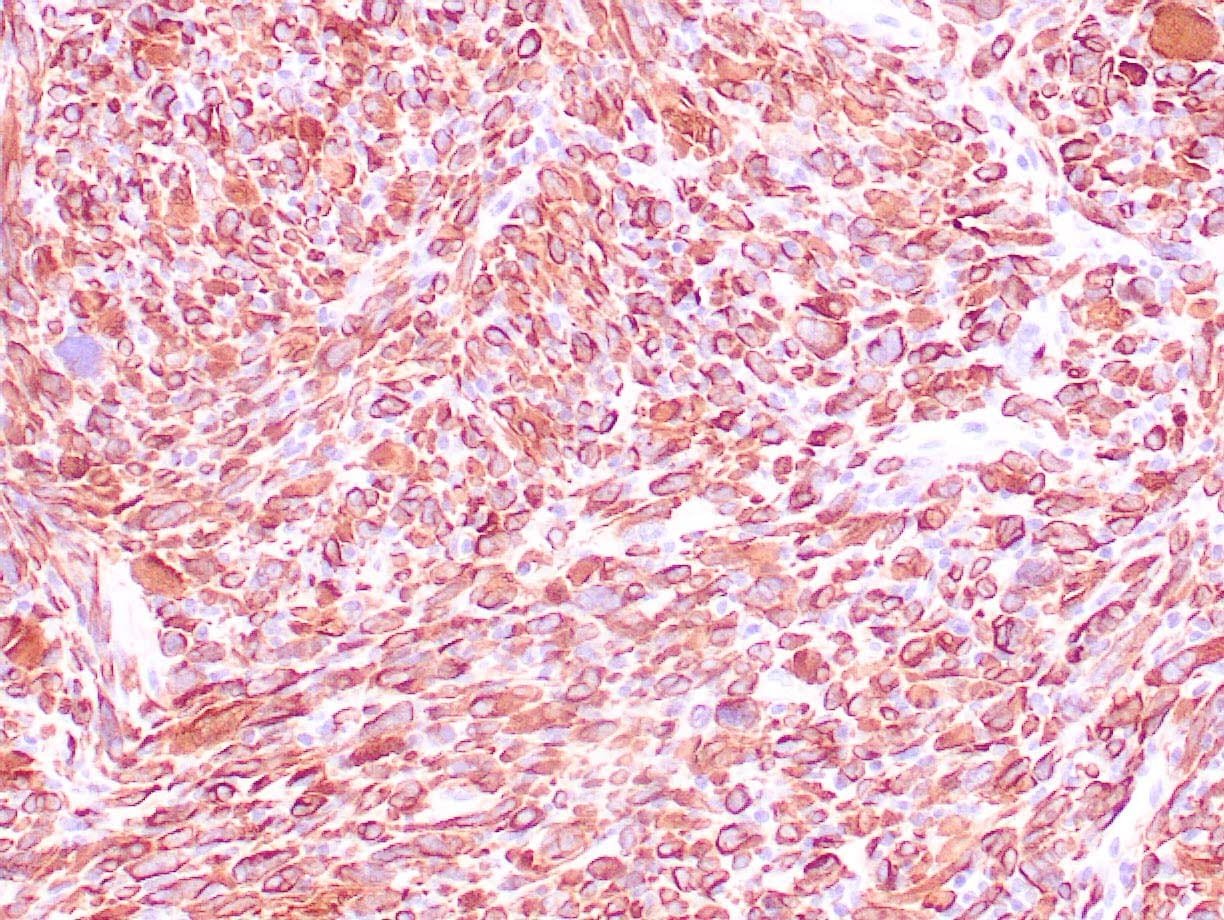 |
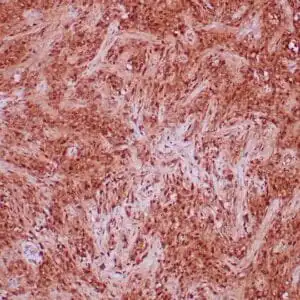
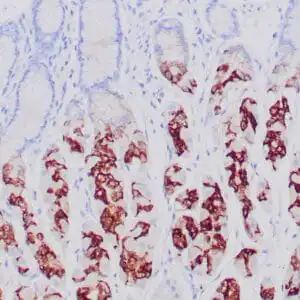
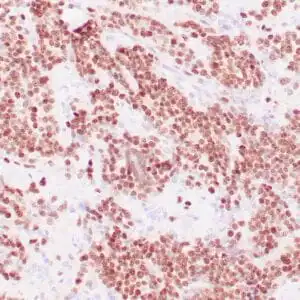
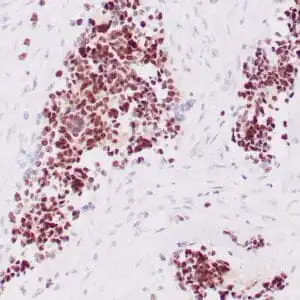
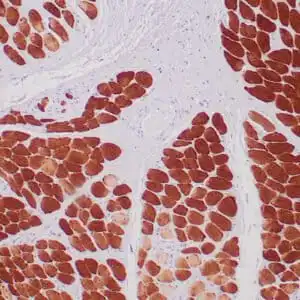
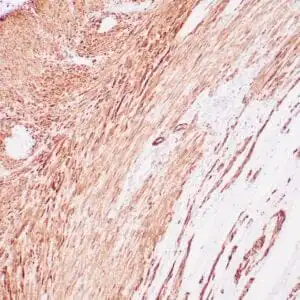
| Human uterus stained with anti-desmin antibody using peroxidase-conjugate and DAB chromogen. Note the cytoplasmic staining of smooth muscle cells. |
FAQ & Publications
Frequently Asked Questions
What applications is the mouse anti-Desmin monoclonal antibody (ZM34) suitable for?
This antibody is validated for immunohistochemistry (IHC) on formalin-fixed, paraffin-embedded tissues, specifically for detecting Desmin in human samples.
How should the mouse anti-Desmin monoclonal antibody (ZM34) be stored to maintain its stability?
For short-term storage, keep the antibody at 2-8°C. For long-term preservation, store at -20°C and avoid repeated freeze/thaw cycles to maintain antibody integrity.
What is the recommended dilution for using the concentrated form of the mouse anti-Desmin monoclonal antibody in IHC?
The concentrated antibody should be diluted between 1:100 and 1:200 for optimal immunohistochemistry staining results.
Publications
| pmid | title | authors | citation |
|---|---|---|---|
| We haven't added any publications to our database yet. | |||
Published literature highly relevant to the biological target of this product and referencing this antibody or clone are retrieved from the PubMed database provided by the United States National Library of Medicine at the National Institutes of Health.
Protocols
| relevant to this product |
|---|
| IHC |
Documents
| Batch Number | QC File | SDS |
|---|---|---|
| To view batch-specific Safety Datasheets and Quality Certificates associated with your account, please Log In. | ||
Only logged in customers who have purchased this product may leave a review.


Reviews
There are no reviews yet.