| Weight | 1 lbs |
|---|---|
| Dimensions | 9 × 5 × 2 in |
| target | Herpes simplex Virus 1 |
| species reactivity | Herpes Simplex Virus |
| applications | ELISA |
| assay type | Indirect & quantitative |
| available size | 1 mg |

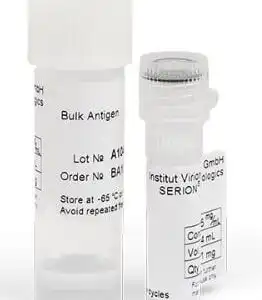
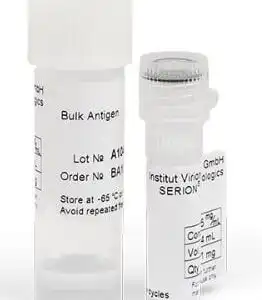
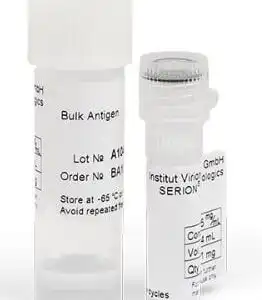
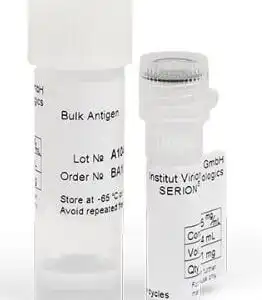
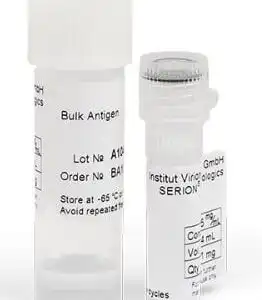
Herpes simplex Virus 1 Antigen BA1051VS
$819.00
Summary
- Virion/Serion Immunologics Antigen for research use (RUO)
- Herpes Simplex Virus (HSV) 1 Antigen, recombinant
- Suitable for detection of IgA, IgG & IgM antibodies in ELISA
- Lot specific concentration, specified in mg/mL
- 1 mg
Herpes simplex Virus 1 Antigen BA1051VS
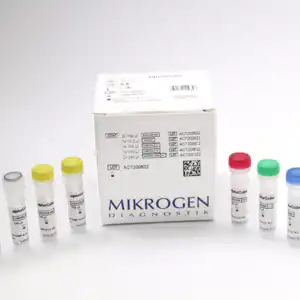
| kit |
|---|
| Research area Infectious Disease |
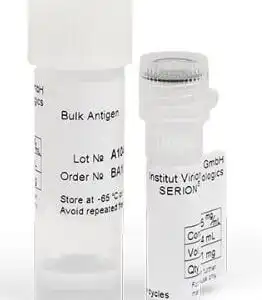
| Storage Store at -65°C or lower. Avoid repeated freeze-thaw cycles. Sonicate before use. 10 years from date of manufacture (under recommended storage conditions). |
| Form liquid |
| Associated products Herpes simplex Virus 1 Glycoprotein G Antigen (BA1051RVS-G) Herpes simplex Virus 1 Antigen (BA1051VS) Herpes Simplex Virus 1 gP IgG Control Serum (BC1051G) Herpes Simplex Virus 1 IgM Control Serum (BC1051M) Herpes simplex Virus 1 IgG ELISA Kit (ESR1051G) Herpes simplex Virus 1 IgM ELISA Kit (ESR1051M) |
| target relevance |
|---|
| Organism Herpes Simplex Virus 1/2 |
| Protein names Herpes Simplex Virus (HSV) |
| Structure and strains Herpes simplex virus 1 and 2 (HSV-1 and HSV-2), also known by their taxonomic names Human alphaherpesvirus 1 and Human alphaherpesvirus 2, are two members of the human Herpesviridae family, a set of viruses that produce viral infections in the majority of humans. Both HSV-1 and HSV-2 are very common and contagious. They can be spread when an infected person begins shedding the virus. As of 2016, about 67% of the world population under the age of 50 had HSV-1. In the United States, about 47.8% and 11.9% are estimated to have HSV-1 and HSV-2, respectively, though actual prevalence may be much higher. Because it can be transmitted through any intimate contact, it is one of the most common sexually transmitted infections. |
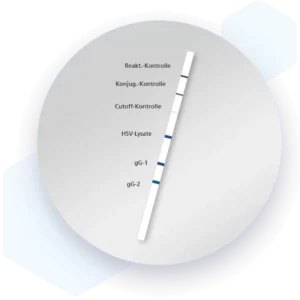
| Detection and diagnosis An important field of application for HSV serology - also during latency - is the detection of serotype-specific HSV IgG antibodies in order to identify potential HSV carriers who could infect susceptible individuals. In particular, the identification of HSV 2 serotype-specific antibodies in pregnant women, who present a high risk of transferring the virus to a newborn child, is recommended. The serological typing of an HSV infection is usually performed by identifying IgG antibodies directed against the viral surface glycoproteins G (gG) of HSV 1 (gG1) and HSV 2 (gG2). Due to the fact that these antibodies are only produced some weeks after a primary infection, the determination of serotype-specific antibodies can also assist in the differentiation between primary infection and reactivation |
Data
FAQ & Publications
Frequently Asked Questions
What applications is the Herpes simplex Virus 1 Antigen BA1051VS suitable for?
The Herpes simplex Virus 1 Antigen BA1051VS is suitable for detecting IgA, IgG, and IgM antibodies in ELISA assays, specifically for indirect and quantitative assay types.
How should the Herpes simplex Virus 1 Antigen BA1051VS be stored to maintain its stability?
This antigen should be stored at -65°C or lower and should be protected from repeated freeze-thaw cycles. It is recommended to sonicate the product before use to ensure proper resuspension.
What species reactivity does the Herpes simplex Virus 1 Antigen BA1051VS exhibit?
The antigen is reactive with Herpes Simplex Virus species, specifically targeting Herpes simplex Virus 1.
What is the form and concentration information provided for the Herpes simplex Virus 1 Antigen BA1051VS?
The product is supplied in liquid form, and the lot-specific concentration is specified in mg/mL on the product label. The available size is 1 mg per vial.
Publications
| pmid | title | authors | citation |
|---|---|---|---|
| We haven't added any publications to our database yet. | |||
Published literature highly relevant to the biological target of this product and referencing this antibody or clone are retrieved from the PubMed database provided by the United States National Library of Medicine at the National Institutes of Health.
Protocols
| relevant to this product |
|---|
Only logged in customers who have purchased this product may leave a review.

Reviews
There are no reviews yet.