| Weight | 1 lbs |
|---|---|
| Dimensions | 9 × 5 × 2 in |
| host | mouse |
| isotype | IgG2b |
| clonality | monoclonal |
| concentration | concentrate, predilute |
| applications | IHC |
| reactivity | human |
| available size | 0.1 mL, 0.5 mL, 1 mL concentrated, 7 mL prediluted |

mouse anti-Cytokeratin 17 monoclonal antibody (E3) 6137
Price range: $160.00 through $528.00
Antibody summary
- Mouse monoclonal to Cytokeratin 17
- Suitable for: Immunohistochemistry (formalin-fixed, paraffin-embedded tissues)
- Reacts with: Human
- Isotype:IgG2b
- Control: Squamous cell carcinoma or skin
- Visualization: Cytoplasmic
- 0.1, 0.5, 1.0 mL concentrated, 7 mL prediluted
mouse anti-Cytokeratin 17 monoclonal antibody E3 6137
| target relevance |
|---|
| Homo sapiens KRT17 Keratin, type I cytoskeletal 17 |
| Protein names Keratin, type I cytoskeletal 17 |
| Alternative names 39.1, Cytokeratin-17, Keratin-17 |
| Gene names KRT17 |
| Protein family Belongs to the intermediate filament family |
| Function Type I keratin involved in the formation and maintenance of various skin appendages, specifically in determining shape and orientation of hair (By similarity). Required for the correct growth of hair follicles, in particular for the persistence of the anagen (growth) state (By similarity). Modulates the function of TNF in the specific context of hair cycling. Regulates protein synthesis and epithelial cell growth through binding to the adapter protein SFN and by stimulating Akt/mTOR pathway (By similarity). Involved in tissue repair. May be a marker of basal cell differentiation in complex epithelia and therefore indicative of a certain type of epithelial 'stem cells'. Acts as a promoter of epithelial proliferation by acting a regulator of immune response in skin: promotes Th1/Th17-dominated immune environment contributing to the development of basaloid skin tumors (By similarity). May act as an autoantigen in the immunopathogenesis of psoriasis, with certain peptide regions being a major target for autoreactive T-cells and hence causing their proliferation |
| Subcellular location Cytoplasm |
| Structure Heterodimer of a type I and a type II keratin. KRT17 associates with KRT6 isomers (KRT6A or KRT6B). Interacts with TRADD and SFN (By similarity) |
| Post-translational modification Phosphorylation at Ser-44 occurs in a growth- and stress-dependent fashion in skin keratinocytes, it has no effect on filament organization |
| Involvement in disease Pachyonychia congenita 2 An autosomal dominant ectodermal dysplasia characterized by hypertrophic nail dystrophy resulting in onchyogryposis (thickening and increase in curvature of the nail), palmoplantar keratoderma and hyperhidrosis, follicular hyperkeratosis, multiple epidermal cysts, absent/sparse eyebrow and body hair, and by the presence of natal teeth. Steatocystoma multiplex Disease characterized by round or oval cystic tumors widely distributed on the back, anterior trunk, arms, scrotum, and thighs. |
| Keywords Coiled coil, Cytoplasm, Disease variant, Ectodermal dysplasia, Intermediate filament, Isopeptide bond, Keratin, Palmoplantar keratoderma, Phosphoprotein, Proteomics identification, Reference proteome, Ubl conjugation |
| Sequence MTTSIRQFTSSSSIKGSSGLGGGSSRTSCRLSGGLGAGSCRLGSAGGLGSTLGGSSYSSC YSFGSGGGYGSSFGGVDGLLAGGEKATMQNLNDRLASYLDKVRALEEANTELEVKIRDWY QRQAPGPARDYSQYYRTIEELQNKILTATVDNANILLQIDNARLAADDFRTKFETEQALR LSVEADINGLRRVLDELTLARADLEMQIENLKEELAYLKKNHEEEMNALRGQVGGEINVE MDAAPGVDLSRILNEMRDQYEKMAEKNRKDAEDWFFSKTEELNREVATNSELVQSGKSEI SELRRTMQALEIELQSQLSMKASLEGNLAETENRYCVQLSQIQGLIGSVEEQLAQLRCEM EQQNQEYKILLDVKTRLEQEIATYRRLLEGEDAHLTQYKKEPVTTRQVRTIVEEVQDGKV ISSREQVHQTTR |
| UniProt accession: Q04695 |
Data
 |
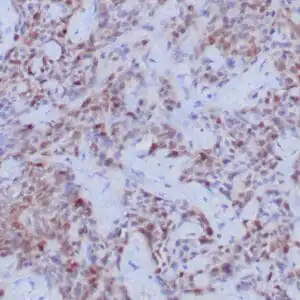
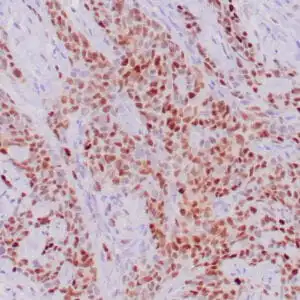
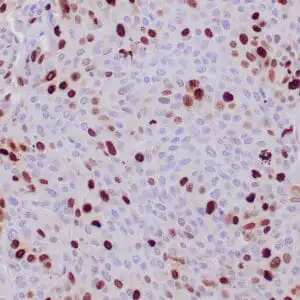
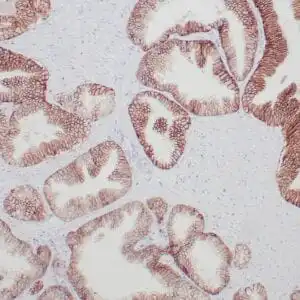
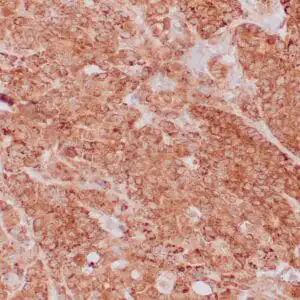
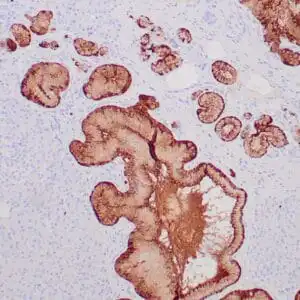
| Human pancreatic ductal carcinoma stained with anti-keratin 17 antibody using peroxidase-conjugate and DAB chromogen. Note the cytoplasmic staining of tumor cells. |
FAQ & Publications
Frequently Asked Questions
What species does the mouse anti-Cytokeratin 17 monoclonal antibody (E3) specifically react with?
This monoclonal antibody reacts specifically with human Cytokeratin 17.
What are the recommended storage conditions for the mouse anti-Cytokeratin 17 monoclonal antibody (E3)?
For short-term storage, keep the antibody at 2-8°C. For long-term storage, it should be stored at -20°C, and freeze/thaw cycles should be avoided to maintain antibody stability.
Publications
| pmid | title | authors | citation |
|---|---|---|---|
| We haven't added any publications to our database yet. | |||
Published literature highly relevant to the biological target of this product and referencing this antibody or clone are retrieved from the PubMed database provided by the United States National Library of Medicine at the National Institutes of Health.
Protocols
| relevant to this product |
|---|
| IHC |
Documents
| Batch Number | QC File | SDS |
|---|---|---|
| To view batch-specific Safety Datasheets and Quality Certificates associated with your account, please Log In. | ||
Only logged in customers who have purchased this product may leave a review.
Reviews
There are no reviews yet.