| Weight | 1 lbs |
|---|---|
| Dimensions | 9 × 5 × 2 in |
| host | rabbit |
| isotype | IgG |
| clonality | polyclonal |
| concentration | 1 mg/mL |
| applications | ICC/IF, WB |
| reactivity | GABABR1 |
| available sizes | 100 µg |
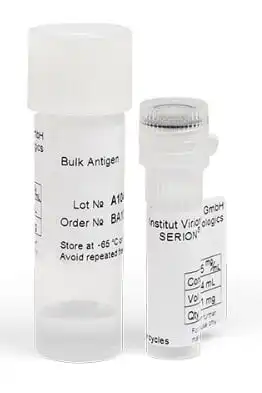
rabbit anti-GABA (B)R1 polyclonal antibody 2393
$376.00
Antibody summary
- Rabbit polyclonal to GABA (B)R1
- Suitable for: WB
- Isotype: Whole IgG
- 100 µg
rabbit anti-GABA (B)R1 polyclonal antibody 2393
| antibody |
|---|
| Tested applications WB |
| Recommended dilutions Immunoblotting: use at 1:500-1:1,000 dilution. In immunoblots, a band of approximately 120 kD is detected. |
| Immunogen Peptide corresponding to aa 33-54 of the GABABR1 subunit. |
| Size and concentration 100µg and lot specific |
| Form liquid |
| Storage Instructions This antibody is stable for at least one (1) year at -20°C. Avoid multiple freeze- thaw cycles. |
| Storage buffer PBS, pH 7.4. |
| Purity protein affinity purification |
| Clonality polyclonal |
| Isotype IgG |
| Compatible secondaries goat anti-rabbit IgG, H&L chain specific, peroxidase conjugated, conjugated polyclonal antibody 9512 goat anti-rabbit IgG, H&L chain specific, biotin conjugated polyclonal antibody 2079 goat anti-rabbit IgG, H&L chain specific, FITC conjugated polyclonal antibody 7863 goat anti-rabbit IgG, H&L chain specific, Cross Absorbed polyclonal antibody 2371 goat anti-rabbit IgG, H&L chain specific, biotin conjugated polyclonal antibody, crossabsorbed 1715 goat anti-rabbit IgG, H&L chain specific, FITC conjugated polyclonal antibody, crossabsorbed 1720 |
| Isotype control Rabbit polyclonal - Isotype Control |
| target relevance |
|---|
| Homo sapiens GABBR1 Gamma-aminobutyric acid type B receptor subunit 1 |
| Protein names Gamma-aminobutyric acid type B receptor subunit 1 |
| Gene names GABBR1 |
| Protein family Belongs to the G-protein coupled receptor 3 family. GABA-B receptor subfamily |
| Function Component of a heterodimeric G-protein coupled receptor for GABA, formed by GABBR1 and GABBR2 (PubMed:15617512, PubMed:18165688, PubMed:22660477, PubMed:24305054, PubMed:36103875, PubMed:9872316, PubMed:9872744). Within the heterodimeric GABA receptor, only GABBR1 seems to bind agonists, while GABBR2 mediates coupling to G proteins (PubMed:18165688). Ligand binding causes a conformation change that triggers signaling via guanine nucleotide-binding proteins (G proteins) and modulates the activity of down-stream effectors, such as adenylate cyclase (PubMed:10075644, PubMed:10773016, PubMed:10906333, PubMed:24305054, PubMed:9872744). Signaling inhibits adenylate cyclase, stimulates phospholipase A2, activates potassium channels, inactivates voltage-dependent calcium-channels and modulates inositol phospholipid hydrolysis (PubMed:10075644). Calcium is required for high affinity binding to GABA (By similarity). Plays a critical role in the fine-tuning of inhibitory synaptic transmission (PubMed:9844003). Pre-synaptic GABA receptor inhibits neurotransmitter release by down-regulating high-voltage activated calcium channels, whereas postsynaptic GABA receptor decreases neuronal excitability by activating a prominent inwardly rectifying potassium (Kir) conductance that underlies the late inhibitory postsynaptic potentials (PubMed:10075644, PubMed:22660477, PubMed:9844003, PubMed:9872316, PubMed:9872744). Not only implicated in synaptic inhibition but also in hippocampal long-term potentiation, slow wave sleep, muscle relaxation and antinociception (Probable). Activated by (-)-baclofen, cgp27492 and blocked by phaclofen (PubMed:24305054, PubMed:9844003, PubMed:9872316) |
| Subcellular location Secreted |
| Structure Heterodimer of GABBR1 and GABBR2 (PubMed:10773016, PubMed:15617512, PubMed:18165688, PubMed:22660477, PubMed:24305054, PubMed:9872316, PubMed:9872744). Homodimers may form, but are inactive (PubMed:15617512, PubMed:9872316). Isoform 1E (without C-terminal intracellular domain) is unable to dimerize via a coiled-coil interaction with GABBR2 (PubMed:10906333). Interacts (via C-terminus) with ATF4 (via leucine zipper domain) (By similarity). Interacts with JAKMIP1 (PubMed:14718537) |
| Involvement in disease Neurodevelopmental disorder with language delay and variable cognitive abnormalities An autosomal dominant disorder characterized by language delay ranging from mild to severe, varying degrees of intellectual disability, and learning difficulties. Additional features include early motor delay, muscular hypotonia, behavioral abnormalities, sleep disorders, and seizures. |
| Keywords 3D-structure, Alternative splicing, Cell membrane, Cell projection, Coiled coil, Direct protein sequencing, Disease variant, Disulfide bond, G-protein coupled receptor, Glycoprotein, Intellectual disability, Membrane, Phosphoprotein, Postsynaptic cell membrane, Proteomics identification, Receptor, Reference proteome, Repeat, Secreted, Signal, Sushi, Synapse, Transducer, Transmembrane, Transmembrane helix |
| Sequence MLLLLLLAPLFLRPPGAGGAQTPNATSEGCQIIHPPWEGGIRYRGLTRDQVKAINFLPVD YEIEYVCRGEREVVGPKVRKCLANGSWTDMDTPSRCVRICSKSYLTLENGKVFLTGGDLP ALDGARVDFRCDPDFHLVGSSRSICSQGQWSTPKPHCQVNRTPHSERRAVYIGALFPMSG GWPGGQACQPAVEMALEDVNSRRDILPDYELKLIHHDSKCDPGQATKYLYELLYNDPIKI ILMPGCSSVSTLVAEAARMWNLIVLSYGSSSPALSNRQRFPTFFRTHPSATLHNPTRVKL FEKWGWKKIATIQQTTEVFTSTLDDLEERVKEAGIEITFRQSFFSDPAVPVKNLKRQDAR IIVGLFYETEARKVFCEVYKERLFGKKYVWFLIGWYADNWFKIYDPSINCTVDEMTEAVE GHITTEIVMLNPANTRSISNMTSQEFVEKLTKRLKRHPEETGGFQEAPLAYDAIWALALA LNKTSGGGGRSGVRLEDFNYNNQTITDQIYRAMNSSSFEGVSGHVVFDASGSRMAWTLIE QLQGGSYKKIGYYDSTKDDLSWSKTDKWIGGSPPADQTLVIKTFRFLSQKLFISVSVLSS LGIVLAVVCLSFNIYNSHVRYIQNSQPNLNNLTAVGCSLALAAVFPLGLDGYHIGRNQFP FVCQARLWLLGLGFSLGYGSMFTKIWWVHTVFTKKEEKKEWRKTLEPWKLYATVGLLVGM DVLTLAIWQIVDPLHRTIETFAKEEPKEDIDVSILPQLEHCSSRKMNTWLGIFYGYKGLL LLLGIFLAYETKSVSTEKINDHRAVGMAIYNVAVLCLITAPVTMILSSQQDAAFAFASLA IVFSSYITLVVLFVPKMRRLITRGEWQSEAQDTMKTGSSTNNNEEEKSRLLEKENRELEK IIAEKEERVSELRHQLQSRQQLRSRRHPPTPPEPSGGLPRGPPEPPDRLSCDGSRVHLLY K |
| UniProt accession: Q9UBS5 |
Data
| No results found |
FAQ & Publications
Frequently Asked Questions
What species is the host for the anti-GABA (B)R1 polyclonal antibody 2393?
The host species for this antibody is rabbit.
Which applications has the rabbit anti-GABA (B)R1 polyclonal antibody 2393 been validated for?
This antibody has been tested and validated for use in Western blotting (WB) and immunocytochemistry/immunofluorescence (ICC/IF).
What is the recommended dilution range for using this antibody in Western blot assays?
For immunoblotting, the antibody is recommended to be used at a dilution between 1:500 and 1:1,000.
How should the rabbit anti-GABA (B)R1 antibody be stored to maintain stability?
The antibody should be stored at -20°C and is stable for at least one year under these conditions; it is important to avoid multiple freeze-thaw cycles.
What is the immunogen used to generate the rabbit anti-GABA (B)R1 polyclonal antibody 2393?
The immunogen is a peptide corresponding to amino acids 33 to 54 of the GABABR1 subunit.
Publications
| pmid | title | authors | citation |
|---|---|---|---|
| We haven't added any publications to our database yet. | |||
Published literature highly relevant to the biological target of this product and referencing this antibody or clone are retrieved from the PubMed database provided by the United States National Library of Medicine at the National Institutes of Health.
Protocols
| relevant to this product |
|---|
| Western blot IHC ICC |
Documents
| Batch Number | QC File | SDS |
|---|---|---|
| To view batch-specific Safety Datasheets and Quality Certificates associated with your account, please Log In. | ||
Only logged in customers who have purchased this product may leave a review.


Reviews
There are no reviews yet.