| Weight | 1 lbs |
|---|---|
| Dimensions | 9 × 5 × 2 in |
| host | rabbit |
| isotype | IgG |
| clonality | polyclonal |
| concentration | 1 mg/mL |
| applications | ICC/IF, WB |
| reactivity | CKIIα |
| available sizes | 100 µg |


rabbit anti-CKII α polyclonal antibody 7489
$518.00
Antibody summary
- Rabbit polyclonal to CKII α
- Suitable for: WB,IP,IHC
- Isotype: Whole IgG
- 100 µg
rabbit anti-CKII α polyclonal antibody 7489
| antibody |
|---|
| Tested applications WB,IHC,IHC,IP |
| Recommended dilutions Western Blot: 0.3 - 1 ug/ml. Immunoprecipitation: Use Catalog Number 13030. |
| Immunogen Synthetic peptide representing a portion of the protein located within exons 12 and 13 (LocusLink ID 1457). |
| Size and concentration 100µg and lot specific |
| Form liquid |
| Storage Instructions Store at 2 - 8°C. Antibody is stable at 2 - 8°C for 1 year. |
| Storage buffer Tris-buffered Saline containing 0.1% BSA and 0. |
| Purity immunogen affinity purification |
| Clonality polyclonal |
| Isotype IgG |
| Compatible secondaries goat anti-rabbit IgG, H&L chain specific, peroxidase conjugated, conjugated polyclonal antibody 9512 goat anti-rabbit IgG, H&L chain specific, biotin conjugated polyclonal antibody 2079 goat anti-rabbit IgG, H&L chain specific, FITC conjugated polyclonal antibody 7863 goat anti-rabbit IgG, H&L chain specific, Cross Absorbed polyclonal antibody 2371 goat anti-rabbit IgG, H&L chain specific, biotin conjugated polyclonal antibody, crossabsorbed 1715 goat anti-rabbit IgG, H&L chain specific, FITC conjugated polyclonal antibody, crossabsorbed 1720 |
| Isotype control Rabbit polyclonal - Isotype Control |
| target relevance |
|---|
| Homo sapiens CSNK2A1 Casein kinase II subunit alpha |
| Protein names Casein kinase II subunit alpha |
| Gene names CSNK2A1 |
| Protein family Belongs to the protein kinase superfamily. Ser/Thr protein kinase family. CK2 subfamily |
| Function Catalytic subunit of a constitutively active serine/threonine-protein kinase complex that phosphorylates a large number of substrates containing acidic residues C-terminal to the phosphorylated serine or threonine (PubMed:11239457, PubMed:11704824, PubMed:16193064, PubMed:18411307, PubMed:18583988, PubMed:18678890, PubMed:19188443, PubMed:20545769, PubMed:20625391, PubMed:22017874, PubMed:22406621, PubMed:24962073, PubMed:30898438, PubMed:31439799). Regulates numerous cellular processes, such as cell cycle progression, apoptosis and transcription, as well as viral infection (PubMed:12631575, PubMed:19387551, PubMed:19387552). May act as a regulatory node which integrates and coordinates numerous signals leading to an appropriate cellular response (PubMed:12631575, PubMed:19387551, PubMed:19387552). During mitosis, functions as a component of the p53/TP53-dependent spindle assembly checkpoint (SAC) that maintains cyclin-B-CDK1 activity and G2 arrest in response to spindle damage (PubMed:11704824, PubMed:19188443). Also required for p53/TP53-mediated apoptosis, phosphorylating 'Ser-392' of p53/TP53 following UV irradiation (PubMed:11239457). Phosphorylates a number of DNA repair proteins in response to DNA damage, such as MDC1, MRE11, RAD9A, RAD51 and HTATSF1, promoting their recruitment to DNA damage sites (PubMed:18411307, PubMed:18583988, PubMed:18678890, PubMed:20545769, PubMed:21482717, PubMed:22325354, PubMed:26811421, PubMed:28512243, PubMed:30898438, PubMed:35597237). Can also negatively regulate apoptosis (PubMed:16193064, PubMed:22184066). Phosphorylates the caspases CASP9 and CASP2 and the apoptotic regulator NOL3 (PubMed:16193064). Phosphorylation protects CASP9 from cleavage and activation by CASP8, and inhibits the dimerization of CASP2 and activation of CASP8 (PubMed:16193064). Phosphorylates YY1, protecting YY1 from cleavage by CASP7 during apoptosis (PubMed:22184066). Regulates transcription by direct phosphorylation of RNA polymerases I, II, III and IV (PubMed:12631575, PubMed:19387550, PubMed:19387551, PubMed:19387552, PubMed:23123191). Also phosphorylates and regulates numerous transcription factors including NF-kappa-B, STAT1, CREB1, IRF1, IRF2, ATF1, ATF4, SRF, MAX, JUN, FOS, MYC and MYB (PubMed:12631575, PubMed:19387550, PubMed:19387551, PubMed:19387552, PubMed:23123191). Phosphorylates Hsp90 and its co-chaperones FKBP4 and CDC37, which is essential for chaperone function (PubMed:19387550). Mediates sequential phosphorylation of FNIP1, promoting its gradual interaction with Hsp90, leading to activate both kinase and non-kinase client proteins of Hsp90 (PubMed:30699359). Regulates Wnt signaling by phosphorylating CTNNB1 and the transcription factor LEF1 (PubMed:19387549). Acts as an ectokinase that phosphorylates several extracellular proteins (PubMed:12631575, PubMed:19387550, PubMed:19387551, PubMed:19387552). During viral infection, phosphorylates various proteins involved in the viral life cycles of EBV, HSV, HBV, HCV, HIV, CMV and HPV (PubMed:12631575, PubMed:19387550, PubMed:19387551, PubMed:19387552). Phosphorylates PML at 'Ser-565' and primes it for ubiquitin-mediated degradation (PubMed:20625391, PubMed:22406621). Plays an important role in the circadian clock function by phosphorylating BMAL1 at 'Ser-90' which is pivotal for its interaction with CLOCK and which controls CLOCK nuclear entry (By similarity). Phosphorylates CCAR2 at 'Thr-454' in gastric carcinoma tissue (PubMed:24962073). Phosphorylates FMR1, promoting FMR1-dependent formation of a membraneless compartment (PubMed:30765518, PubMed:31439799). May phosphorylate histone H2A on 'Ser-1' (PubMed:38334665) |
| Catalytic activity L-seryl-[protein] + ATP = O-phospho-L-seryl-[protein] + ADP + H(+) L-threonyl-[protein] + ATP = O-phospho-L-threonyl-[protein] + ADP + H(+) |
| Subcellular location Nucleus |
| Structure Heterotetramer composed of two catalytic subunits (alpha chain and/or alpha' chain) and two regulatory subunits (beta chains). The tetramer can exist as a combination of 2 alpha/2 beta, 2 alpha'/2 beta or 1 alpha/1 alpha'/2 beta subunits. Also part of a CK2-SPT16-SSRP1 complex composed of SSRP1, SUPT16H, CSNK2A1, CSNK2A2 and CSNK2B, which forms following UV irradiation. Interacts with RNPS1. Interacts with SNAI1. Interacts with PML (isoform PML-12). Interacts with CCAR2. Interacts with HIRIP3 (PubMed:38334665) |
| Post-translational modification Phosphorylated at Thr-344, Thr-360, Ser-362 and Ser-370 by CDK1 in prophase and metaphase and dephosphorylated during anaphase. Phosphorylation does not directly affect casein kinase 2 activity, but may contribute to its regulation by forming binding sites for interacting proteins and/or targeting it to different compartments |
| Involvement in disease Okur-Chung neurodevelopmental syndrome An autosomal dominant neurodevelopmental disorder characterized by developmental delay, intellectual disability, behavioral problems, hypotonia, speech problems, microcephaly, pachygyria and variable dysmorphic features. |
| Keywords 3D-structure, Alternative splicing, Apoptosis, ATP-binding, Biological rhythms, Cell cycle, Disease variant, Intellectual disability, Kinase, Nucleotide-binding, Nucleus, Phosphoprotein, Proteomics identification, Reference proteome, Serine/threonine-protein kinase, Transcription, Transcription regulation, Transferase, Wnt signaling pathway |
| Sequence MSGPVPSRARVYTDVNTHRPREYWDYESHVVEWGNQDDYQLVRKLGRGKYSEVFEAINIT NNEKVVVKILKPVKKKKIKREIKILENLRGGPNIITLADIVKDPVSRTPALVFEHVNNTD FKQLYQTLTDYDIRFYMYEILKALDYCHSMGIMHRDVKPHNVMIDHEHRKLRLIDWGLAE FYHPGQEYNVRVASRYFKGPELLVDYQMYDYSLDMWSLGCMLASMIFRKEPFFHGHDNYD QLVRIAKVLGTEDLYDYIDKYNIELDPRFNDILGRHSRKRWERFVHSENQHLVSPEALDF LDKLLRYDHQSRLTAREAMEHPYFYTVVKDQARMGSSSMPGGSTPVSSANMMSGISSVPT PSPLGPLAGSPVIAAANPLGMPVPAAAGAQQ |
| UniProt accession: P68400 |
Data
 |
| Detection of mouse CKII Alpha by immunohistochemistry. Sample: FFPE section of mouse teratoma. Antibody: Affinity purified rabbit anti-CKII Alpha (Cat. No. 7489 Lot2) used at a dilution of 1:1,000 (1µg /ml). Detection: DAB |
 |
| Detection of human CKII Alpha by immunohistochemistry. Sample: FFPE section of human ovarian carcinoma. Antibody: Affinity purified rabbit anti-CKII Alpha (Cat. No. 7489 Lot2) used at a dilution of 1:1,000 (1µg /ml). Detection: DAB |
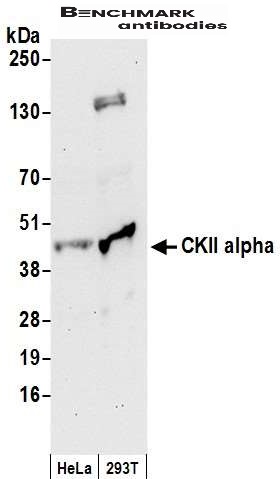 |
| Detection of human and mouse CKII alpha by western blot. Samples: Whole cell lysate (50 µg ) from HeLa, HEK293T, and mouse NIH 3T3 cells prepared using NETN lysis buffer. Antibody: Affinity purified rabbit anti-CKII alpha antibody 7489 (lot 7489-2) used for WB at 0.1 µg /ml. Detection: Chemiluminescence with an exposure time of 3 minutes. |
FAQ & Publications
Frequently Asked Questions
What applications has the rabbit anti-CKII α polyclonal antibody 7489 been validated for?
This antibody has been tested and is suitable for Western Blot (WB), Immunoprecipitation (IP), and Immunohistochemistry (IHC) applications.
How should the rabbit anti-CKII α polyclonal antibody 7489 be stored to maintain its stability?
The antibody should be stored at 2 to 8°C, where it remains stable for up to one year.
What is the immunogen used to generate the rabbit anti-CKII α polyclonal antibody 7489?
The immunogen is a synthetic peptide representing a portion of the CKII α protein located within exons 12 and 13, based on LocusLink ID 1457.
Publications
| pmid | title | authors | citation |
|---|---|---|---|
| We haven't added any publications to our database yet. | |||
Published literature highly relevant to the biological target of this product and referencing this antibody or clone are retrieved from the PubMed database provided by the United States National Library of Medicine at the National Institutes of Health.
Protocols
| relevant to this product |
|---|
| Western blot IHC |
Documents
| Batch Number | QC File | SDS |
|---|---|---|
| To view batch-specific Safety Datasheets and Quality Certificates associated with your account, please Log In. | ||
Only logged in customers who have purchased this product may leave a review.


Reviews
There are no reviews yet.