| Weight | 1 lbs |
|---|---|
| Dimensions | 9 × 5 × 2 in |
| target | Yersinia enterocolitica O:9 YOP (Yersinia outer proteins) |
| species reactivity | Yersinia |
| applications | ELISA |
| assay type | Indirect & quantitative |
| available size | 1 mg |

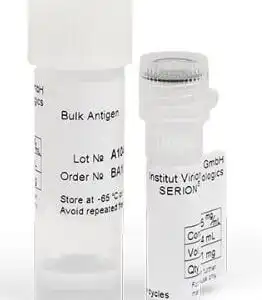
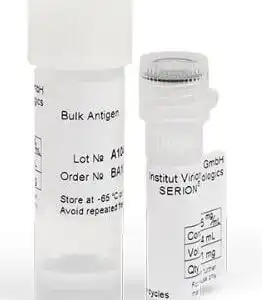
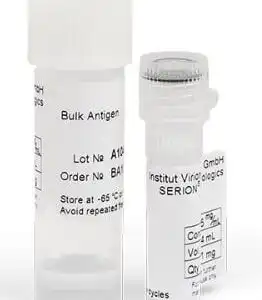
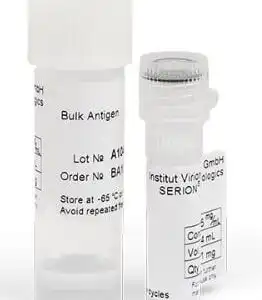
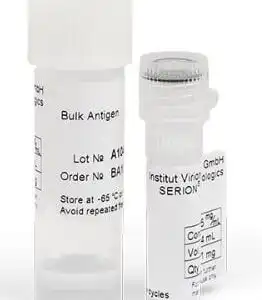
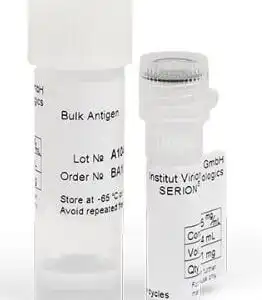
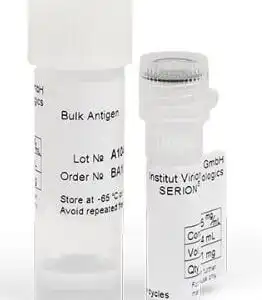
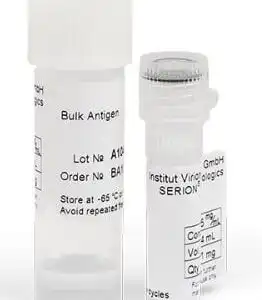
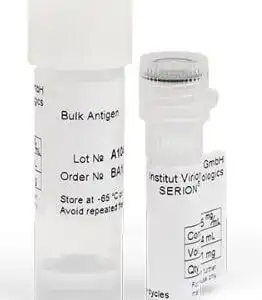
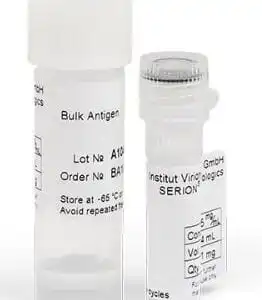
Yersinia enterocolitica O:9 YOP (Yersinia outer proteins) Antigen BA13809VS
$1,515.00
Summary
- Virion/Serion Immunologics Antigen for research use (RUO)
- Yersinia enterocolitica O:9 YOP (Yersinia outer proteins) Antigen, recombinant
- Suitable for detection of IgA, IgG & IgM antibodies in ELISA
- Lot specific concentration, specified in mg/mL
- 1 mg
Yersinia enterocolitica O:9 YOP (Yersinia outer proteins) Antigen BA13809VS
| kit |
|---|
| Research area Infectious Disease |
| Storage Store at -65°C or lower. Avoid repeated freeze-thaw cycles. 10 years from date of manufacture (under recommended storage conditions). |
| Form liquid |
| Associated products Yersinia enterocolitica o-8 YOP (Yersinia outer proteins) Antigen (BA13808VS) Yersinia enterocolitica o-9 YOP (Yersinia outer proteins) Antigen (BA13809VS) Yersinia enterocolitica o-3 YOP (Yersinia outer proteins) Antigen (BA138VS) Yersinia IgA Control Serum (BC138A) Yersinia IgG Control Serum (BC138G) Yersinia IgM Control Serum (BC138M) Yersinia IgA ELISA Kit (ESR138A) Yersinia IgG ELISA Kit (ESR138G) Yersinia IgM ELISA Kit (ESR138M) |
| target relevance |
|---|
| Yersinia |
| Description Bacterial genus that causes yersiniosis, plague, and other zoonotic infections |
| Structure Yersinia is a genus of Gram-negative, facultatively anaerobic coccobacilli belonging to the family Yersiniaceae. Members of the genus are widely distributed in nature and can infect a variety of mammalian hosts. The most clinically important species include Yersinia enterocolitica, Yersinia pseudotuberculosis, and Yersinia pestis. Y. enterocolitica and Y. pseudotuberculosis are primarily enteric pathogens that cause gastrointestinal disease, while Y. pestis is the causative agent of plague. Yersinia species possess numerous virulence factors, including adhesins, invasins, secretion systems, and plasmid-encoded proteins that enable invasion of host tissues and evasion of immune responses. The bacteria can survive and replicate within host cells and are capable of causing both localized and systemic infections. |
| Diagnosis The diagnosis of Yersinia infection is performed through microbiological, molecular, and serological methods. Isolation of the organism from stool, blood, lymph node aspirates, or other clinical specimens remains the definitive diagnostic method. Selective culture techniques may be required, particularly for Yersinia enterocolitica. Polymerase chain reaction (PCR) assays provide rapid and sensitive detection of Yersinia DNA and are increasingly used in clinical laboratories. Serological tests, including ELISA-based assays, may be used to detect antibodies against Yersinia antigens and can be particularly useful in cases of post-infectious complications or epidemiological investigations. For plague caused by Yersinia pestis, rapid diagnosis is essential to enable prompt treatment and public health intervention. |
| Symptoms Clinical manifestations of Yersinia infection vary depending on the infecting species. Yersinia enterocolitica and Yersinia pseudotuberculosis commonly cause yersiniosis, characterized by fever, abdominal pain, diarrhea, nausea, and vomiting. In older children and adults, infection may mimic acute appendicitis due to mesenteric lymphadenitis. Reactive arthritis and erythema nodosum can occur as post-infectious complications. Yersinia pestis causes plague, which may present as bubonic plague with painful swollen lymph nodes (buboes), septicemic plague with bloodstream infection, or pneumonic plague involving severe respiratory disease. Without prompt treatment, systemic Yersinia infections can progress to severe sepsis, organ failure, and death. |
Data
FAQ & Publications
Frequently Asked Questions
What is the recommended storage condition for the Yersinia enterocolitica O:9 YOP Antigen BA13809VS?
The antigen should be stored at -65°C or lower and repeated freeze-thaw cycles should be avoided to maintain stability for up to 10 years from the date of manufacture under these recommended conditions.
Which antibody classes can be detected using the Yersinia enterocolitica O:9 YOP Antigen in ELISA assays?
This antigen is suitable for the detection of IgA, IgG, and IgM antibodies in indirect and quantitative ELISA applications.
Is the Yersinia enterocolitica O:9 YOP Antigen specific to any particular species?
Yes, the antigen is specific to Yersinia species, particularly targeting Yersinia enterocolitica O:9 outer proteins (YOP).
Publications
| pmid | title | authors | citation |
|---|---|---|---|
| We haven't added any publications to our database yet. | |||
Published literature highly relevant to the biological target of this product and referencing this antibody or clone are retrieved from the PubMed database provided by the United States National Library of Medicine at the National Institutes of Health.
Protocols
| relevant to this product |
|---|
Only logged in customers who have purchased this product may leave a review.



Reviews
There are no reviews yet.