| Weight | 1 lbs |
|---|---|
| Dimensions | 9 × 5 × 2 in |
| target | Toxoplasma gondii |
| species reactivity | Toxoplasma gondii |
| applications | ELISA |
| assay type | Indirect & quantitative |
| available size | 1 mg |

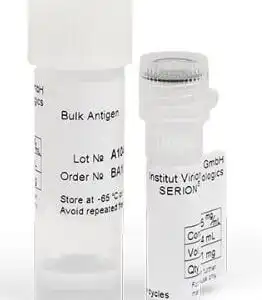
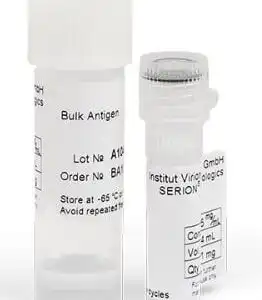
Toxoplasma gondii Antigen BA110VS
$1,246.00
Summary
- Virion/Serion Immunologics Antigen for research use (RUO)
- Toxoplasma gondii Antigen, recombinant
- Suitable for detection of IgA, IgG & IgM antibodies in ELISA
- Lot specific concentration, specified in mg/mL
- 1 mg
Toxoplasma gondii Antigen BA110VS
| kit |
|---|
| Research area Infectious Disease |
| Storage Store at -65°C or lower. Avoid repeated freeze-thaw cycles. 10 years from date of manufacture (under recommended storage conditions). |
| Form liquid |
| Associated products Toxoplasma gondii Avidity Reagent (B110AVID) Toxoplasma gondii Antigen (BA110VS) Toxoplasma gondii IgG Control Serum (BC110G) Toxoplasma gondii IgM Control Serum (BC110M) Toxoplasma gondii IgG ELISA Kit (ESR110G) Toxoplasma gondii IgM ELISA Kit (ESR110M) |
| target relevance |
|---|
| Toxoplasma gondii |
| Description Protozoan parasite that causes toxoplasmosis |
| Structure Toxoplasma gondii is an obligate intracellular protozoan parasite belonging to the phylum Apicomplexa. The parasite has a complex life cycle involving both sexual and asexual stages. Members of the cat family (Felidae) serve as the definitive hosts in which sexual reproduction occurs, while a wide range of warm-blooded animals, including humans, act as intermediate hosts. T. gondii exists in several developmental forms, including rapidly dividing tachyzoites, slowly replicating tissue cysts containing bradyzoites, and environmentally resistant oocysts shed in feline feces. The parasite is distributed worldwide and is one of the most common parasitic infections of humans. Following infection, T. gondii can establish lifelong latent infection within muscle and neural tissues through the formation of tissue cysts. |
| Diagnosis The diagnosis of Toxoplasma gondii infection is performed through serological, molecular, histological, and microbiological methods. Serological testing is the most commonly used diagnostic approach and includes detection of Toxoplasma-specific IgM and IgG antibodies using ELISA and other immunoassays. Measurement of antibody avidity may help distinguish recent from past infection. Molecular techniques such as polymerase chain reaction (PCR) are widely used for detecting parasite DNA in blood, cerebrospinal fluid, amniotic fluid, and tissue specimens, particularly in congenital infections and immunocompromised patients. Histopathological examination and direct visualization of parasites may also aid diagnosis in selected cases. Early diagnosis is especially important during pregnancy because of the risk of congenital transmission. |
| Symptoms Most immunocompetent individuals infected with Toxoplasma gondii remain asymptomatic or develop mild flu-like symptoms, including fever, fatigue, headache, muscle aches, and lymphadenopathy. Following primary infection, the parasite establishes latent infection that may persist for life. In immunocompromised individuals, including patients with advanced HIV infection, organ transplant recipients, and individuals receiving immunosuppressive therapy, reactivation of latent infection can cause severe disease, particularly toxoplasmic encephalitis characterized by headache, confusion, seizures, focal neurological deficits, and altered mental status. Congenital toxoplasmosis can occur when infection is acquired during pregnancy and may result in miscarriage, stillbirth, hydrocephalus, intracranial calcifications, chorioretinitis, vision impairment, developmental delay, and other severe neurological complications. |
Data
FAQ & Publications
Frequently Asked Questions
What is the recommended storage condition for the Toxoplasma gondii Antigen BA110VS to maintain its stability?
The Toxoplasma gondii Antigen BA110VS should be stored at -65°C or lower and repeated freeze-thaw cycles should be avoided to maintain its stability. Under these recommended storage conditions, the product has a shelf life of 10 years from the date of manufacture.
For which antibody isotypes is the Toxoplasma gondii Antigen BA110VS suitable for detection in ELISA assays?
The Toxoplasma gondii Antigen BA110VS is suitable for the detection of IgA, IgG, and IgM antibodies in ELISA applications, enabling indirect and quantitative assay formats.
Publications
| pmid | title | authors | citation |
|---|---|---|---|
| We haven't added any publications to our database yet. | |||
Published literature highly relevant to the biological target of this product and referencing this antibody or clone are retrieved from the PubMed database provided by the United States National Library of Medicine at the National Institutes of Health.
Protocols
| relevant to this product |
|---|
Only logged in customers who have purchased this product may leave a review.




Reviews
There are no reviews yet.