| Weight | 1 lbs |
|---|---|
| Dimensions | 9 × 5 × 2 in |
| host | mouse |
| isotype | IgG |
| clonality | monoclonal |
| concentration | concentrate, predilute |
| applications | IHC |
| reactivity | human |
| available size | 0.1 mL, 0.5 mL, 1 mL concentrated, 7 mL prediluted |

rabbit anti-S100B monoclonal antibody (ZR379) 6358
Price range: $160.00 through $528.00
Antibody summary
- Rabbit monoclonal to S100B
- Suitable for: Immunohistochemistry (formalin-fixed, paraffin-embedded tissues)
- Reacts with: Human
- Isotype:IgG
- Control: Melanoma or brain
- Visualization: Cytoplasmic and nucleus
- 0.1, 0.5, 1.0 mL concentrated, 7 mL prediluted
rabbit anti-S100B monoclonal antibody ZR379 6358
| target relevance |
|---|
| Homo sapiens S100B Protein S100-B |
| Protein names Protein S100-B |
| Alternative names S-100 protein beta chain, S-100 protein subunit beta, S100 calcium-binding protein B |
| Gene names S100B |
| Protein family Belongs to the S-100 family |
| Function Small zinc- and- and calcium-binding protein that is highly expressed in astrocytes and constitutes one of the most abundant soluble proteins in brain (PubMed:20950652, PubMed:6487634). Weakly binds calcium but binds zinc very tightly-distinct binding sites with different affinities exist for both ions on each monomer (PubMed:20950652, PubMed:6487634). Physiological concentrations of potassium ion antagonize the binding of both divalent cations, especially affecting high-affinity calcium-binding sites (By similarity). Acts as a neurotrophic factor that promotes astrocytosis and axonal proliferation (By similarity). Involved in innervation of thermogenic adipose tissue by acting as an adipocyte-derived neurotrophic factor that promotes sympathetic innervation of adipose tissue (By similarity). Binds to and initiates the activation of STK38 by releasing autoinhibitory intramolecular interactions within the kinase (By similarity). Interaction with AGER after myocardial infarction may play a role in myocyte apoptosis by activating ERK1/2 and p53/TP53 signaling (By similarity). Could assist ATAD3A cytoplasmic processing, preventing aggregation and favoring mitochondrial localization (PubMed:20351179). May mediate calcium-dependent regulation on many physiological processes by interacting with other proteins, such as TPR-containing proteins, and modulating their activity (PubMed:22399290) |
| Subcellular location Cytoplasm, Nucleus, Secreted |
| Structure Dimer of either two alpha chains, or two beta chains, or one alpha and one beta chain (PubMed:12480931, PubMed:20950652). The S100B dimer binds two molecules of STK38 (By similarity). Interacts with CACYBP in a calcium-dependent manner (By similarity). Interacts with ATAD3A; this interaction probably occurs in the cytosol prior to ATAD3A mitochondrial targeting (PubMed:20351179). Interacts with S100A6 (PubMed:9925766). The S100B dimer interacts with two molecules of CAPZA1 (PubMed:12480931). Interacts with AGER (PubMed:20943659). Interacts with PPP5C (via TPR repeats); the interaction is calcium-dependent and modulates PPP5C activity (PubMed:22399290). Interacts with TPPP; this interaction inhibits TPPP dimerization (PubMed:33831707). Interacts with isoform CLSTN3beta of CLSTN3; interaction promotes secretion (By similarity) |
| Keywords 3D-structure, Acetylation, Calcium, Cell adhesion, Cytoplasm, Direct protein sequencing, Metal-binding, Nucleus, Proteomics identification, Reference proteome, Repeat, Secreted, Zinc |
| Sequence MSELEKAMVALIDVFHQYSGREGDKHKLKKSELKELINNELSHFLEEIKEQEVVDKVMET LDNDGDGECDFQEFMAFVAMVTTACHEFFEHE |
| UniProt accession: P04271 |
Data
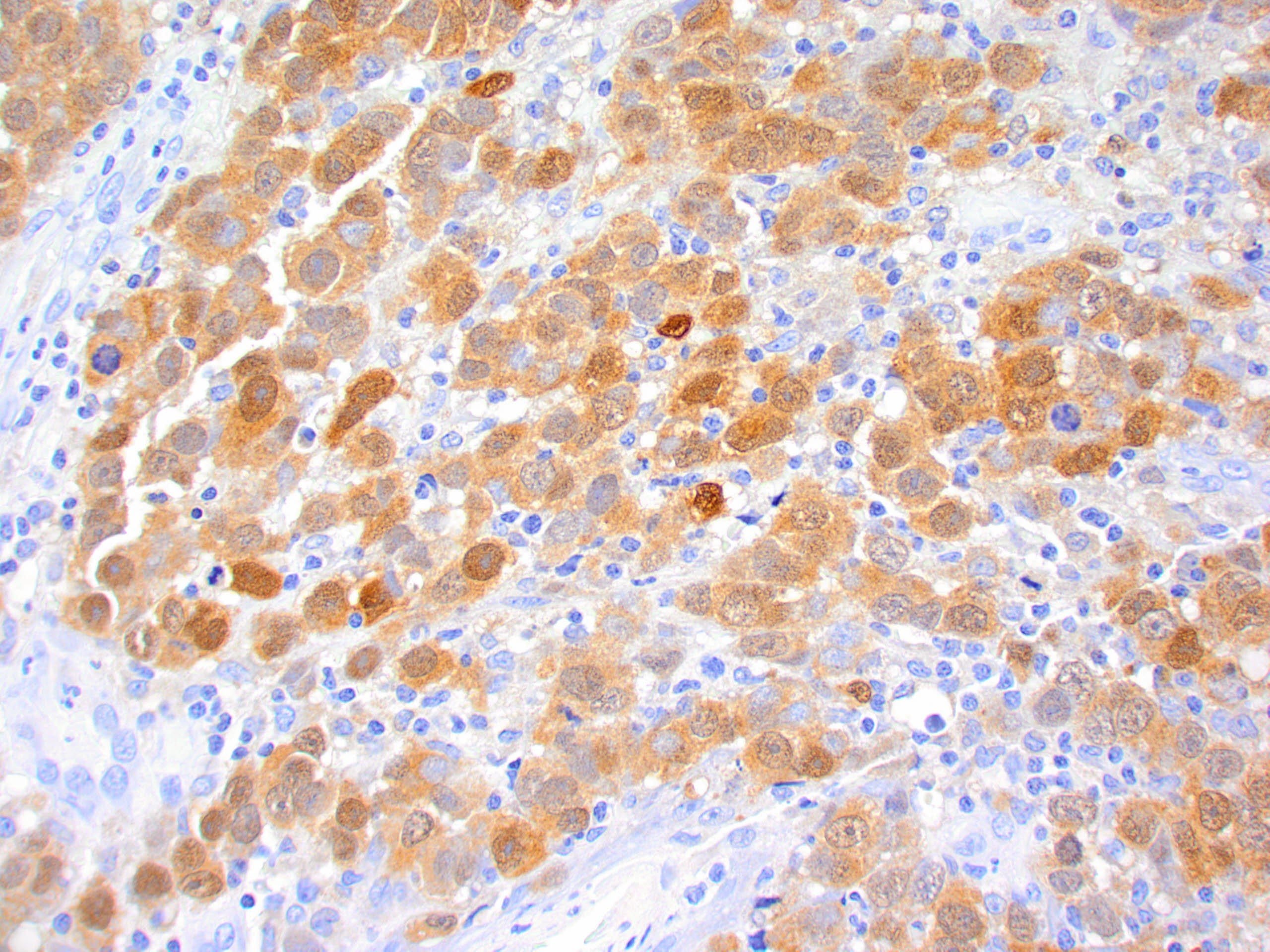 |
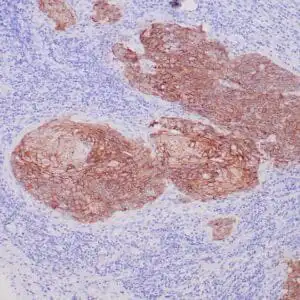
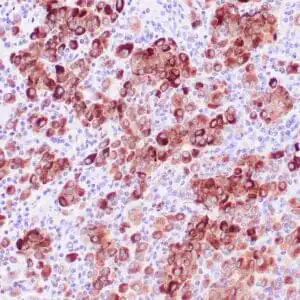
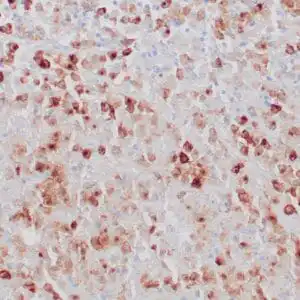
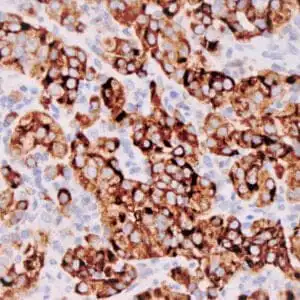
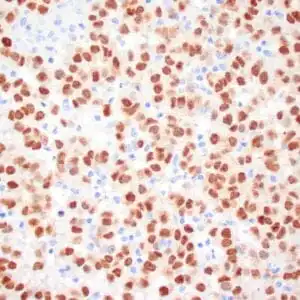
| Formalin-fixed, paraffin-embedded human melanoma stained with anti-S-100B antibody using peroxidase conjugate and DAB chromogen. Note intense nuclear and cytoplasmic staining of melanoma cells |
FAQ & Publications
Frequently Asked Questions
What species does the rabbit anti-S100B monoclonal antibody (ZR379) specifically react with?
This antibody specifically reacts with human S100B protein.
Which applications is this rabbit anti-S100B monoclonal antibody validated for?
It is validated for immunohistochemistry (IHC) on formalin-fixed, paraffin-embedded tissues.
What are the recommended storage conditions for maintaining the stability of this antibody?
For short-term storage, keep the antibody at 2-8°C. For long-term storage, it should be kept at -20°C, avoiding repeated freeze/thaw cycles.
What is the immunogen used to generate the rabbit anti-S100B monoclonal antibody (ZR379)?
The immunogen is a recombinant fragment of human S100B protein, approximately amino acids 3 to 92.
Publications
| pmid | title | authors | citation |
|---|---|---|---|
| We haven't added any publications to our database yet. | |||
Published literature highly relevant to the biological target of this product and referencing this antibody or clone are retrieved from the PubMed database provided by the United States National Library of Medicine at the National Institutes of Health.
Protocols
| relevant to this product |
|---|
| IHC |
Documents
| Batch Number | QC File | SDS |
|---|---|---|
| To view batch-specific Safety Datasheets and Quality Certificates associated with your account, please Log In. | ||
Only logged in customers who have purchased this product may leave a review.
Reviews
There are no reviews yet.