| Weight | 1 lbs |
|---|---|
| Dimensions | 9 × 5 × 2 in |
| accession | Q9NRJ3 |
| express system | E.coli |
| product tag | none |
| purity | > 97% by SDS PAGE |
| molecular weight | Predicted Molecular Mass: 12.031 kDa Extinction Coefficient: 8,970 M-1 cm-1 Actual Molecular Mass: 12.031kDa by ESI Mass Spec |
| available size | 100 µg, 1mg, 20 µg, 5 µg, 50 µg |
| endotoxin | <0.01 EU per 1μg of the protein by the LAL method |
| sequence | ILPIASSCCTEVSHHISRRLLERVNMCRIQRADGDCDLAAVILHVKRRRICVSPHNHTVK QWMKVQAAKKNGKGNVCHRKKHHGKRNSNRAHQGKHETYGHKTPY |

Mucosae-associated epithelial chemokine (MEC/CCL28) 8012
Price range: $61.00 through $2,189.00
Summary
- Expression: E.coli
- Amino Acid Range: 23-127
Mucosae-associated epithelial chemokine (MEC/CCL28) 8012
| protein |
|---|
| Database link: human Q9NRJ3 |
| Size and concentration 5, 20, 50, 100, 1000µg and lyophilized |
| Form Lyophilized |
| Storage Instructions Avoid repeated freeze-thaw cycles: • 12 months from date of receipt, -20 to -70 °C as supplied. • 1 month, 2 to 8 °C under sterile conditions after reconstitution. • 3 months, -20 to -70 °C under sterile conditions after reconstitution |
| Storage buffer ​Reconstitution: Spin sample prior to reconstitution. Recommended concentration of 100µg/mL in sterile water. Shipping: Room Temp |
| Purity > 97% by SDS PAGE and HPLC |
| target relevance |
|---|
| Mucosae-associated epithelial chemokine (MEC/CCL28) is secreted by epithelial cells of gastrointestinal and nonintestinal mucosal cells, and regulates chemotaxis of cells expressing surface receptors CCR3 and CCR10. It shows broad-spectrum antibacterial activities, and could also be useful in vaccination of HIV infection. |
| Protein names C-C motif chemokine 28 (Mucosae-associated epithelial chemokine) (MEC) (Protein CCK1) (Small-inducible cytokine A28) |
| Gene names CCL28,CCL28 SCYA28 |
| Protein family Intercrine beta (chemokine CC) family |
| Mass 14280Da |
| Function FUNCTION: Chemotactic activity for resting CD4, CD8 T-cells and eosinophils. Binds to CCR3 and CCR10 and induces calcium mobilization in a dose-dependent manner. |
| Subellular location SUBCELLULAR LOCATION: Secreted. |
| Tissues TISSUE SPECIFICITY: Preferentially expressed by epithelial cells of diverse tissues including normal and pathological colon, salivary gland, mammary gland, trachea and rectum. Also found in prostate, spleen, thyroid, psoriasis skin and in lower levels in peripheral blood leukocytes, small intestine, Peyer patches, stomach and normal skin. |
| Target Relevance information above includes information from UniProt accession: Q9NRJ3 |
| The UniProt Consortium |
Data
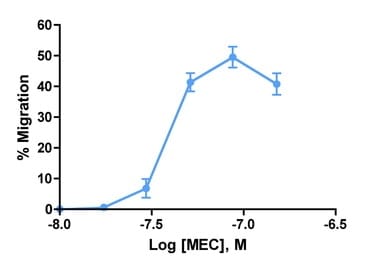 |
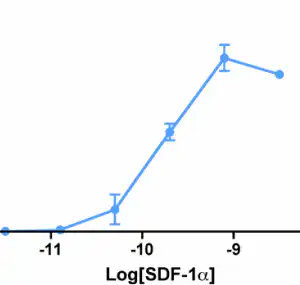
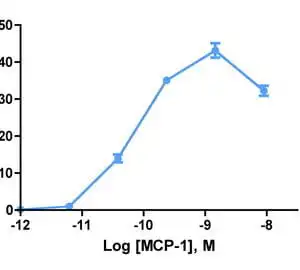
| Migration Assay: Cells expressing recombinant CCR10 were assayed for migration through a transwell filter at various concentrations of MEC. Responses are expressed as the % of total input cells. |
FAQ & Publications
Frequently Asked Questions
What is the expression system used for producing Mucosae-associated epithelial chemokine (MEC/CCL28) 8012?
The MEC/CCL28 protein is expressed in Escherichia coli (E.coli).
How should Mucosae-associated epithelial chemokine (MEC/CCL28) 8012 be stored to maintain stability?
The lyophilized protein should be stored at -20 to -70 °C and is stable for 12 months from the date of receipt. After reconstitution, it can be stored for 1 month at 2 to 8 °C under sterile conditions or for 3 months at -20 to -70 °C under sterile conditions. Repeated freeze-thaw cycles should be avoided.
What is the purity level and molecular weight of the MEC/CCL28 protein provided?
The protein has a purity greater than 97% as assessed by SDS-PAGE and HPLC, with an actual molecular mass of approximately 12.031 kDa confirmed by ESI Mass Spectrometry.
What biological function does the Mucosae-associated epithelial chemokine (MEC/CCL28) serve?
MEC/CCL28 exhibits chemotactic activity for resting CD4 and CD8 T-cells as well as eosinophils by binding to CCR3 and CCR10 receptors, inducing calcium mobilization. It is also known for broad-spectrum antibacterial activity and potential use in HIV vaccination strategies.
Publications
| pmid | title | authors | citation |
|---|---|---|---|
| We haven't added any publications to our database yet. | |||
Published literature highly relevant to the biological target of this product and referencing this antibody or clone are retrieved from the PubMed database provided by the United States National Library of Medicine at the National Institutes of Health.
Protocols
| relevant to this product |
|---|
| Migration assay |
Documents
| # | ||
|---|---|---|
| Please enter your product and batch number here. | ||
Only logged in customers who have purchased this product may leave a review.
Reviews
There are no reviews yet.